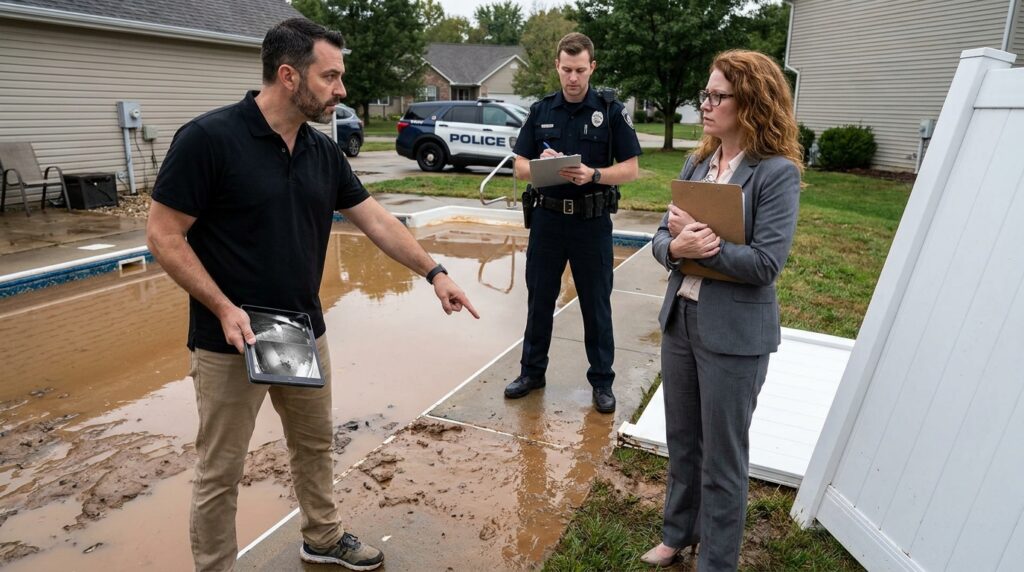
CHAPTER 7: THE SUBSURFACE LIQUIDATION
The numeric indicator on the tablet screen spun in a white blur, the digits cascading past four gallons per second with a dry, internal electronic hiss. Mark didn’t check the sky. His weight was already shifting forward, his sneakers gripping the wet concrete aggregate as he cleared the filtration shed and broke into a low, kinetic stride down the narrow side alley.
Behind him, the scraping sound of Officer Reynolds’ pen died instantly.
“Mark, stay behind the residential fence line,” Reynolds commanded, his boots hitting the mud slick with a heavy, wet slap as he gave chase. But Mark was already three paces clear of the rear gate. His focus was locked on the front curb joint where the three-quarter-inch galvanized iron water service line met the master subdivision manifold.
The late-afternoon shadows cut the street into alternating slats of black and grey, the geometric precision of the curb line vibrating under the heavy, low-frequency rumble of a second vehicle entering the cul-de-sac. It wasn’t a patrol unit. It was an unbranded, commercial vacuum rig, its heavy steel storage tanks catching the low glare of the setting sun like a row of giant, dull artillery casings.
Mark dropped to his knees at the edge of his asphalt driveway, the rough stone biting through the fabric of his khakis until he felt the cold moisture of the subgrade beneath his skin.
Right beside his primary mailbox post, the rectangular cast-iron cover of the water meter box was already crooked. A thick, dark stream of high-pressure water was surging out from beneath the rim, pooling into the concrete gutter and cutting a jagged channel through the neat, black mulch Brenda had inspected that morning.
He didn’t use a tool. He shoved his fingers into the narrow lift-hole of the iron lid, the cold metal catching his nail with a short, tearing scrape as he hauled the plate back.
The meter pit was submerged in a turbulent, muddy eddy. Six feet below the surface grade, where the private residential line met the corporate main, a secondary hydraulic bypass valve had been forced open with a long-handled curb key. A heavy copper jumper wire—the kind used to ground master electrical systems to the municipal iron grid—had been sliced clean through with an industrial shear.
“The connection was unauthorized from the beginning, Mark.”
Brenda stood at the foot of his driveway, her silhouette casting a long, thin needle of shadow that reached all the way to his knees. She hadn’t dropped her clipboard, but her phone was tucked into her jacket pocket, its small green recording light blinking through the gray weave of the synthetic fabric. Her expression was static, dead, her eyes fixed on the water flooding the asphalt.
“The automated mitigation sequence doesn’t stop because you found the proxy server,” she said. Her voice was flat, empty of the earlier bureaucratic malice, carrying only the cold, mechanical weight of an operative executing a pre-calculated contingency. “The moment your primary utility volume exceeds the regional infrastructure threshold by twenty percent, the district receiver files for an immediate judicial asset freeze. The Delaware filing was the soft option. This is the liquidation.”
Mark reached down into the freezing water of the pit, his fingers searching blindly through the clay silt for the iron tee-handle of the main curb stop. The pressure was intense, a violent, vibrating column of fluid that threatened to strip the skin from his knuckles as he fought the current.
“The registry doesn’t hold an escrow block on a flooded plat, Brenda,” Mark said. His breathing was short, deep, focused through his teeth as his palms finally wrapped around the cold iron cross of the valve. “And the county magistrate doesn’t sign asset locks when the evidence of intentional infrastructure sabotage is sitting in a municipal data switch.”
“It’s not an entry error, Mark,” she replied, her heels clicking twice as she aligned her stance with the edge of the iron pit. “The corporation already owns the debt on nine of the twelve houses on this block. Your divorce settlement left you with a thirty-year conventional note held by a secondary servicer. They assigned the voting rights to the association management company four weeks ago. You’re outvoted three to one on the municipal boundary variance, whether the officer signs the trespass citation or not.”
Mark threw his weight against the iron tee-handle, his shoulder checking the side of the concrete pit wall as he strained against the hydraulic torque. The metal gave a sharp, agonizing creak—a grinding screech of rusted threads yielding to sheer physical force—before it turned ninety degrees to the right.
The high-pressure hiss died instantly, the water in the pit settling into a flat, brown mirror that reflected the hard, red lines of the cruiser’s emergency lights as Reynolds finally cleared the side gate.
But the tablet on the grass beside Mark’s knee didn’t reset to zero.
The screen flickered twice, the white directory matrix disappearing to reveal a single, automated notification from his mortgage servicer’s online portal. The status bar didn’t show an open balance or a regular billing cycle; it was completely red, overlaid with a digital execution stamp from the state land court: Acceleration Notice – Demarcation Breach Plat 42.
The decoy wasn’t just the pool, and it wasn’t the six-foot easement. The entire confrontation had been timed to coincide with a scheduled banking system sweep at 4:30 PM. By forcing his property into an unresolvable structural variance during the exact hour the corporate escrow cleared, they had triggered an automatic default clause hidden in the fine print of his refinancing agreement—a clause that reclassified any active police intervention on the land as an immediate hazard to the primary lien holder.
Mark stood up slowly, the water dripping from his soaked polo shirt into the dry mulch. He looked past Brenda’s shoulder toward the unmarked vacuum truck that had parked directly behind Reynolds’ cruiser, its high-vis light bar casting a cold, amber pulse across the identical facades of the suburban sanctuary he had spent eighteen months trying to build.
The system had calculated his composure. They had known he wouldn’t yell, they had known he would check the security footage, and they had used his own defensive precision to drag the timeline out until the clock ran out on his title.
“The citation for the fence is a misdemeanor, Officer,” Brenda said, turning her face toward Reynolds with a razor-thin smile that didn’t reach her eyes. “But the default on the master deed is a civil foreclosure. The mitigation crew has an administrative right to secure the asset now.”
Mark didn’t look at the officer. He tapped the tablet screen one final time, his index finger resting on the internal hard drive path where the unredacted clubhouse files were stored, his eyes tracking the thin geometric line of the next parameter block.