CHAPTER 5: THE THRESHOLD FAULT
The steel latch of the side gate didn’t just rattle; it gave way under the blunt thrust of a shoulder.
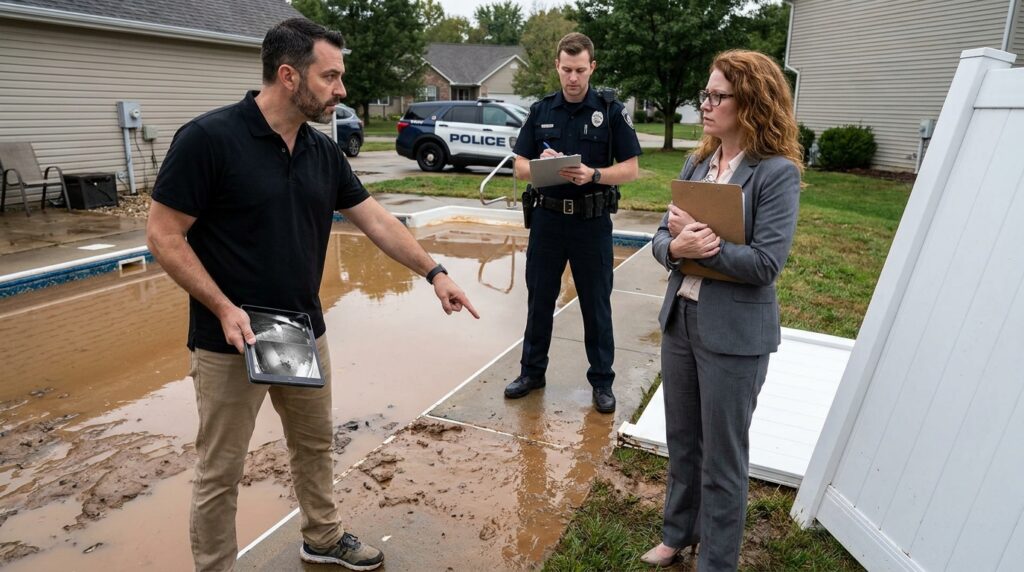
Officer Reynolds stepped through the gap first, his dark uniform cutting a hard, vertical line against the bleached expanse of the neighbor’s vinyl siding. Behind him, the low, mechanical whine of the flatbed’s power take-off unit dropped an octave as the two workers in safety-orange vests dragged a heavy pneumatic cutter across the property line. The machine’s reinforced rubber hose left a deep, grey indentation in Mark’s damp lawn, squeezing out a thin track of stagnant water from the turf.
Mark didn’t step back from his electrical panel. His fingers remained braced against the cold, zinc-coated edge of the junction box, his knuckles white under the flat glare of the afternoon sun. He watched Reynolds’ eyes drop to the mud slurry spreading from the cracked valve stem.
“The county health inspector logged the emergency environmental variance ten minutes ago, Mark,” Reynolds said. He didn’t unclip his holster, but his right forearm rested flat across the heavy utility belt, his fingers hovering inches from his citation book. “The report states there’s a major backflow contamination coming from your drainage well into the common aquifer line. I’ve got an administrative order to clear the access corridor for the isolation crew.”
Brenda stepped up behind the officer’s left shoulder, her heels sinking an inch into the soft loam of the utility lane. Her aluminum clipboard was clamped against her ribs like a piece of structural bracing, the neon-orange violation slips protruding from the top like tiny, jagged markers.
“He’s intentionally obstructing the mitigation sequence, Officer,” Brenda said. Her voice carried the tight, rhythmic hiss of a high-pressure valve. She pointed a polished finger toward the mud-slicked concrete coping of the pool. “The bylaws give the board emergency enforcement rights over any residential asset that threatens the subdivision’s structural integrity. The pump needs to be severed immediately.”
Mark kept his glare fixed on the small, square lens of Brenda’s sunglasses. He could see his own reflection trapped in the dark glass—a small, dark figure standing before a grey wall, perfectly static.
“The work order number on your screen is a code-three corporate filing, Reynolds,” Mark said. His syllables were short, dry, stripped of any emotional resonance. “Check the county prefix. It doesn’t originate from the municipal health department. It’s an infrastructure acquisition block issued out of Wilmington.”
Reynolds didn’t look at Brenda. He stepped closer to the pool coping, his boot heels grinding a small pile of stray aggregate into the concrete. He reached into his vest pocket, pulled out a rugged mobile terminal, and typed a short string of characters. The screen threw a blue glare across his clean-shaven jaw as he waited for the internal database loop to resolve.
“The code clears as a common-line isolation, Mark,” Reynolds muttered, though his thumb hovered over the terminal’s refresh button for two seconds too long. “The board has structural primacy over the easement.”
“They have primacy over the six feet recorded in the 2018 deed,” Mark replied. He reached into his back pocket and drew out the tablet, his thumb sliding across the unmarred glass to activate the auxiliary diagnostic feed he had pulled from his router. “They don’t have it over the six feet they carved out last Tuesday night without a public notice hearing.”
He didn’t tilt the screen toward the officer yet. He waited. He needed Brenda to commit her positioning fully before he deployed the verification file.
Brenda took a step closer, her shoulder checking the side of the white vinyl fence panel until the hollow plastic frame groaned under the pressure. “The amendments are proprietary board documents, Mark. You don’t have access credentials to the master plat, and your recording doesn’t change the fact that this pool is currently a certified bio-hazard.”
She turned her face toward the lead worker, her chin jerking sharply toward the brass pump assembly. “Cut the line. The association will absorb the mitigation assessment under the emergency reserve fund.”
The worker didn’t wait for Reynolds to sign the log. He dropped the pneumatic cutter against the primary copper junction point where the three-inch pipe entered the filtration shed. The steel teeth of the blade caught the edge of the metal with a high-pitched, metallic shriek that echoed off the two-story houses flanking the yard. A shower of bright, orange sparks sprayed across the wet grass, sizzling as they hit the brown puddle forming at Mark’s feet.
Mark didn’t call out. He didn’t drop his hand from the junction box. He simply clicked the playback button on the tablet interface, his screen throwing a bright, high-definition matrix of lines directly across the grey fabric of Reynolds’ sleeve.
The video didn’t show the backyard pool. It showed the interior server rack located inside the Whispering Pines community clubhouse—a clean, white room where a single figure in a gray pantsuit was actively plugging an unbranded network mirror module into the neighborhood’s main data switch at 11:42 PM the previous evening. The timestamp in the lower-right corner glowed in bright, unblinking green digits, syncing perfectly with the frame deletions on Mark’s home router.
“The clubhouse network log is public record under section twelve of the state corporate code, Brenda,” Mark said, his voice dropping into a hard, low frequency that cut through the mechanical scream of the cutter. “And you didn’t scrub the backup mirror on the water district’s side of the node.”
Reynolds froze. His terminal emitted a short, three-tone system chime—the specific signal for a manual database override from the county clerk’s main desk. He looked down at his own screen, then up at the video playing on Mark’s tablet, his jaw hardening into a rigid line.
The pneumatic cutter stopped mid-stroke, its engine idling down with a low, hydraulic hiss that left the backyard suddenly, brutally quiet.