CHAPTER 8: THE RETURN TO THE BORDER
The air along the curb didn’t smell like summer anymore. It smelled of raw diesel exhaust, split subsoil, and the sharp, chalky dust of broken concrete. The low, rhythmic thrum of an orange municipal excavator vibrated through the floorboards of my station wagon before I even shut down the engine. Its heavy track assemblies had ground the gray gravel of the road shoulder into a fine, white paste that coated the grass blades like lime wash.
I stood by the front fender, the keys cold and greasy against my palm. The blue zip jacket was unzipped now, the fabric stiff from the dried salt of three days of sweat. My fingers found the unraveled thread on the handle of the cream tote bag tucked inside my pocket—the single strand of white canvas had grown gray, thin, and stiff with grit, but it was still holding together.
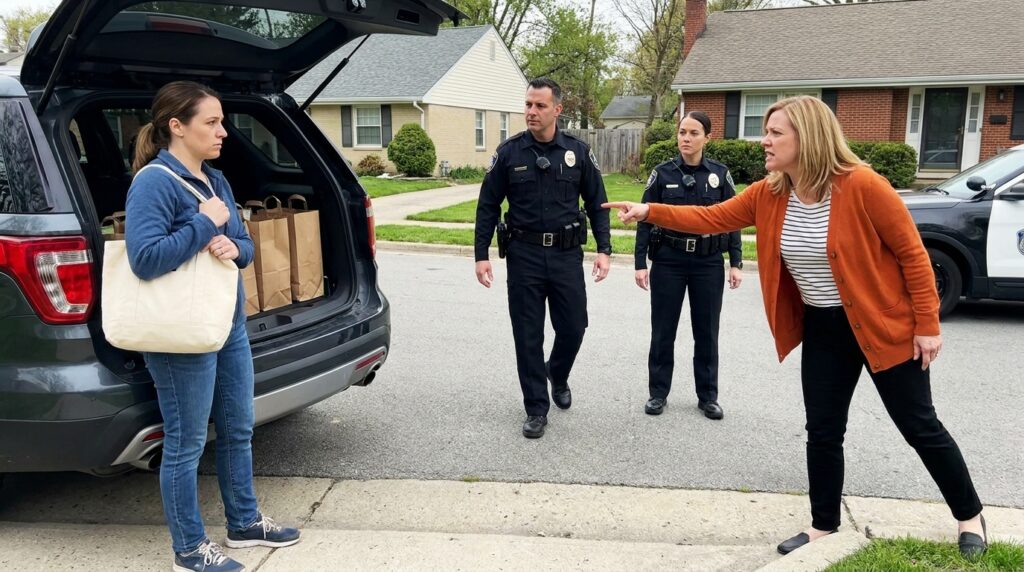
Across the property line, the changes were brutal and instantaneous. The boxwood hedges that Mrs. Gable had manicured for over two decades lay stacked in a tangled, unceremonious heap of broken roots and split green leaves on the far side of her lawn. A crew of three men in faded orange vests and muddy work boots moved along the line, their heavy spade shovels cutting clean, vertical slices into the turf. They weren’t looking at property stakes; they were tracing a bright yellow string line pulled taut between two iron stakes driven straight through the center of her old brick walkway.
Mrs. Gable was there, but she wasn’t on her porch. She stood at the very edge of her remaining sod, her hands shoved deep into the pockets of her dark cardigan, her shoulder-length blonde hair flattened against her temples by the dry wind. Her glasses were tucked into her collar. Without them, her eyes looked sunken, pale, and completely detached from the physical movement around her. She didn’t have her folder, her phone, or her fake notices. She looked exactly like what she was—a squatter on a state utility map who had run out of terrain to defend.
The lead excavator operator pulled a hydraulic lever, and the machine’s heavy iron bucket swung over the corner of my driveway. The metal teeth ground against the low concrete retaining wall my grandfather had poured back in the late sixties. The sound was a deafening, metallic shriek that tore through the quiet of the neighborhood, followed by the dull, heavy crunch of old aggregate fracturing under sixty tons of pressure. A spray of gray concrete flakes and rusted rebar wire rained down into the dirt, burying the old five-gallon zinc bucket that sat bolted to the hidden monument block below.
“Mind the grade on that clearance,” a flat voice called out from the shoulder lane.
Inspector Miller stood by the excavator’s track, his aluminum clipboard clamped firmly under his arm. He didn’t look up as the machine tore another three feet of stone out of the easement. His gray windbreaker was grease-stained along the hem, his leather service boots caked in the thick, gray clay that lay beneath our lawns. He reached down and picked up a rusted brass surveyor’s disk that the bucket had just ripped from the bedrock—the 1954 marker, its stamped coordinates completely obliterated by a deep scratch from an iron tooth.
He didn’t hand it to me, and he didn’t show it to Gable. He simply tossed it into the back of his utility truck, where it landed against a pile of broken orange cones with a dull, hollow clink.
I walked toward the edge of my remaining pavement, my boots tracking through the loose limestone powder until I was standing within five feet of Mrs. Gable. The yellow string line ran exactly between us, a thin, nylon boundary that didn’t belong to either house, dividing two pieces of ground that were no longer ours to name.
She didn’t turn her head, but her jaw tightened, the muscles along her neck going rigid against the collar of her sweater. The air between us was thick with the smell of scorched hydraulic fluid and the cold, damp scent of ancient clay that hadn’t seen the sun in seventy years.
“They’re taking the culvert tomorrow,” she said, her voice thin, completely stripped of its performative malice. It was just the dry, tired rasp of an old neighbor who had lived too long behind the same fence. “Arlan’s transfer went through this morning. He’s working the county line out by the reservoir loop now.”
“He knew about the 1954 maps,” I said, my voice level, hitting the empty space between our shoulders without any edge. “He knew nobody owned the frontage when he logged that variance from his cruiser.”
“We all knew something was under the blacktop,” she whispered, her fingers twisting inside her pockets until the knit wool stretched thin over her knuckles. “My father helped clear the trees for the original roadbed. He told me the county surveyors didn’t use real chains; they just paced it out between the drainage pits and left the paperwork for the city to settle when the population grew. We just wanted the space to stay quiet.”
I looked down at the trench where my driveway used to end. The excavator had reached the primary water line now—a massive, black iron cylinder coated in bitter coal tar that ran straight through the heart of the loop, its surface completely unblemished by the decades of neighborhood bickering that had taken place twelve feet above it. The line was cold, unyielding, and completely indifferent to the names written on the mailboxes.
“It isn’t going to be quiet,” I said, watching the operator tilt the bucket to clear the iron main. “They’re putting the emergency access gravel down before the frost hits.”
She didn’t answer. She turned and walked back up the raw earth slope toward her house, her leather loafers picking up heavy rings of gray mud with every step until she reached the dry, unpainted boards of her porch. The door didn’t slam when she went inside; it clicked shut with that same flat, hollow thud that cut through the mechanical drone of the diesel engine.
I stayed by the yellow string until the sun went down behind the boxwood pile, casting long, desaturated shadows across the open trench. The crew unhooked the line and rolled it back around an old plastic spool, leaving only a row of raw iron stakes driven into the dirt to mark where the public easement began.
I reached into my pocket, pulled out the gray, frayed thread from the cream tote bag, and dropped it into the loose limestone dust at my feet. It didn’t make a sound when it hit the ground. It was just another piece of unrecorded sediment buried under the new frontage lane, waiting for the concrete to go down over the top of it.