CHAPTER 7: THE ADMINISTRATIVE FORUM
“This meeting of the District Planning Commission will come to order.”
The gavel didn’t sound like wood. It hit the laminate block with a flat, metallic tack that vibrated through the pressed-metal legs of the folding chairs lined up across the linoleum floor. The room smelled of unwashed wool coats, cold floor wax, and the dry, powdery exhaust of an old copy machine working overtime in the corner. Above the long dais, three regional board members sat behind low nameplates made of scratched faux-walnut plastic, their faces washed out by the flickering overhead tubes into a uniform, institutional gray.
Mrs. Gable sat three rows ahead of me, her posture so rigid her shoulders formed a straight line beneath her floral blouse. She hadn’t looked back once since the clerk called our sector’s file number. In her right hand, she clutched a thick manila folder, her fingers digging into the reinforced cardboard edges until the yellow stock buckled. Beside her, Officer Arlan stood with his thumbs hooked firmly into his leather uniform belt, his black duty boots leaving twin gray smudges of dried road mud on the clean floor tiles.
“We are reviewing the infrastructure re-registry for West Loop secondary access routes,” the center board member mumbled, his voice gravelly, dry as unwashed gravel. He didn’t look up from his printouts as his thumb flicked through three consecutive pages of code summaries. “Specifically, the occupancy variance objections for Lots 4A and 4B. The chair recognizes the regional engineering representative.”
Inspector Miller didn’t use the podium. He stepped up to the edge of the dais, his gray nylon windbreaker rustling sharply against the metal railing. He unlatched his aluminum clipboard with that same heavy, gunshot snap that had cut the power in the annex terminal two days prior. Instead of documents, he laid out three separate rolls of blue-line master schematics, the ancient linen sheets uncoiling with a stiff, brittle rattle that sounded like dry leaves sliding across blacktop.
“The digital registry entries for the West Loop setbacks have been quarantined,” Miller said, his tone entirely level, carrying the flat finality of a surveyor who had found a shifted monument block. “A field audit of the terminal logs from the sub-station shows five unauthorized coordinate revisions processed outside the statutory window. Those entries are discarded. We are reverting to the foundational 1954 county charter mappings.”
A low, collective shifting of weight rippled through the back of the room. Two neighbors from down the block leaned forward, their boots clicking softly against the floorbars of their chairs.
Mrs. Gable stood up before her name was called, her chair scraping a raw, screeching line into the linoleum. Her sunglasses were gone, her small, sharp eyes fixed on the center board member with a cold, desperate calculation.
“The structural variance was locked by the field supervisor three terms ago,” she said, her voice rising above the low hum of the copy machine, her index finger jabbing down onto her manila folder. “The frontage maintenance has been handled privately under an active lien code. My family has twenty thousand dollars of masonry tied into that curb line. The township cannot unilaterally re-allocate a private parking corridor because of a clerical filing discrepancy from fifty years ago.”
The center board member finally looked up from his sheets. His eyes were small, hidden behind thick, yellowed reading lenses that magnified his squint into something completely blank and unyielding.
“The township isn’t re-allocating a private corridor, Mrs. Gable,” he said, his words coming out in a slow, administrative rasp that made Arlan’s shoulders tighten beneath his black polyester jacket. “The township doesn’t have the jurisdiction to maintain it. The 1954 master survey locked that entire thirty-foot loop as an unrecorded state drainage easement for the primary reservoir system. Neither house on that boundary line holds a valid clear title. The land you’re standing on belongs to the regional water authority, and it has since before the asphalt was laid.”
Gable froze. Her hand stayed flat against her folder, her knuckles turning the exact color of unwashed chalk. She turned her head slowly, her eyes tracking past Arlan’s frozen silhouette to find me sitting in the rear row. The hostility in her face didn’t look like anger anymore; it was the hollow, dry shock of a homeowner who had spent twenty-two years defending a border wall only to find out the dirt beneath her house had been hollowed out by an old map.
“The federal infrastructure audit requires the removal of all secondary residential obstructions within twelve feet of the water trunk line,” Miller continued, his pen making a heavy, dry scratch across the blueprint linen. “The boxwood hedges on Lot 4A, the concrete driveway retaining wall on Lot 4B, and the entire public curb lane are scheduled for reclamation by the engineering department on the first of the month. The occupancy permits are cancelled.”
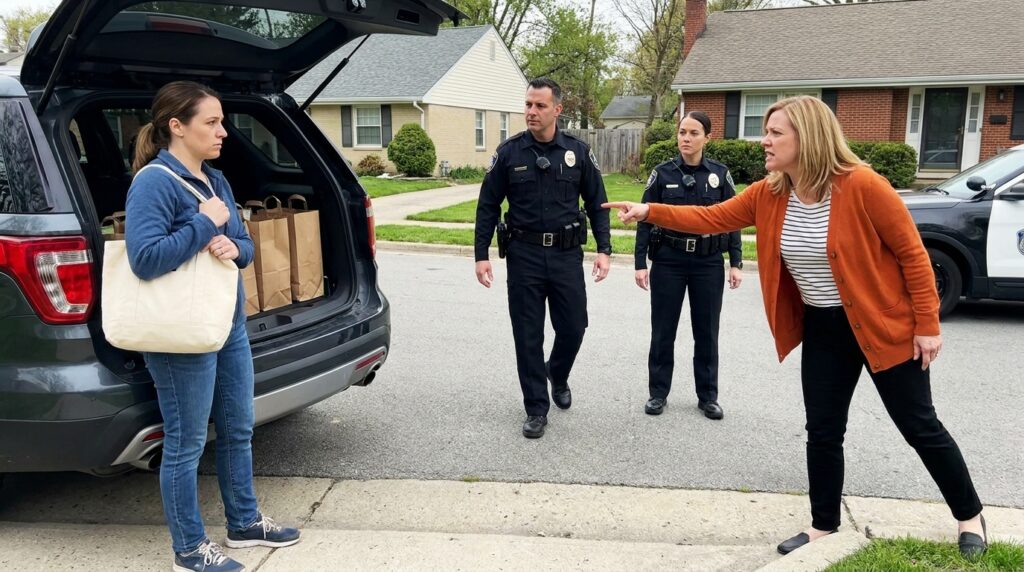
The silence that followed was absolute, broken only by the steady, rhythmic click-whir of the copy machine as it finished its run. The entire conflict—the weeks of public shaming, the jabbing fingers at the SUV hatch, the secret ledger entries Arlan had processed while sitting at the stoplight—had been reduced to an administrative correction. We hadn’t been fighting over a parking spot. We had been fighting over an island that didn’t exist.
Arlan slowly unhooked his thumbs from his belt, his eyes fixed on the low baseboard heating strip behind the dais. He didn’t speak, and he didn’t reach for his notebook. He simply turned and walked toward the side exit, his heavy boots making a slow, dragging sound against the floor tiles until the iron push-bar clicked shut behind him.
Mrs. Gable remained standing for three more seconds, her fingers uncurling from the manila folder until the papers inside spilled out onto the front row table—a collection of obsolete digital permits, outdated tax receipts, and colored maps that carried no more weight than the dust settling on the linoleum.
I stood up from my folding chair, my fingers tracing the frayed seam on the handle of the cream tote bag inside my blue jacket pocket. The thread was still there, a small, loose nerve that didn’t mean anything to the county recorders or the state engineers, but it was the only thing I had left that belonged to the house behind the fence line. I turned my back on the dais, my boots making a light, hollow sound against the concrete floor as I walked out into the gray afternoon light of the entrance courtyard.