CHAPTER 3: THE DEEDS IN THE DUST
The heavy metal latch of the basement door didn’t want to yield. It required the full leverage of my hip against the unpainted pine paneling, forcing a spray of dry, oxidized zinc flakes to rain down over the toes of my sneakers. The air down here didn’t belong to the summer outside. It was cool, damp, and thick with the heavy sediment of forty years of foundational settling, smelling intensely of iron deposits and old limestone dust.
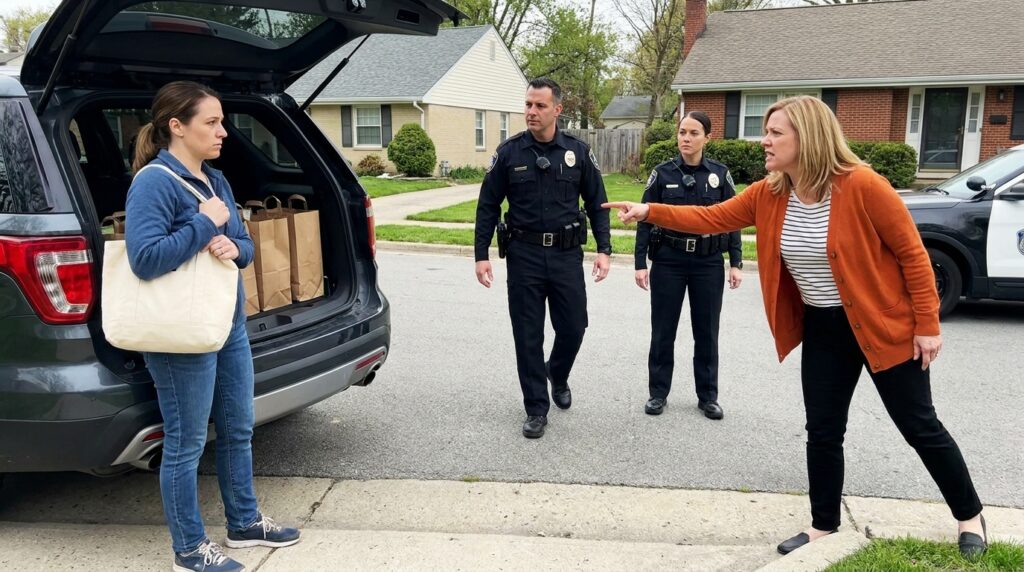
I set the two paper grocery bags down on the bottom step. The cardboard milk carton inside had begun to sweat through its wax coating, leaving a dark, translucent ring on the dry-rotted wood. My hands were still tracking the deep, red indentations where the cream tote bag’s unraveling handle had bitten into my palm. I white-knuckled my knuckles together to get the blood flowing again, watching the small, pale flakes of zinc settle into the deep cracks of the concrete floor.
The blue-ink blueprint stuck in Officer Arlan’s console had stayed behind my eyes like an image burned into a television tube. That heavy, black grease pencil stroke hadn’t been an official revision. It was too thick, too jagged, slashed across the pristine, faded gridlines of the 1954 county seal by a hand that wanted to obliterate what lay beneath.
In the far corner, past the disused water heater with its rusted pressure relief valve, stood my grandfather’s old olive-drab administrative locker. Its green enamel paint was bubbled and pitted with orange acne where the subterranean moisture had spent decades eating the steel. The padlock hanging from the hasp was an old American Lock model, its solid brass body completely dulled into a dark, greasy greenish-brown.
The key was where it had been since the winter he died—tucked behind the exposed copper ground wire of the electrical panel. The metal felt cold and gritty between my fingers. When I slid it into the cylinder, the internal pins ground against years of fine lime dust before a heavy, flat clack echoed off the stone walls.
The door shrieked as I pulled it open, the bottom edge scraping a crescent-shaped scar into the concrete. Inside, the shelves were stacked with gray cardboard document boxes, their corners held together by corroded metal rivets that had begun to bleed white powder. I pulled the lowest box down, its weight surprising me, nearly tearing the fragile, oil-stained twine wrapped around its middle.
The paper inside didn’t rustle; it felt soft, almost like felt, the edges yellowed to the color of corn silk. These were the primary parcel manifests from before the county had paved the secondary access loops. My grandfather had kept everything—every utility invoice, every easement variance, every dispute over fence lines that had been settled with a handshake and a five-gallon bucket of gravel.
I flipped past the property tax assessments from the sixties, my fingers picking up the faint, dry scent of old ink and cellar rot. Halfway through the stack, my thumb caught on a stiff divider made of heavy, gray pressed fiberboard. Behind it lay a smaller, unlabelled manila folder. The brass brads holding it together were twisted and coated in a brittle layer of rust that snapped off the moment I touched them.
Inside was a series of older survey maps, drawn on thick, translucent vellum that had grown brittle enough to crack if unrolled too quickly. I flattened the top sheet with the palms of my hands, using two heavy iron coupling pins from the workbench to hold the curling corners down.
The grid was identical to the one I’d lived on for nine years, but the names in the margins belonged to dead men. The ink was a sharp, dark sepia. My house was marked as Lot 4B; Gable’s house, across the drainage ditch line, was Lot 4A. But when I traced the curb line with the tip of my finger, the clean layout of the residential street dissolved.
A set of handwritten annotations ran along the margins in a cramped, tight cursive that used the archaic legal terms of the mid-century. According to the original field notes from the county surveyor, the standard thirty-foot roadway allowance didn’t terminate at the ditch edge. It extended twelve feet deeper into what was now Mrs. Gable’s front lawn, cutting directly through her boxwood hedges and terminating exactly three inches from the corner of my concrete retaining wall.
But it was the alteration that stopped my breath. Someone had come back to this folder years after the original filing. A thick, dark line—drawn with the exact same type of grease pencil I’d seen in the police cruiser—had been used to scratch out the original dimensions. Over the top of the sepia ink, a new notation had been written in a hasty, slanted hand: Re-registry filed under variance 88-C. Access restricted by executive order.
Beside the note was a small, purple ink stamp from the county recorder’s office, but the signature line inside the ink box was entirely blank. No initials. No authorization code. Just an empty space where the law should have been.
I leaned closer, the iron-scented dust from the locker tickling my throat. The grease pencil hadn’t just changed the numbers; it had physically scored the vellum, leaving a deep indentation in the translucent paper that felt like a scar when I ran my fingernail across the reverse side. Someone hadn’t just modified the map; they had hidden something that the original survey had made concrete.
A sudden, sharp vibration against my hip made me flinch. The phone inside my blue jacket pocket was buzzing, its small motor rattling against the zipper tab. I pulled it out, my thumb smudging the screen with gray cellar soot.
The number on the screen was unlisted, a string of zeros that usually indicated a routed corporate desk or a city annex line. I slid the bar to answer, holding the speaker away from my ear as the low, crackling static of a poor connection filled the narrow space of the basement.
There was no greeting. No introductory name. Just the dry, rhythmic breathing of someone standing in an office where a typewriter or a high-speed document scanner was humming steadily in the background.
“You should have left the car in the lane,” the voice said. It wasn’t Gable. It was a man’s voice—low, clipped, and completely devoid of inflection, matching the flat neutrality of the town’s administrative offices. “The paperwork on that parcel is already closed. If you keep digging into the curb, you’re going to find out exactly who pays for the asphalt.”
The line went dead before I could reply, the dial tone a flat, mechanical drone that bounced off the cold stone walls.