CHAPTER 1: THE CURB LINE
“You can’t just take my spot and act like it’s nothing!”
The words didn’t travel across the yard; they were slammed down like an iron gate. The heat rising from the suburban asphalt carried the sharp, synthetic smell of a midday engine cooling under the July sun.
I didn’t let go of the grocery bags. The heavy brown paper was already damp from condensation where the plastic milk jug pressed against my ribs. Through the thin fabric of my blue zip jacket, I could feel the cold weight of the milk, a small, grounding anchor against the sudden violence of the intrusion.
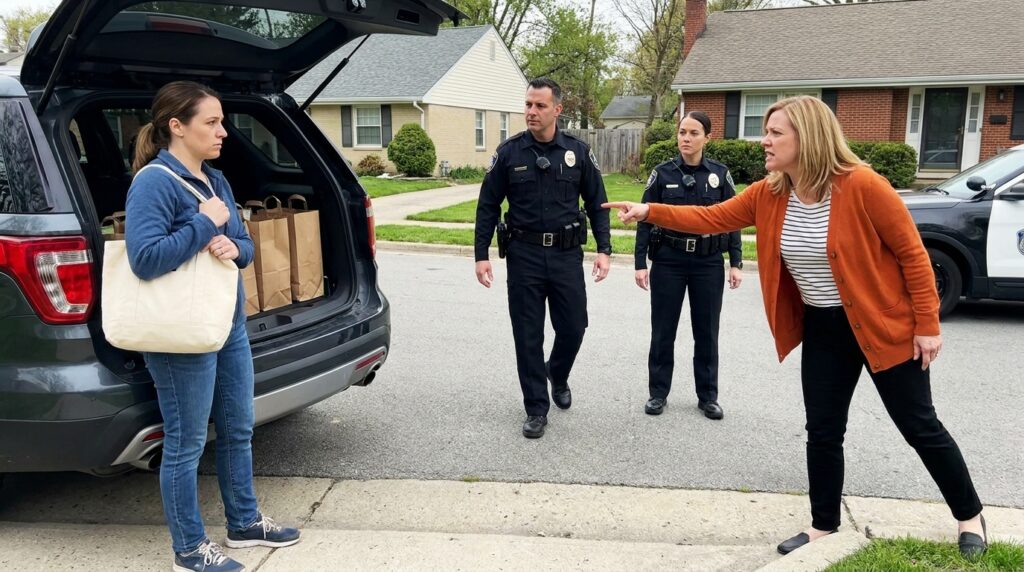
She had crossed the invisible line before the SUV’s engine had even stopped clicking. Her boot heel ground into the gray gravel at the edge of my driveway, a harsh, scraping sound that ruptured the quiet of the street. Her orange cardigan was a jagged slash of color against the faded, desaturated green of the overgrown boxwood hedges behind her. She leaned forward, her chest flat, her face tight with a dry, weathered malice that had been curing for months behind her closed blinds.
“This is a public street,” I said. My voice was too low, caught in the back of my throat, but it didn’t shake. “And I am unloading my car.”
“It’s my frontage!” Her index finger cut through the thick air, jabbing toward the open vertical liftgate of my vehicle. She didn’t touch me, but her proximity was an eviction. Her sunglasses slipped slightly down the bridge of her nose, revealing eyes that were entirely bloodshot, driven by a manic, territorial panic. “My family has cleared this curb since the county laid the blacktop. You don’t get to slide your rusted chassis in here because you’re too lazy to park in the garage.”
My fingers tightened around the woven, frayed strap of the cream tote bag hanging from my shoulder. The seam was unraveling where the heavy canvas met the handle, a tiny white thread sticking out like a nerve. I white-knuckled that exact spot, counting the threads, using the physical friction of the cloth to keep my feet planted in the dirt.
Across the street, a window blind clicked upward three inches. A pale hand held the slat down, a silent, faceless witness to the ritual. Every driveway along this road was a fortification; every mailbox a marker. We all knew the rules of the dusty gray—the unwritten code of endurance where a neighbor’s silence was earned only through absolute vigilance.
She took another half-step, her black pants brushing the edge of my bumper. She was blocking the narrow gap between the vehicle and the low concrete retaining wall, trapping me against the stacked bags of flour and canned goods.
“Move it,” she hissed, her breath smelling faintly of stale coffee and peppermint. “Move it now, or I’ll make sure the city code truck spends every morning idling outside your bedroom window.”
The threat was real, grounded in the petty bureaucracy of a town that lived by its infractions. But then the air changed. From three blocks away, the low, rhythmic thrum of an engine shifted into a higher gear. It wasn’t the delivery truck. It was the heavy, low-revving growl of a municipal V8.
A black-and-white cruiser rounded the corner, its tires humming against the hot seams of the asphalt. It didn’t have its lights on, but it moved with the slow, predatory certainty of an arriving authority. The glare of the sun hit the dusty windshield, obscuring the driver’s face, but the silhouette of the light bar on top was unmistakable.
The claimant’s finger remained frozen in mid-air, her knuckles white, her jaw locking as the cruiser slowly angled toward our curb.