CHAPTER 2: THE BUFFER ZONE
“Step back, ma’am, we’re sorting this out now.”
The door of the cruiser hadn’t even latched shut when the voice cut through the stagnant heat. It was flat, dehydrated, and perfectly level—the tone of a man who spent his afternoons unsticking small-town fuses before they could blow.
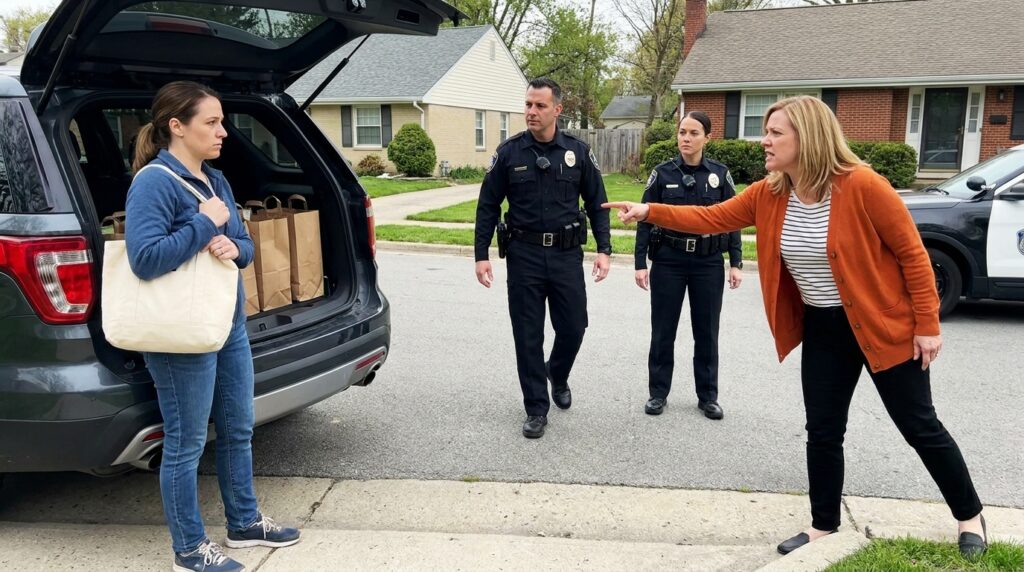
The lead police officer didn’t look at me first. He didn’t look at the grocery bags sweating through their paper casings in the back of my SUV, either. His boots made a heavy, rhythmic crunch-crackle against the unwashed gravel at the edge of the asphalt as he stepped into the narrow, pressurized gap between us. His black uniform looked thick, almost rigid in the midday glare, absorbing the sun until it seemed to radiate its own oppressive field of heat. On his shoulder, the department patch was clean but worn, its edges frayed into gray fuzz, held in place by an old, inverted silver grommet that didn’t match standard county issue. It was a tiny discrepancy, a cheap repair done on a personal machine, but it spoke of a department that worked on a shoestring and kept its secrets inside the locker room.
Behind him, the backup officer—a younger woman with her dark hair pulled so tightly into a bun it seemed to pull the skin of her temples taut—stayed a half-step back. Her hand didn’t rest on her holster, but her thumb was hooked into her tactical vest, her knuckles white against the dark nylon. Her eyes didn’t blink. They were fixed entirely on the claimant’s right hand, which was still suspended in the air like a frozen claw.
“Sorting what out?” The claimant’s voice spiked an octave, the manic authority leaking out of her stance as she took a compulsory step back. Her boot heel caught the edge of a exposed utility flag—a strip of faded orange plastic tied to a rusty wire spike in the dirt—and she staggered slightly before regaining her balance. Her orange cardigan shifted, exposing a damp patch of sweat between her shoulder blades. “Officer, this woman is deliberately blocking a designated loading corridor. I’ve lived on this block for twenty-two years, and my family has an established right of frontage. She’s trespassing on an active residential easement.”
“Ma’am,” the lead officer said again. He didn’t raise his hand high; he simply turned his palm outward, keeping it low, just above his utility belt. It was a leverage move, a physical bar dropped into the dirt between her orange sweater and my blue jacket. “I said step back. Let us handle this.”
I stayed backed against the edge of the liftgate, the metal latch pressing into the small of my back. The cream tote bag was still squeezed tight against my hip, my fingers dug so deeply into the unraveled thread of the handle that the canvas was leaving red, ribbed indentations across my knuckles. I could feel the cold sweat of the milk jug soaking through my shirt now, a deep, localized chill that made the rest of the humid air feel twice as heavy. I didn’t say a word. In the dusty gray, you let the person with the loudest mouth dig the hole until the shovel hits bedrock.
The claimant’s chest heaved. She looked past the officer’s shoulder, trying to lock eyes with me, her sunglasses slipping another fraction down her nose. “She’s doing this on purpose. Check her registration. Check her residency permits. She doesn’t even have the proper district variance to keep a high-clearance vehicle on a secondary residential curb. I know the clerk at the county annex. I know exactly how these lines are drawn.”
The lead officer didn’t turn to look at her when she mentioned the county annex, but his shoulders went tight beneath the heavy black polyester. He reached down to his belt, his fingers brushing past his radio before resting on a small, leather-bound notebook tucked into his side pocket. The leather was split down the spine, revealing yellowed pages filled with tight, cramped handwriting.
“Your name isn’t on the county maintenance log for this curb, Mrs. Gable,” the officer said, his voice dropping into a deeper, transactional register that made the claimant—Mrs. Gable—stiffen. He didn’t look up from the book as he flipped a page with his thumb. “And the street registry doesn’t recognize ‘frontage’ on a public curb lane. You know that as well as I do.”
“The registry is being updated,” she said quickly, too quickly. Her hand went to her pocket, her fingers twitching against the plastic corner of a phone or a folded document before she pulled it back empty. “The engineering tech was out here three weeks ago. He verified the setback coordinates. If you call the code enforcement desk right now—”
“We’re not calling the desk from the field,” the backup officer interrupted, her voice a sharp, dry rasp that cut through Gable’s momentum. She hadn’t moved from her support position, but her shadow now fell directly across the utility flag between their feet. “We’re clearing the lane.”
Across the street, the pale hand behind the window blind disappeared, but the slats remained tilted open, a blank, plastic eye recording every shift in weight. Two houses down, an old man in an unbuttoned flannel shirt stepped onto his porch, his boots clicking softly against the weathered cedar planks as he leaned against the railing to watch. The neighborhood pressure was shifting, the silence growing dense and unyielding as the illusion of Gable’s absolute control began to crack under the weight of the cruiser’s idling engine.
The lead officer looked at me then. His eyes were gray, the color of wet river slate, surrounded by deep, sun-baked wrinkles that suggested he’d spent thirty years watching people lie about pieces of dirt. He didn’t ask for my license. He didn’t ask for the registration. He just looked at the heavy paper bags inside the hatch, then down at the unraveling strap in my hand.
“Get your things inside,” he said, his voice dropping the official clip, leaving only the hard, unvarnished pragmatism of a man who wanted the street empty before the heat cracked the pavement. “Leave the car where it is. It isn’t violating anything we’re citing today.”
Gable let out a sharp, whistling breath through her nose, her fingers curling into tight fists at her sides. “This isn’t over, Arlan. You can’t just authorize a violation because—”
“Ma’am,” the lead officer—Arlan—turned his entire body toward her then, his boots grinding a deep semicircle into the gray gravel. His low hand didn’t move, but his shadow completely erased hers from the dirt. “Go back to your porch. Now.”
He didn’t give her a second warning, and he didn’t wait to see if she moved. He simply stood there, an iron bulkhead in the middle of the easement, while the backup officer shifted her weight, her boots clicking in unison against the stone.
I reached into the hatch, my hand steady as I grabbed the first two paper bags by their unreinforced edges. The bottoms were soft from the thawing groceries, the weight shifting precariously as I pulled them toward my chest, but I didn’t look back at Gable. I walked past the officer’s shoulder, my shoulder checking the edge of the liftgate to clear the frame, my eyes fixed on the low, rusted screen door of my own porch.
But as I passed the cruiser’s rear fender, I caught the smell—not of hot oil, but of dry, old paper and damp earth coming from the officer’s open driver-side window. Stuck between the console and the police radio was a faded, blue-ink blueprint, its edges water-stained and marked with an old county seal from decades ago. The red survey lines didn’t stop at Gable’s property line. They ran right through the middle of both our driveways, crossed out with a heavy, black grease pencil that had the word RESERVED scratched beside it in a hand that didn’t look like any clerk’s I’d ever seen.