CHAPTER 5: THE PRESSURE TRANSIT
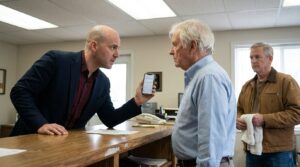
The iron clasp of the leather folder didn’t just click; it severed the room’s remaining stability. As Arthur Vance tucked the worn case back beneath his elbow, the windowless office felt smaller, the stark white drywall seemingly absorbing the heat from the three men standing inside its narrow perimeter.
“Let’s move to the lower transit bay, Arthur,” General Hayes said, his voice dropping into the lower, gravelly register he used when an advance post was no longer tenable. He reached out to palm the heavy exit lever, but before his fingers could engage the chrome surface, the overhead LED grid flickered once—a cold, blue stutters that left the room in near-darkness before the auxiliary power strips clicked over with a dry, mechanical snap.
The rhythmic thrum of the facility’s main HVAC system died out instantly. In its place came a thin, high-pitched whistle from the ceiling vents as the static pressure dropped across the sector line.
Marcus Cole didn’t look at the door. His eyes stayed fixed on the emergency floor-level indicators where a small amber LED began to flash an unmapped logic sequence: E-00. Clear Boundary Zone. His fingers, still stained with the grey halo of metal dust from the table, twitched against the seam of his trousers. “The offline backups shouldn’t be drawing from this grid,” he muttered, his voice brittle, stripped of its corporate cadence. “The terminal bay has its own isolated isolation bank.”
“It isn’t a power failure, son,” Arthur said, his tone flat as he adjusted his wire frames. His loafers found the seam where the concrete floor joined the structural steel sill. “The main frame just executed a localized quarantine block. Someone on your server floor realized the Roanoke weigh-bills were sitting on the metal table.”
Hayes pulled the door lever down. It clicked, but the heavy steel frame stayed pinned inside its hydraulic casing, the magnetic lock buzzing with a low, sixty-cycle frequency that signaled a forced security hold. “Director Cole,” the general snapped, his head turning with a slow, dangerous precision. “Clear this exit line.”
“I… my credentials won’t override a sector-wide level four isolation,” Cole stammered, stepping back toward the aluminum table as if the metal surface could protect him from the four-star detail waiting outside the glass partition. Through the soundproof paneling, the three junior security officers were already lifting their handheld terminals, their thumbs working the membrane keys as the corridor’s auxiliary red light tubes hummed to life. “The automated system triggers this sequence if the digital integrity metric drops below seventy percent. It’s an anti-espionage baseline.”
“It’s an institutional blanket,” Arthur said, his gravelly rasp cutting through the electrical hum. He turned his vertical frame toward the secondary maintenance corridor at the back of the room, where an old iron hatch led toward the service elevator hoistway. The surface of the hatch was painted a thick, peeling gray, the rivets showing white crusts of oxide around the rims. “The corporate offices want the data confined to this sector until they can run an overwrite routine from the main server house in Bethesda. They don’t want your file folder crossing the threshold of General Hayes’s transport.”
Hayes didn’t argue the point. He knew the architecture of defense contractors better than most; he knew that when a multi-billion-dollar federal appropriation was at stake, the boundary between an administrative audit and a physical containment operation could become thin enough to bleed through. “The service hoist uses a manual hydraulic bypass,” Hayes said, his eyes scanning the rusted iron hatch. “We used to map them into the emergency evacuation annex during the early construction phase.”
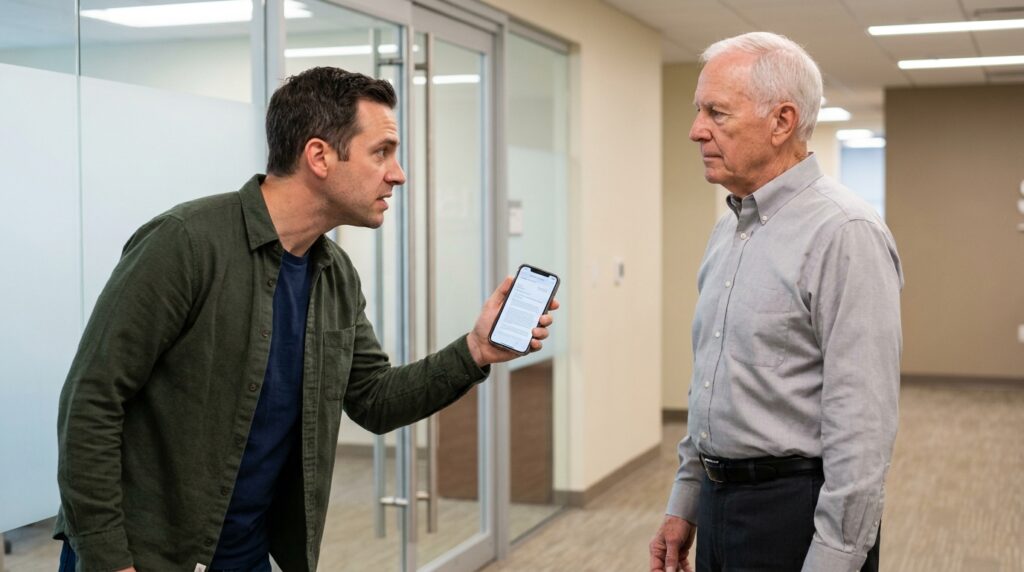
“The manual link was disconnected during the 2022 digital modernization cycle,” Cole interjected, his voice rising as he stepped into the gap between Arthur and the hatch. His dark green overshirt was soaked through at the shoulder seams, the fabric clinging to his athletic build like wet moss. “You can’t operate the lift without an encrypted handshake from the central gate desk. If you force that lever, the counterweights will lock into the guide rails. We’ll be stuck in the sub-level shaft until the morning shift resets the logic.”
Arthur walked past him, his shoulder dropping just enough to brush Cole’s green sleeve aside with the indifference of an engine moving along a fixed track. He reached out with his left hand, the weathered West Point ring scraping the oxidized iron handle of the maintenance hatch as he gripped the lever. The cold metal felt familiar—it was the same rough-cast zinc they had used in the old underground command silos during the mid-winter alerts of sixty-eight.
“The modernization cycle only replaces the things the accountants can see on a spreadsheet, Director,” Arthur said softly. He braced his feet against the concrete sill, his spine locking into a rigid, unyielding line of leverage. “They don’t spend money to remove forty feet of solid iron rod buried behind three inches of industrial masonry. They just paint over the handle and tell the staff it doesn’t work anymore.”
He threw his weight into the lever. The sound that followed was a wet, grinding crack as twenty years of calcified hydraulic grease gave way. Deep within the drywall shaft behind the room, a pair of steel cable sheaves turned with a heavy, ungreased groan, their friction vibrating through the polished floor beneath their feet.
The hatch swung open into a dark vertical trench that smelled of wet dust, copper slag, and cold concrete sweat. The service platform sat three inches below the lip, its rusted iron mesh floor groaning under the sudden imbalance of air. On the small control console, a mechanical counter-wheel click-clicked twice, its physical numbers rolling over to reveal an offline routing code that hadn’t been mapped to the corporate server since the facility changed its name from the old naval ordnance yard.
Arthur stood at the threshold, the leather portfolio secured beneath his elbow, looking down into the gray vacuum of the old infrastructure. The first layer of their tactical victory had just dissolved into a forced retreat; they weren’t walking out through the main glass entry doors as victors. They were dropping into the rusted marrow of the old line, and the ultimate reality of what Arthur Vance was actually investigating remained buried, five levels below the clean corporate carpet.