CHAPTER 2: THE PRESSURE GRADIENT
The hiss of the glass doors was a sharp, clinical decompression that cut right through the dry, stagnant air of the corridor. It smelled of rainwater, ozone, and wet asphalt from the Virginia transit lot outside—a sudden invasion of the raw elements into a space that had been sealed too tight for too long.
Marcus Cole didn’t look back at the doors immediately. His knuckles were still white where he gripped the chrome stanchion rail, his body weighted forward, attempting to maintain the physical blockade he had thrown up between Arthur Vance and the exit. But the sudden shift in the room’s atmospheric pressure wasn’t something that could be ignored. The two junior contractors who had been lingering near the elevators didn’t just look up; they went rigid, their spines straightening in a mechanical reflex that had nothing to do with corporate hierarchy.
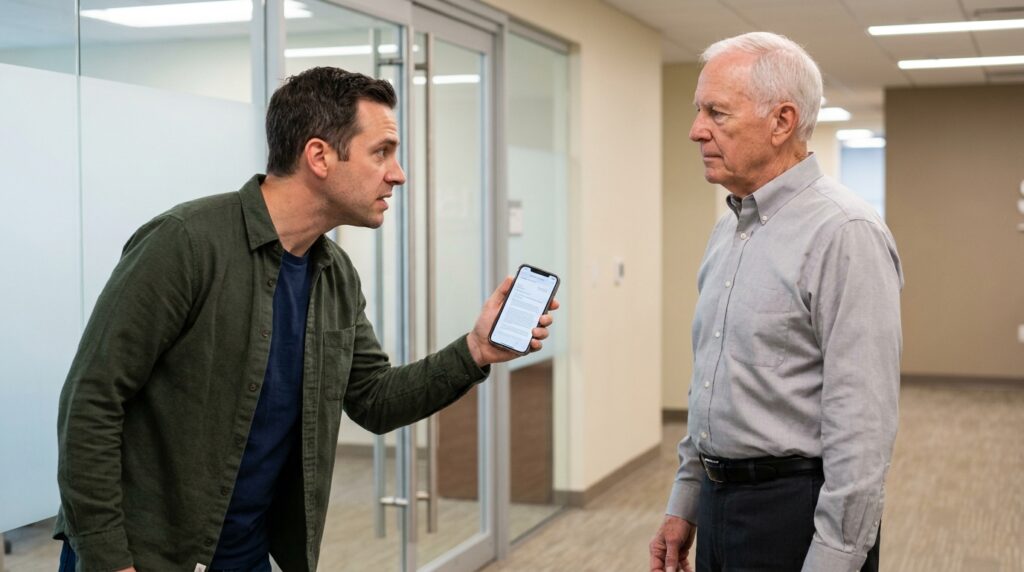
Arthur didn’t alter his stance by a single degree. He kept his feet planted at forty-five-degree angles on the polished concrete, his shoulder lowered just enough to shield the faded leather portfolio under his arm from Cole’s proximity. Through the glass panels, the grey dusk outside was rapidly thickening, casting long, desaturated shadows across the modern drywall. The fluorescent lights overhead hummed a flat, metallic B-flat, casting a sickly yellow sheen over the director’s dark green overshirt.
“Sir, you need to return to the desk,” Cole said, though his voice had dropped an octave, the aggressive timber cracking slightly under the weight of the silence behind him. “The log isn’t clear. You’re carrying unvetted material.”
“The material is signed,” Arthur said. His voice remained a level, gravelly rasp. He didn’t point to the folder. He didn’t have to. The heavy gold-and-silver West Point ring on his left hand caught the harsh glare as his thumb remained hooked over the leather seam, a silent anchor of old iron amidst the cheap corporate chrome.
The boots came next. Heavy, synchronized, double-soled leather striking the floor with the unmistakable cadence of a security detail that didn’t stop for badges or digital check-in kiosks. There were four of them—three junior officers in starched utility uniforms, their faces frozen into blank tactical masks, and at the center, a man whose dark green service coat bore the heavy silver weight of four stars on each shoulder.
General Thomas Hayes didn’t look at the corporate signage. He didn’t look at the modern indoor balconies where the administrative assistants were now leaning over the railings, their phones forgotten in their hands. His eyes scanned the concrete corridor like a man checking a familiar grid map for familiar coordinates. When his gaze hit the gray button shirt and the unyielding, white-haired posture of Arthur Vance, the general’s stride didn’t just alter—it locked.
Cole turned then, his corporate ID badge swinging wildly on its lanyard, his mouth already open to offer a well-rehearsed bureaucratic greeting, the defensive reflex of a manager caught out of position. “General Hayes, sir, we were just completing a standard security audit on an unregistered—”
Hayes didn’t let him finish the sentence. The four-star general stopped exactly three paces from the stanchion rail. The air between them tasted of cold salt and discipline. Hayes’s heels came together with a sharp, dry snap that echoed off the synthetic drywall. His right hand came up, fingers straight, thumb tucked, the palm angled precisely over the brow of his cap in a rigid, flawless command salute.
“General Vance, sir,” Hayes said. The words weren’t loud, but they carried the flattened, institutional authority of a man who commanded forty thousand men under federal appropriation. “The transport from the Pentagon is holding in the lower bay. We didn’t expect you on the floor until the morning session.”
The silence that followed was absolute. It was the specific, heavy quiet that happens when an engine drops its transmission at high speed—a sudden cessation of functional noise that leaves only the raw vibration of things breaking.
Cole’s hand didn’t just leave the chrome rail; it dropped as if the metal had turned white-hot. His athletic frame seemed to shrink inside the green overshirt, his shoulders rounding as his gaze traveled from Hayes’s silver stars down to the weathered West Point ring on Arthur’s hand. The skin along Cole’s jawline turned a mottled, chalky white, the modern lighting making his sweat-sheened forehead look like unbaked clay.
Arthur slowly lowered his head by a fraction of an inch—a minimalist acknowledgement that had served as his baseline for forty years. He didn’t return the salute; he was in civilian clothes, and the rules were the rules, even when the floor was melting beneath them.
“The clerk gave me a day pass, Tom,” Arthur said, his voice dropping into the familiar, sparse rhythm of old colleagues who had shared bad coffee in unventilated command tracks. “The digital kiosk was down. This young man felt the discrepancy required an exhibition.”
Hayes’s eyes moved to Cole. They didn’t widen; they simply narrowed, the gray pupils turning into cold, iron sights. “Director Cole, is it?” Hayes asked, his voice descending into a flat, dangerous register that made the junior security guards behind him step back an inch. “You’re the security director for this sector?”
“Yes, General, I—” Cole stammered, his fingers twitching toward his pocketed phone, then freezing as he realized the sheer irrelevance of his digital network. “The protocol… we had an internal leak last Tuesday… I was simply ensuring that no unvetted documents—”
“The documents under General Vance’s arm are federal property,” Hayes interrupted, his hand moving to his side, where a staff officer immediately proffered an official, leather-bound folder with an identical operational seal to the one Arthur held. “More specifically, they are the independent review sheets for your facility’s top-tier defense clearance. The sheets you signed off on when you bypassed the physical perimeter checks to hit your quarterly cost metrics.”
Arthur didn’t smile. He watched the realization hit Cole’s face—the physical collapse of a man who had built his power on the belief that the world was entirely populated by people who were afraid of his green lanyard. Arthur quietly shifted the portfolio under his arm, the brass corners clicking against his ring. The first clue had just been dropped into the corridor, but the heavy iron box of the real investigation remained locked, deep within his gray shirt pocket.