CHAPTER 4: THE CROSSING POINT
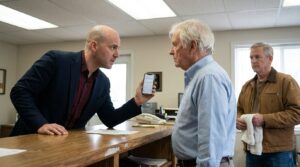
The red ink smudge on the frayed carbon paper looked like a dried rust spot under the harsh LED grid. Marcus Cole’s fingers remained flattened against the aluminum table, his palms leaving twin grey halos of condensation on the brushed metal. He did not look up at the ceiling cameras. He was looking at the blank line where an inspector’s signature should have been, his jaw working with a tight, microscopic twitch.
“The Roanoke facility was cleared under the emergency material reallocation act,” Cole said, his voice dropping into a flat, defensive monotone. He didn’t look at General Hayes, nor did he look at Arthur. His focus remained pinned to the manual ledger page. “The compliance parameters allow for the substitution of structural alloys if the primary supplier hits a maritime bottleneck. It’s all logged in the regional server.”
“The regional server only records what you type into the interface, son,” Arthur said. He adjusted his wire-rimmed glasses, his thumb rubbing the worn, silver-gray crest of his West Point ring. “It doesn’t record the weight of the flatbeds when they cross the secondary scales at the perimeter gate. It doesn’t see the rust on the structural tubing before the painters hit it with corporate primer.”
General Hayes shifted his weight, his heavy leather boots creaking against the floorboards. The sound was an unyielding reminder of the institutional authority flanking the small, windowless office. “Director Cole,” Hayes said, his voice carrying the cold rhythm of a formal deposition. “The low-latency arrays aren’t the issue. The defense procurement board flagged forty-eight structural beams shipped to the main satellite integration hangar last month. The digital manifests say they’re aerospace-grade titanium. The manual weigh-bills from the old Roanoke yard say otherwise.”
Arthur reached down and turned the carbon sheet over, his skin rough against the brittle paper. The friction made a dry, scraping sound that seemed to fill the small room. Beneath the first layer lay a duplicate invoice, its edges yellowed from years in an unventilated file drawer. It wasn’t an automated printout; it was typed on an old manual ribbon machine, the letters unevenly spaced, the serial blocks stamped by hand.
“You thought the record was dead because the Roanoke office went dark during the ninety-five closure cycle,” Arthur said softly. He pulled the leather folder closer to his chest, the brass corners catching a thin glint of the cold overhead light. “But some things don’t dissolve in a database. The old logistics battalions didn’t use cloud storage. They left paper trails in the concrete vaults under the old supply tracks.”
Cole finally raised his eyes, his gaze sharp and defensive, the desperate intellect of a cornered bureaucrat looking for an analytical flaw in a veteran’s line. “If the steel wasn’t certified, the automated ultrasonic scanners at the receiving dock would have tripped a code forty validation. The integration team wouldn’t have accepted the shipment. I don’t control the scanners, General. That’s an automated quality control protocol.”
“The automated scanners only check the pieces that pass through the main warehouse portal,” Arthur said. He stepped closer to the aluminum table, his vertical posture cast like a long shadow across Cole’s side of the room. “The gate override you executed during the rain filter didn’t just clear the low-latency arrays. It let three heavy transport flatbeds bypass the diagnostic bay entirely. You told the gate guards the materials were pre-vetted by an external audit team.”
“The delivery milestone was tied to our prime contract renewal,” Cole snapped, his voice cracking slightly as the corporate pretense fell away completely, leaving only the raw anxiety of an executive who had overreached his authority. “If those integration frames weren’t set by midnight, the entire procurement timeline for the next fiscal year would have defaulted. I didn’t write the contract deadlines, General. Your people at the Pentagon did.”
“My people didn’t tell you to use decommissioned structural iron to build a satellite housing,” General Hayes said, his voice dropping into a dangerous, low register that made the security clerks outside the glass door look around. “You didn’t execute an override to save a deadline, Director. You did it because the certified titanium alloy was sold to a commercial aviation broker two months ago, and you needed forty-eight structural columns to fill the physical gap before our inspection team walked through the door.”
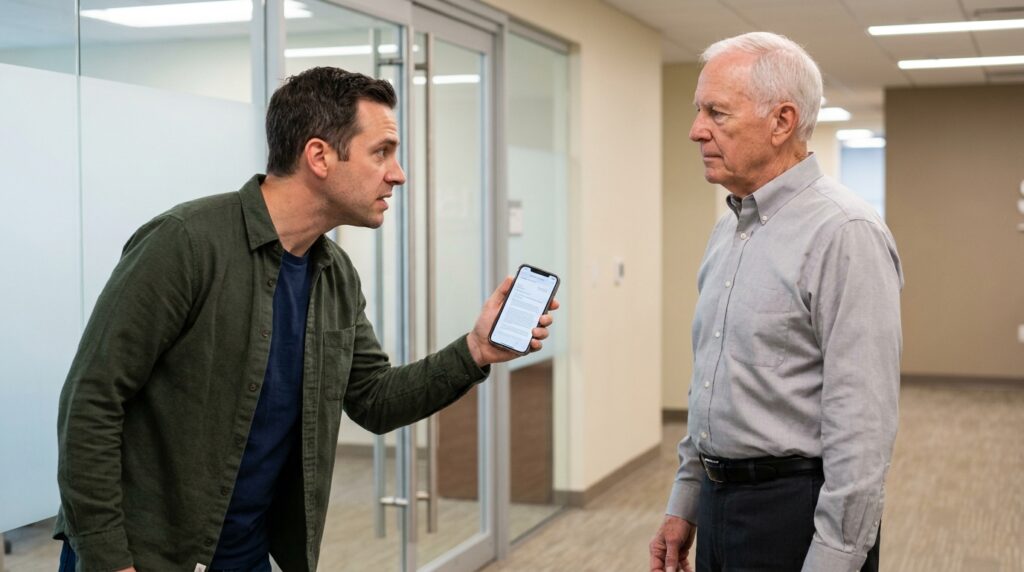
Cole’s hand dropped from the table, his arms hanging limp at his sides. The green lanyard looked heavy around his neck, the corporate ID card dangling like an old iron tag. The modern, clean lines of Apex Defense Systems—the structural glass walls, the exposed and painted gray conduit, the anti-glare filters—seemed to lose their high-tech luster, replaced by the ancient, unmistakable atmosphere of an unventilated military stockade.
Arthur quietly picked up the carbon sheets, sliding them back into the faded leather portfolio. The iron clasp closed with a sharp, heavy click that signaled the end of the argument. He looked at Cole one last time, his eyes steady behind his wire frames, offering neither anger nor pity, only the cold, unyielding precision of a man who had spent his life evaluating the structural boundaries of an organization under fire.
“The decoy was well-constructed, son,” Arthur said, his gravelly voice echoing off the synthetic drywall. “The digital ledger looks perfect on the monitor. But the concrete beneath this facility doesn’t lie, and neither do the old weigh-station receipts from the Virginia road depots.”
He turned toward the soundproof door, the folder secure under his elbow. The first layer of the corporate lie had been cracked wide open on the metal table, but the ultimate final truth—the real reason why the Department of Defense had sent an eighty-year-old corps commander to a regional contractor’s office instead of a standard audit team—remained strictly locked inside his gray shirt pocket, waiting for the terminal bay doors to clear.