CHAPTER 3: THE ARCHIVE TRAIL
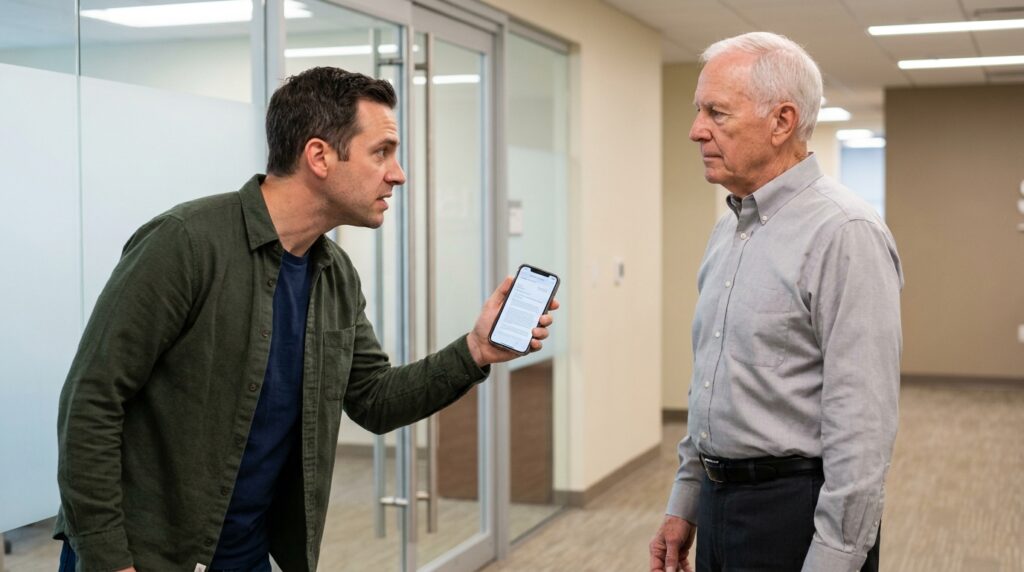
The corporate corridor did not clear quickly; it dissolved. Marcus Cole’s breathing remained shallow, a ragged scraping sound against the smooth click of General Hayes’s detail adjusting their formation. Under the sharp overhead light, Cole’s hand drifted toward the green lanyard around his neck, fingers tangling in the woven synthetic fiber as if looking for a physical anchor in a shifting floor.
“We have an office cleared in Sector Two,” Hayes said, his voice flat, his eyes never leaving the sweat-slicked bridge of Cole’s nose. “Move.”
Arthur didn’t wait for the security director to lead. He walked with a steady, unhurried gait, his worn loafers finding the seams where the carpet met the polished concrete. The leather portfolio remained locked beneath his elbow, its brass hinges cold against his ribs. He could feel the weight of the pages inside—not just the single flagged compliance sheet, but the deeper, unprinted ledger numbers that had brought him out of his quiet retirement in the foothills.
They moved past rows of glass-walled cubicles where the defense contractors sat like ghosts behind anti-glare filters. The modern architecture of Apex Defense Systems was built to suggest transparency—every wall was paneled in structural glass, every cable tray exposed and painted a uniform industrial gray. Yet, beneath the clean scent of high-grade air filtration, Arthur caught the faint, persistent odor of older infrastructure: the damp smell of sub-floor grease and the scorched iron tang of transformers running hot behind the drywall.
The auxiliary office in Sector Two was small, windowless, and isolated by a heavy soundproof door that closed with the dull thud of a vault. A single brushed-aluminum table sat in the center under an unshielded LED grid.
General Hayes stepped to the corner of the room, his security detail remaining outside the glass boundary. He nodded once to Arthur, a silent transfer of tactical priority that required no formal explanation.
Arthur placed the leather portfolio flat on the aluminum surface. The sound of the weathered hide striking the metal was loud, a dead, unyielding thud. He unbuckled the iron clasp with a single twist of his left thumb, his West Point ring scraping the metal casing with a dry, metallic scratch.
“The regional logs from last Tuesday show an eight-hour gap in the primary entry sequence at the assembly bay,” Arthur said. He did not sit. He stood with his fingers lightly touching the edge of the leather folder, his posture remaining perfectly vertical, a human plumb line in the windowless room. “The automated gate threw three separate parity errors. Each one was overridden from a terminal registered to your sector office, Director Cole.”
Cole remained near the door, his athletic frame looking out of balance against the stark white line of the baseboards. He had unbuttoned the top notch of his dark green overshirt, revealing the pale, salt-stained rim of his undershirt. “The system was undergoing a scheduled logic update,” Cole said, his voice returning in thin, structured pieces. “We had five hundred crates of low-latency arrays sitting on the tarmac during a heavy rain filter. If I didn’t bypass the kiosk verification, the moisture sensor would have tripped a secondary quarantine. We would have missed the quarterly delivery milestone by forty-eight hours.”
“You cleared the crates without a counter-signature,” Arthur said.
“I cleared them under the operational efficiency clause,” Cole countered, his eyes hardening as he found the familiar terrain of corporate policy. He stepped closer to the table, his hand flat against the opposite edge, trying to lean into the space. “Apex is a commercial vendor, General. We aren’t running an active-duty motor pool here. If we miss a procurement window, the funding line drops by three percent on the next cycle. I saved the company twelve million dollars in asset penalties.”
Arthur looked down at the open folder. The page on top wasn’t a standard corporate memo; it was a triple-ply carbon copy from an older, military-issue inspection book, its pink edges frayed and yellowed around the margin holes. On the lower right-hand corner, Cole’s digital authorization code was printed in sharp, pixelated black ink. Next to it, the line for the independent federal inspector’s signature was completely blank.
But Arthur’s eyes weren’t fixed on Cole’s printed validation. He was looking at a minor discrepancy on the duplicate page underneath—a faint, indented red ink smudge that didn’t match the digital sequence. It was a physical mark, a manual stamp from a logistics office that should have been decommissioned during the Base Realignment closures ten years prior.
“The twelve million dollars isn’t the metric that matters, son,” Arthur said softly. He reached into his gray shirt pocket and drew out a pair of wire-rimmed reading glasses, unfolding the tarnished steel stems with a deliberate, rhythmic click. “The low-latency arrays you brought through that gate didn’t come from the depot in Chambersburg. The manifest has an old supply depot code from the third-tier sub-contractors in Roanoke.”
Cole’s hand slid an inch across the aluminum table, his palms leaving a damp, grey smudge on the brushed finish. “The sourcing was approved by the procurement board. It’s in the digital annex.”
“The digital annex is a shadow,” Arthur rasping out the words without raising his tone. He adjusted the wire frames on his nose, looking through the glass at the pale reflection of his own white hair. “The paper in this folder shows that the Roanoke facility hasn’t drawn federal steel since the mid-nineties. The parts you brought through the rain aren’t components, Director Cole. They’re old inventory that someone re-labeled to clear an outstanding liability off the books before the independent review team arrived.”
He turned the carbon sheet over. The movement was crisp, the dry paper crackling under his fingers like dead leaves.
“You didn’t bypass the protocol to save a deadline,” Arthur said, his eyes locking back onto Cole’s face with the absolute weight of a commander who had spent thirty years identifying structural failures in the field. “You bypassed it because you knew the inspector’s signature line would stay blank forever if you kept the transaction off the live grid. But you forgot the manual ledger link. Someone in Roanoke still uses a stamp.”
Cole opened his mouth to reply, his jaw working silently for three seconds before he could find the words. The corporate confidence had completely drained from his posture, leaving only the hard, defensive instinct of a mid-level manager who had realized the trap wasn’t behind him—it was already closing around his wrists.
The red ink mark on the duplicate page remained visible under the harsh LED grid, a small, rusted anchor of truth that corporate policy couldn’t erase.