
CHAPTER 8: THE CITATION AND THE SILENT FENCE
“Ma’am, I need you to sign the acknowledgement on line three.”
Inspector Miller’s voice didn’t carry anger, but it possessed the cold, unyielding weight of a municipal decree backed by county ordinance. He held the aluminum clipboard across the cedar top rail, his yellow-gloved thumb holding down a fresh carbon-copy form stamped OFFICIAL CITATION — UNLAWFUL DISPOSAL & STRUCTURAL ENCROACHMENT.
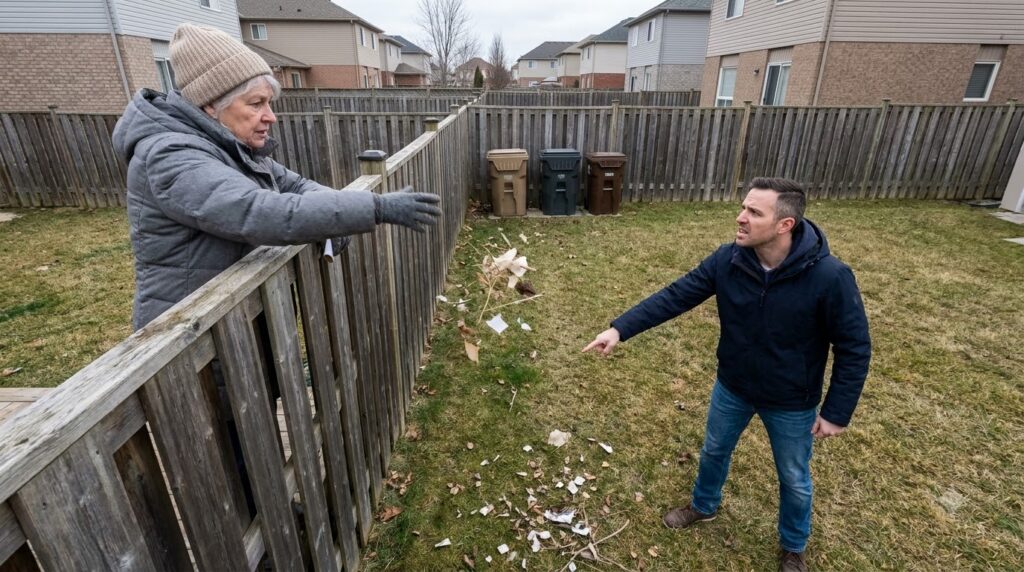
Evelyn stood on her side of the fence, her oversized gray coat bunched tight around her neck. Her dark gloves hovered an inch above the paper. For forty years, her signature on neighborhood petitions, informal agreements, and hand-drawn maps had carried absolute authority on this block. Now, her hand trembled as she took the cheap ballpoint pen from Miller’s fingers.
“The remediation order requires a licensed civil contractor to clear the buried fill within thirty business days,” Miller said, his pen tapping the red-bordered section of the citation. “All waste removed from the subsoil will be weighed and logged. If any material crosses onto this property line without an approved excavation plan, the city will issue an immediate stop-work injunction and attach a tax lien to your parcel.”
The neighbors across the street didn’t move. They stood clustered at the edge of the curb, their hands deep in their pockets, watching in total, heavy silence as Evelyn pressed the pen to the carbon paper. The scratch of the ballpoint against the clipboard was the only sound in the freezing morning air.
She signed her name. The signature was small, jagged, and devoid of the sweeping flourishes that marked her old butcher-paper map.
“Keep copy two,” Miller said, tearing the yellow sheet from the pad and handing it to her. He didn’t offer a polite closing. He unclipped his brass soil probe, wiped the dark sludge off the steel tip with a rag, and packed his gear into the back of his utility truck. The heavy diesel engine roared to life, its exhaust curling white against the leaden sky, before the truck pulled away from the curb and disappeared down the street.
The street returned to its winter silence. One by one, the neighbors turned and walked back toward their front porches, their boots crunching on the frosted sidewalks, leaving the boundary line empty.
Evelyn held the yellow carbon sheet in her gloved hand, her eyes fixed on the trench Mark had cleared.
Beneath the open cedar rail, the three-quarter-inch solid iron survey pin gleamed in the pale gray light, its orange cap stamped COUNTY BOUNDARY PIN #4821 sitting clean and undisturbed four inches below grade. The yellow mason’s string stretched taut between the orange-topped steel stakes, tracing a razor-thin, unbroken line from the front curb straight to the rear corner post.
Mark stood on his side of the line, his navy hooded jacket zipped to his chin, his dark boots planted squarely on his own turf. He didn’t gloat. He didn’t raise his voice. He reached into his coat pocket, pulled out a small steel cap, and pressed it securely over the top of the open iron box, sealing the empty cavity where the decoy document had rested.
“The fence line stays right where it is, Evelyn,” Mark said, his voice quiet, flat, and absolute. “Keep your hands on your side.”
Evelyn looked up from the yellow citation sheet. Her jaw twitched once, her shoulders stiffening as if to summon a final rally of her old territorial pride. But as her eyes met Mark’s—and then traveled up to the dark, steady glass of the roof-mounted security camera watching from the eaves—the fight drained out of her face.
She didn’t speak. She didn’t drop another line of dialogue.
Slowly, her head bowed, she turned on her heel and walked down her concrete path toward her back door. Her boot heels dragged slightly in the damp gravel, her gray coat trailing behind her like a faded shroud as she stepped into her house and pulled the heavy wooden door shut.
The latch clicked into place with a dry, final sound.
Mark turned away from the fence and walked back toward his rear porch. He paused at the top step, looking out over his lawn. The turf was cold, damp, and scarred where the spade had bitten into the soil, but the line was drawn. The survey pins were exposed, the video feeds were active, and the legal truth of his boundary sat permanently recorded in county steel and municipal ink.
He stepped inside his house, pulled the porch door shut behind him, and turned the lock.








