
CHAPTER 6: THE MAP AND THE BURIED MINE
The yellow citation notice fluttered against the cedar rail, its heavy laminated paper snapping sharply in the rising northerly wind.
Inspector Miller stepped back from the fence, his boots leaving deep impressions in the frozen mud where the probe had plunged into the rotten fill. He pulled a yellow industrial grease pencil from his vest pocket, preparing to draw a boundary perimeter box across both properties on his official site survey.
“Hold that pencil, Inspector,” Evelyn said. Her voice didn’t waver. It rasped with the brittle, desperate force of a woman backing toward her final defensive line.
She reached deep inside her oversized wool coat and pulled out a leather-bound folio, cracked and salt-stained around the brass hinges. With cold, steady fingers, she unlatched the clasp and unfolded a broad, linen-backed document—not the rough butcher-paper sketch she had shown Mark on the driveway, but a formal county plot map from 1971, complete with an official raised notary seal pressed into the lower corner.
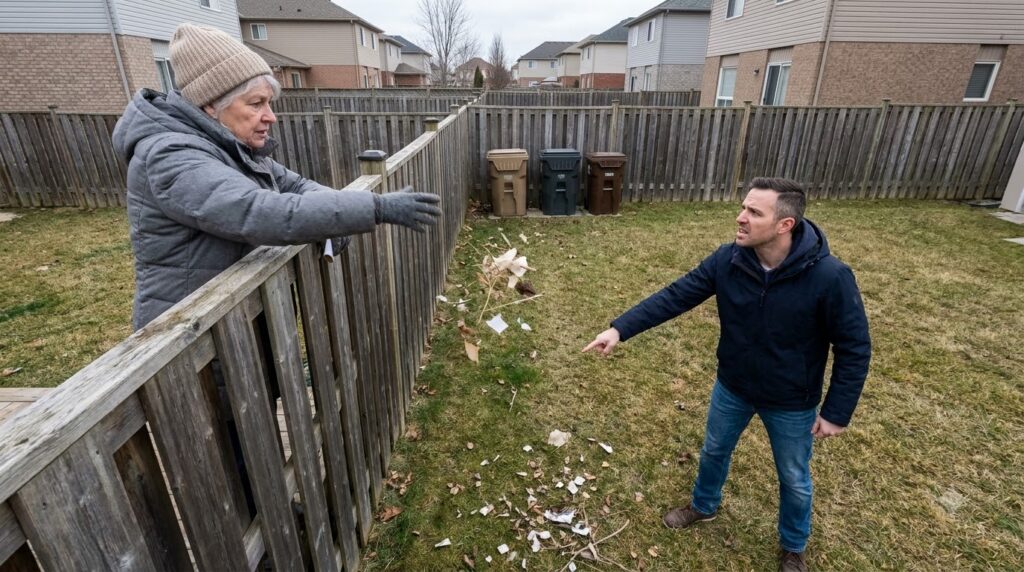
She slammed the linen map flat onto the top rail of the cedar fence, holding it down against the wind with her dark-gloved palms.
“You’re looking at a Code 204 violation on his side of the line,” Evelyn said, staring straight into Miller’s eyes. Her gray hair whipped wild around the edges of her beanie. “My late husband didn’t bury waste. This map proves that the county original boundary line was drawn forty-eight inches east of this cedar fence. Look at the benchmark notes! The land where that hole sits isn’t mine. It isn’t even his. It’s a recorded municipal drainage easement created when the subdivision was platted in 1971.”
Miller hesitated. He leaned over the rail, his gloved thumb tracing the red-ink lines on the linen sheet. “A 1971 county benchmark…”
“He built his fence two feet inside the real boundary line,” Evelyn pressed, her voice rising so the two neighbors watching from across the street could hear every word. “Mark moved the cedar posts three years ago when he bought the place. He buried that box to hide the fact that he built over a county drainage easement. He’s trying to blame my family for a sinkhole his own illegal fence installation created!”
Mark didn’t yell. He didn’t step back. The trap was elegant, designed decades ago by a man who knew how suburban bureaucracies worked: create enough conflicting paper records that the city freezes everything, leaving the incumbent neighbor in functional control while the newcomer pays for legal fees and site surveys.
Mark stepped up to the rail, his body blocking the biting wind. He pulled his tablet from his navy jacket, tapped the screen, and turned the glass toward Inspector Miller.
“That 1971 map shows a benchmark tied to a brass pin on the northwest corner post,” Mark said, his tone as hard and precise as cold steel. “Look at the map’s elevation key, Inspector. Page two, footnote B.”
Miller squinted at the faded cursive on the linen document. “Footnote B… ‘Benchmark reference point tied to iron pin buried eighteen inches below grade.'”
“Now look at this,” Mark said. He swiped his finger across the tablet screen, bringing up a high-definition thermal imaging scan he had run through his roof camera two nights ago when the frost first set in. The screen glowed with blue and violet heat gradients, rendering the soil layers beneath the fence in stark detail. “I ran a ground-penetrating radar pass along the fence line when I installed the camera system. The 1971 county benchmark pin isn’t under the cedar fence. It’s buried four feet inside her garden bed, right under that concrete birdbath.”
Evelyn’s breath caught in her throat. Her gloved hands tightened on the edges of the linen map, crumpling the ancient paper.
“And look at the thermal density under her garden bed,” Mark continued, his voice dropping into a relentless, rhythmic cadence that laid bare every layer of the lie. “The pocket of buried plaster, asphalt shingles, and decaying timbers doesn’t start on my lawn. The plume originates under her shed, runs underneath the fence line, and vents out through that open iron box. She didn’t call code enforcement to report a violation, Inspector. She called you because the sinkhole her husband buried fifty years ago is finally collapsing, and her shed foundation is cracking.”
Miller looked up from the tablet, his eyes shifting from the glowing screen to the dark, decaying hole in the turf, and finally to Evelyn’s face.
The silence that followed was heavy, absolute, and cold.
Evelyn didn’t answer. She didn’t offer another document. Her eyes darted from the inspector to the neighbors on the curb, whose quiet murmuring had suddenly stopped. The ironclad authority she had wielded over the block for forty years—the legacy of maps, handshakes, and fake easements—was crumbling as fast as the rotting timbers buried beneath her feet.
Miller reached down, picked up his grease pencil, and pressed it hard against the laminated yellow notice stuck to the fence. He drew a thick, dark arrow pointing straight toward Evelyn’s side of the property line.
“Ma’am,” Miller said, his voice stripped of all leniency, “I’m expanding this site audit to include your entire back yard. If that sinkhole originates under your outbuildings, you’re looking at a mandatory emergency excavation order from the county.”
Evelyn pulled her hands back from the linen map. The wind caught the ancient paper, folding it back on itself with a dry, hollow rustle. She stood frozen beside the cedar rail, caught between the city’s clipboard and the collapsing earth beneath her own home.








