
CHAPTER 4: STEEL AND FROST AT MIDNIGHT
The heavy steel head of the ten-pound sledgehammer struck the orange-topped iron stake with a dull, subterranean thud that vibrated through the soles of Mark’s boots.
Midnight had flattened the neighborhood into shades of charcoal and frost. The temperature had dropped to twenty-two degrees, locking the top inch of turf into a brittle crust that cracked like glass beneath his weight. Mark swung the hammer again, bringing it down with a short, controlled arc that forced the cold-rolled steel stake another three inches into the frozen mud along the cedar fence line.
Beside his knee rested a heavy canvas tool bag containing three more stakes, a magnetic locator, and a hundred-foot reel of yellow mason’s string.
He didn’t use a flashlight. The pale blue backscatter from the roof-mounted security camera gave him just enough light to trace the property line.
To anyone watching from the dark windows along the alley, it looked like a man driven to obsession by a neighbor dispute. But Mark wasn’t acting on anger. He was establishing a physical, measurable boundary before the ground froze solid until March.
He set the third stake four inches from the corner fence post—right where the ground dipped into the soft, spongy hollow. As the steel tip bit six inches deep into the soil, it didn’t hit clay. It didn’t hit limestone.
It struck hollow iron with a loud, ringing clack.
Mark paused, his hands locked around the rubber grip of the hammer, his breath blooming white in the freezing darkness. The sound wasn’t the dense, solid thud of a natural rock. It was the sharp resonance of a metal container or a buried pipe cap.
He dropped to his knees on the frozen grass, his dark gloves instantly soaking up the ice-cold moisture from the turf. He pulled a short steel trowel from his pocket and scraped back the frost-hardened sod.
Two inches below the grass roots, tucked right beside the official rusted iron survey pin, lay a rectangular iron box lid. It was roughly six inches wide, coated in flaking black enamel, and secured with a heavy, rusted brass padhasp.
Mark wiped the mud off the plate. Stamped directly into the iron face were the same faint block letters he had seen on the brass valve head hours earlier: M. VANCE – PROPERTY & DRAINAGE – 1974.
His fingers went cold—not from the winter air, but from the realization.
Evelyn hadn’t just drawn a fake map on butcher paper. Her husband had buried physical decoy markers all along the lot line fifty years ago. This iron box was the physical anchor of the Layer 1 decoy—the “proof” Evelyn intended to show any city official or surveyor who came digging. If opened or uncovered during a shallow inspection, it would appear to be a legitimate historical utility junction box, seemingly confirming her claim that a two-foot easement belonged to her family.
Mark pulled the rusted skeleton key out of his jacket pocket. The cold iron key, which he had pulled from his camera bracket the night before, fit the padhasp’s keyway with a tight, gritty click.
He turned the key. The rusted tumbler gave way with a sharp snap.
He lifted the iron lid.
Inside the shallow box lay a folded sheet of oilskin paper, stiff and yellowed with age. Mark unfolded it carefully under the dim camera light. It was a formal, typed document bearing a notary seal from 1975—an agreement between M. Vance and the original developer permitting the installation of a “temporary surface overflow drain” across the northern two feet of the lot.
On the surface, it was a bulletproof document. It was the physical reality Evelyn’s entire legal strategy rested on: a documented, notarized easement showing her family had possessed rights to this two-foot strip of land for half a century.
Mark stared at the yellowed paper, his mind calculating every angle. If this document was admitted during a code enforcement inspection, it would force a months-long legal freeze, tying his property up in municipal arbitration and giving Evelyn total control of the fence line.
Then he noticed the bottom corner of the oilskin sheet.
The paper was damp—not with recent groundwater, but with a thick, dark, oily residue that smelled faintly of creosote and rotting wood. He reached down into the iron box beneath where the document had rested.
The bottom of the box wasn’t solid metal. It had no floor. The iron frame was simply a collar set over a deep, dark shaft that plunged far below the shallow two-inch mark.
Mark slid his gloved finger down into the dark gap beside the box. His fingertips didn’t touch clean soil or drainage gravel. They brushed against jagged, crumbling edges of decaying asphalt shingles, crushed tin cans, and soft, rotting wood timber buried deep in the subsoil.
The iron box wasn’t just holding a decoy document. It was acting as a vent cap for a massive, buried layer of illegal construction refuse that spanned the deep subsoil along the entire fence boundary—a hidden hazard that had been slowly settling and causing the yard to sink for decades.
A soft click sounded from the dark side of the cedar fence.
Mark didn’t jump. He stayed on his knees, his trowel held loose in his right hand, his eyes shifting toward the top rail of the fence.
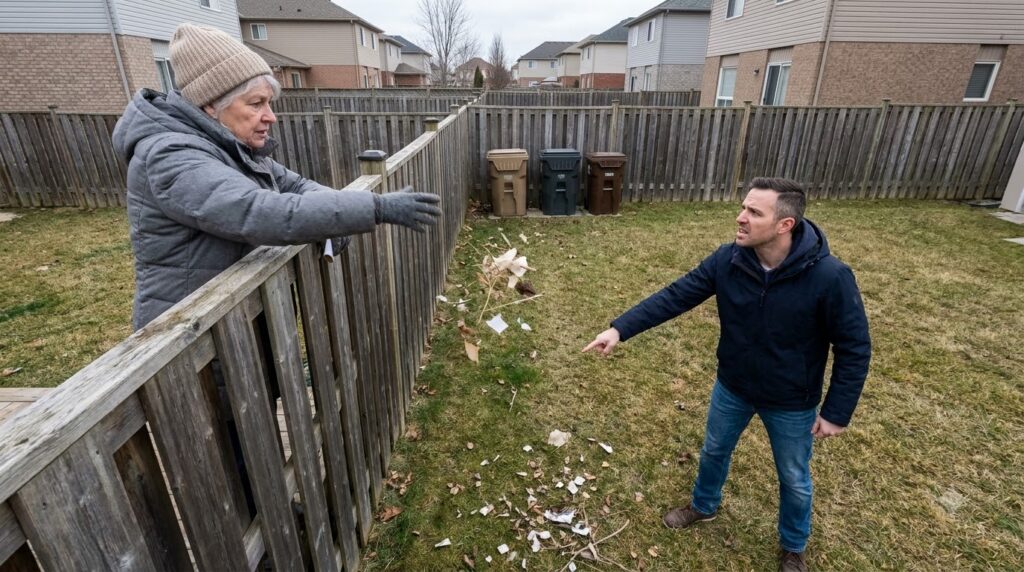
Evelyn was standing on a wooden crate on her side of the boundary, her head and shoulders silhouetted against the cold stars. She didn’t have her beanie on. Her gray hair was wispy in the night wind, her face pale and sharp.
In her hands, she held a dark plastic landline phone receiver connected to a long coiled cord that stretched back into her dark kitchen window.
“I see you digging,” Evelyn whispered, her voice carrying across the frozen yard like dry leaves scraping over concrete. She held the phone receiver up to her ear. “The city officer is already dispatched, Mark. I filed the report twenty minutes ago. Hazardous waste, illegal night excavation, and destruction of a historical utility easement.”
She smiled—a cold, thin expression devoid of warmth or hesitation.
“They’ll be here at seven in the morning,” she added, her gloved finger tapping the plastic receiver. “Bring your surveyor, Mark. Bring your cameras. Let’s see what the city says when they open that box.”
Mark stood up slowly, his boots crunching on the frozen turf. He didn’t close the iron box. He didn’t hide the paper. He stepped over the line of orange stakes he had driven into the earth, his shadow long and dark under the roof light.
“I’ll be waiting for them, Evelyn,” Mark said, his voice completely level. “Make sure you’re outside when they pull the tape.”








