CHAPTER 2: DIGITAL SENTINELS AND BURIED IRON
The monitor’s pale blue glare cut through the dark of the back porch like a scalpel, illuminating the fine layer of winter dust on the plastic housing. Mark leaned against the doorframe, the cold air seeping through his navy jacket, his thumb tracing the seam of the handheld display unit wired directly to the roof-line feed.
On the six-inch screen, the backyard was stripped of color, rendered in high-contrast gray and black.
He didn’t scrub forward to the confrontation he had just lived through. He scrubbed backward.
The digital timeline was a series of thin blue notches spanning fourteen weeks. Mark dragged his thumb across the scrub wheel, watching the high-angle lens replay the slow, silent siege of his property line in six-second bursts.
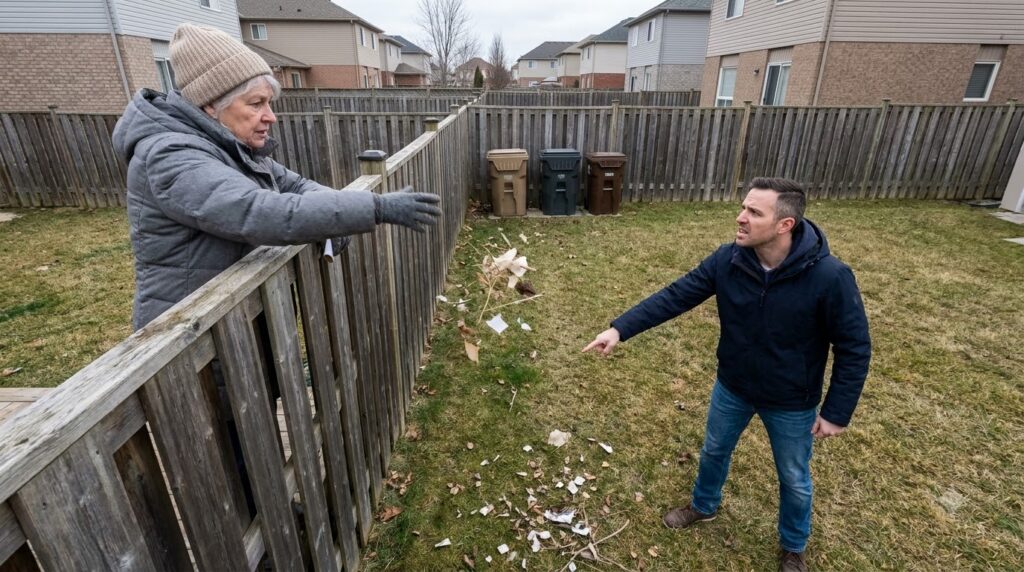
Tuesday, November 12th, 3:14 AM: A shadow in a bulky wool coat steps to the cedar rail. A dark-gloved hand extends. A heavy canvas bag tilts. A dark cascade of crushed brick and sour oak mulch spills across the turf, landing precisely four inches past the fence line.
Friday, December 6th, 11:42 PM: The same silhouette. The same methodical reach over the top rail. This time, a plastic jug of winter lawn acid poured in a deliberate, dripping line parallel to his flower bed.
Sunday, January 19th, 4:05 AM: A heavy, rusted iron bracket dropped straight into the grass near the corner post.
Mark paused the frame. He zoomed in until the pixels broke into jagged squares of gray noise.
Evelyn wasn’t dumping trash out of convenience. The waste was grouped in specific zones, always crowding the exact three-foot radius around the corner fence post where the ground dipped into a shallow, moss-lined depression. She wasn’t trying to clear her own yard; she was trying to weigh down his.
A faint metallic clink sounded high above his head.
Mark froze, the monitor still humming in his palm. He looked up toward the eaves.
The camera housing, mounted to the fascia board with three heavy-duty lag bolts, vibrated slightly in the rising wind. Tucked into the small gap between the steel mounting bracket and the soffit wood was something that hadn’t been there when he mounted the rig three weeks ago: a small, rectangular key, oxidized orange and bound with a loop of cracked yellow twine.
He stepped onto the porch railing, his boot heel digging into the damp wood, and reached up into the dark eaves. His cold fingers brushed the iron. The key was long, flat-bitted, and heavy—an old skeleton key, coated in a sticky film of grease and soot.
It hadn’t fallen from the roof. Someone had reached up from the narrow gap between his garage wall and Evelyn’s overgrown arborvitae hedge and wedged it high into the hardware.
The back porch door creaked as he stepped down, his boots hitting the decking with a hollow thud. He slipped the rusted key into his jacket pocket, the iron burning cold against his hip through the denim.
He turned back to the screen.
On the live feed, across the dark expanse of wet lawn, a light flickered on in Evelyn’s side kitchen window. The yellow beam cut through the dark, reflecting off the damp cedar pickets of the privacy fence. A hand pulled the lace curtain back an inch.
Mark didn’t look at the window directly. He kept his eyes locked on the monitor, watching her watch him through the digital eye mounted high on his roof.
She had seen him reach into the eaves.
On the screen, her silhouette shifted. She didn’t drop the curtain. Instead, her hand rose, her gloved index finger pressing flat against the glass, pointing straight at the ground beneath his corner fence post—the exact spot where the rusted survey pin lay buried under the damp, shifting soil.
Mark closed the monitor’s plastic flip-lid with a sharp snap. He stepped off the porch and walked back toward the fence, his boots sinking into the dark, wet earth. He didn’t stop until his toe caps brushed the pale debris she had dropped hours before.
He bent down, picked up a heavy chunk of the thrown drywall, and felt its weight. It wasn’t modern gypsum board. It was thick, horsehair plaster backed by cedar lath—the kind of wall torn out of a house built in 1950.
Evelyn hadn’t remodeled her home in thirty years. This wasn’t waste from her house. It was old structure, dug up from somewhere else, delivered to his turf one handful at a time.
He gripped the plaster until it crumbled into white dust between his fingers, falling onto the dark grass right beside the hidden iron pin.