CHAPTER 3: THE DRIVEWAY AMBUSH AND LEGACY LORE
The diesel clatter of a heavy delivery truck rattled the cold morning air, its exhaust hanging in gray, fuel-heavy ribbons over the damp asphalt. Mark stepped off his porch with a thermos in one hand and a steel clipboard in the other, his boots crunching over the crushed limestone skirt of his driveway.
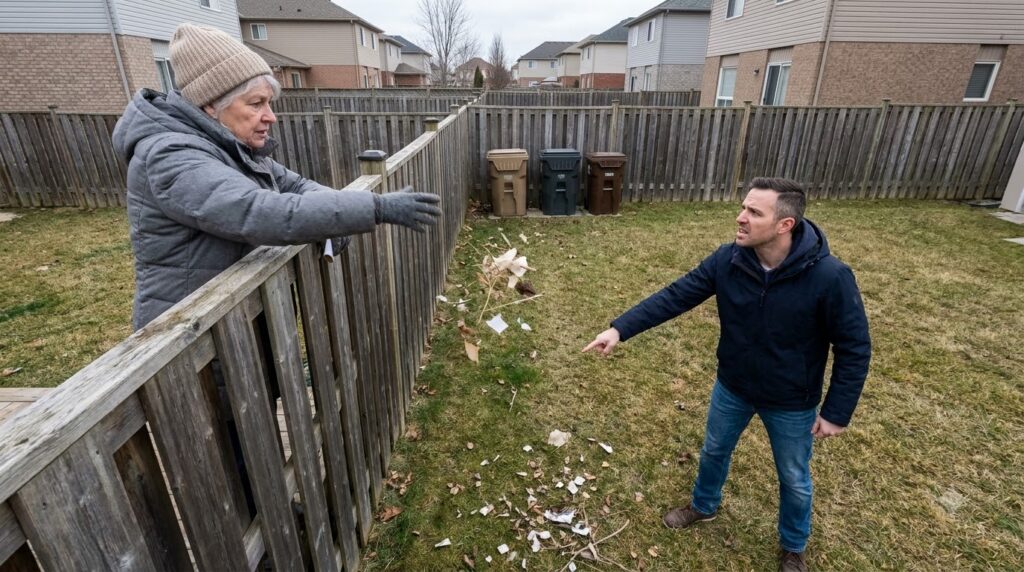
A flatbed contractor truck had pulled up along the curb, its air brakes hissing loudly. In the driver’s lane stood Evelyn, her oversized gray wool coat buttoned to her throat, her beige beanie pulled down so low her eyebrows were hidden. She held a rolled cylinder of heavy butcher paper under her arm like a weapon, her dark-gloved hand resting on the tailgate of the idling flatbed.
Beside her, a young driver in an orange hi-vis vest stood holding a clipboard, looking thoroughly exhausted before eight in the morning.
“You can’t dump the gravel on the easement,” Mark said, his voice cutting through the rumble of the diesel engine. He didn’t slow his stride until he reached the property line where his gravel met Evelyn’s cracked concrete driveway. “The utility easement runs six feet back from the curb. Leave the load on her side of the apron, or take it back.”
The driver looked between them, adjusting his mesh cap. “Look, man, the lady said this driveway was shared up to the fence post—”
“It isn’t,” Mark said flatly. He didn’t look at the driver. He looked straight at Evelyn. “The property line was surveyed three years ago when I bought the parcel. My lot extends eighteen inches past the gravel edge.”
Evelyn didn’t flinch. She took one deliberate step toward him, her boot heels dragging across the wet pavement with a harsh, grating sound. She unrolled the butcher paper with a sharp snap of her wrists, revealing a faded blue-and-black grid drawing drawn in thick India ink.
“Three years ago means nothing in this township,” Evelyn said, her voice raspy, laced with a cold, unyielding conviction that had spent decades hardening. She slammed her gloved palm against the center of the paper, pinning it against the hood of his parked truck. “My husband laid the drainage tile under this drive in 1974. My father built the original cedar fence two feet inside our boundary line as a courtesy to the city so the snowplows wouldn’t tear it down. You think a little piece of paper from a title company changes fifty years of physical occupation?”
Mark leaned down, his eyes scanning the faded blue lines. The ink was old, feathered at the edges where moisture had seeped into the paper. It showed a rough hand-drawn map of the two parcels, complete with measurements written in cursive pencil. But right along the boundary line separating their lots, a section of the cedar fence had been drawn in red ink with a bold annotation: Temporary Fence Line – 2ft Encroachment Allowed for Runoff Control.
It was a classic decoy map—a piece of informal neighborhood lore crafted by former owners to justify informal arrangements.
“This isn’t an official recorded plat,” Mark said, his fingers tracing the cold metal edge of his clipboard. “This is a hand-drawn sketch without a surveyor’s stamp or a county register seal. It holds zero legal weight.”
“My family built this block,” Evelyn snapped, stepping closer until her breath puffed white in the space between their faces. Her gloved finger jabbed into his chest, hard enough to feel through the layers of his navy jacket. “Before your house was framed, this whole section was a orchard owned by my uncle. You come in here with your cameras, your concrete borders, and your city attitude, thinking you can erase the way things have been run for half a century? That fence sits two feet on my land, Mark. Every blade of grass you’ve been mowing along that cedar line belongs to me.”
Mark didn’t push her hand away. He stood perfectly still, letting the cold wind whip the gray diesel fumes between them.
“If that fence is on your land,” Mark said softly, his voice dropping into a lethal, quiet register, “then why did you put a skeleton key in my roof camera bracket last night? Why are you trying to dig up the corner post?”
Evelyn’s jaw twitched. For a fraction of a second, the iron certainty in her eyes wavered, replaced by a sharp, darting anxiety that flickered toward the back corner of his yard before she smothered it with anger.
“I don’t know what garbage you’re talking about,” she said, her voice tightening as she rolled the butcher paper back into a tight cylinder. “You’re operating out of bounds. You think you’re protecting your home, but you’re standing on borrowed dirt. Ask the township about the 1974 drainage easement before you talk to me about property lines.”
She turned on her heel and motioned sharply to the flatbed driver. “Dump the gravel on my side. Right against his border.”
As the driver engaged the hydraulic lift, the truck’s bed tilted, spilling a heavy cascade of angular gray limestone onto Evelyn’s driveway. The stone hit the concrete with a deafening roar, dust rising in a choking cloud.
When the dust cleared, Mark noticed a dark, heavy object that had been displaced by the weight of the fresh gravel at the edge of the lawn. Half-buried in the mud near the property marker was a heavy brass valve head, green with age and stamped with deep block letters: M. VANCE – 1974.
Mark reached down, his dark gloves sinking into the wet mud, and pried the heavy brass fitting out of the earth. It wasn’t connected to a water pipe. It was a blank, heavy shut-off valve that had been driven into the ground like a stake—a fake landmark designed to mimic a utility marker.
He slipped the heavy brass fitting into his coat pocket alongside the rusted skeleton key. The weight in his jacket pulled heavily to the left, a cold, metallic reminder that every piece of history Evelyn claimed to protect was built on a calculated fabrication.