
CHAPTER 5: THE MUNICIPAL SUMMONS
The yellow strobe of the city utility truck flashed against the frosted windows of Mark’s kitchen at precisely 6:58 AM.
Mark didn’t wait for the doorbell. He pulled on his dark work boots, grabbed his tablet containing the roof-camera archives, and stepped out onto the porch. The morning air was thin, brutal, and smelled of cold diesel and wet asphalt.
A municipal sedan marked CITY OF OAK RIDGE – CODE ENFORCEMENT & ZONING sat idling at the curb behind the truck. Stepping out from the driver’s side was a man in his late forties, wearing a navy municipal parka over a high-visibility lime vest. In his right hand, he held a heavy aluminum clipboard clamped with a thick stack of printed complaints; hanging from his belt was an industrial digital tape measure and a brass soil probe.
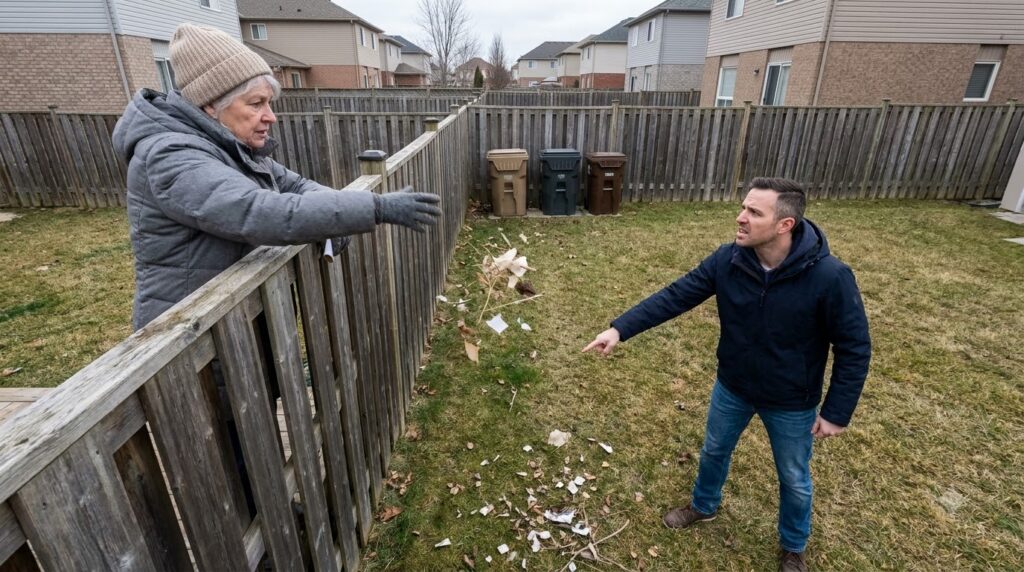
Evelyn was already standing at the head of her driveway, wrapped tight in her gray wool coat, her beanie pulled low, her dark-gloved hands folded across her chest like a shield. Beside her stood two neighbors from across the street, their hands stuffed into their pockets, watching the scene unfold with quiet, speculative curiosity.
“Mark Vance?” the inspector asked, his voice flat, professional, and worn smooth by hundreds of petty neighborhood wars. He checked the top sheet on his clipboard. “I’m Inspector Miller, City Code Enforcement. I have a priority complaint logged for illegal excavation, unpermitted dumping, and obstruction of a recorded utility easement.”
“Mark Miller,” Mark corrected calmly, his voice steady in the crisp dawn air. “I’m Mark Miller. The home is mine. And there is no unpermitted excavation.”
“He dug up the drainage box at midnight!” Evelyn interjected sharply, her raspy voice cutting across the driveway. She stepped forward, pointing an accusatory gloved finger past the inspector’s shoulder toward the rear fence line. “He spent three hours hammering steel rods into the easement line! He’s trying to destroy the 1974 drainage bypass my late husband installed!”
Inspector Miller held up a hand, curbing her escalation without looking at her. He turned his gaze back to Mark, his eyes cool and analytical. “Mind if we walk the line?”
“Lead the way,” Mark said, stepping down from the porch.
The three of them walked in silence along the narrow gravel strip separating the houses. The frozen grass crunched under their boots. When they reached the rear corner, the scene lay bare in the pale gray morning light: the four orange-topped steel stakes driven straight along the cedar fence line, the yellow mason’s string pulled taut between them, and the open iron box sitting flush with the turf.
Inspector Miller stopped. He knelt beside the iron box, his lime vest creasing over his knees. He pulled a heavy steel stylus from his pocket and tapped the iron collar.
“This is the 1974 Vance junction cover,” Miller observed, his tone noncommittal. He reached into the box, picked up the folded oilskin document Mark had left inside, and unfolded it. He scanned the notarized agreement, his brow furrowing as he read the faded typescript. “This is a recorded 1975 temporary easement allowance. Under Municipal Code 114-B, if a historical drainage line is physically present and documented prior to 1980, the city recognizes a two-foot implied public buffer.”
Evelyn’s chin rose higher. A thin, vindictive smile touched the corner of her mouth as she looked at Mark. “I told you,” she muttered under her breath. “You don’t own that two feet.”
Mark didn’t blink. “Read paragraph three of that document, Inspector.”
Miller flipped the page, his eyes narrowing as he read the fine print at the bottom. “Paragraph three states the easement is valid only so long as the underlying corrugated steel pipe remains structurally sound and uncompromised by foreign fill.”
Miller set his clipboard on the frozen grass. He unclipped his brass soil probe—a four-foot steel rod with a T-handle—and aligned it directly inside the open iron box. He pressed down with his full body weight.
The probe didn’t hit a solid steel pipe. It didn’t hit drainage gravel.
With a sickening, hollow crunch, the steel probe drove straight down four feet into the earth without encountering a single inch of resistance. The ground beneath the iron box gave way, swallowing the probe up to its handles. A faint, foul puff of stale air—smelling of damp rot, disintegrating shingles, and decaying wood—poured out of the hole.
Miller’s face changed instantly. The casual indifference of a bureaucrat doing morning rounds vanished, replaced by the sharp focus of a safety official spotting an immediate structural hazard.
“This isn’t a working drainage pipe,” Miller said softly, pulling the probe back out. The steel tip came up covered in black, oily sludge and flakes of rotting asphalt roofing felt. “The pipe collapsed decades ago. This entire corner isn’t an easement—it’s an uncompacted, illegal sinkhole filled with buried construction debris.”
Evelyn froze. Her gloves twitched at her sides, her pale face suddenly losing its composure. “That’s… that’s just settlement from the storm drain—”
“No, ma’am,” Miller interrupted, standing up and pulling a bright laminated yellow slip from his clipboard folder. “This is a Code 204 violation—unlawful burial of hazardous structural waste on residential property. And because it sits directly on the boundary line, both parcels are subject to an immediate municipal hold until the origin of the fill is established.”
Miller slapped the yellow STOP WORK & SITE AUDIT citation onto the top rail of the cedar fence, right above the open box.
Mark looked from the yellow citation to Evelyn. The decoy secret—the 1974 easement she had used as a shield for years—had just been blown wide open by the city itself. But as he looked down into the dark hole left by the inspector’s probe, he realized the trap had sprung on both of them: until the city determined who buried the waste under the fence, neither of them could touch the land, and the whole property line was locked in a legal stranglehold.








