
CHAPTER 7: EXCAVATION AND THE BURIED PIN
The flat edge of Mark’s steel spade sliced into the frozen turf with a sharp, metallic ring that cut through the idling rumble of Inspector Miller’s municipal truck.
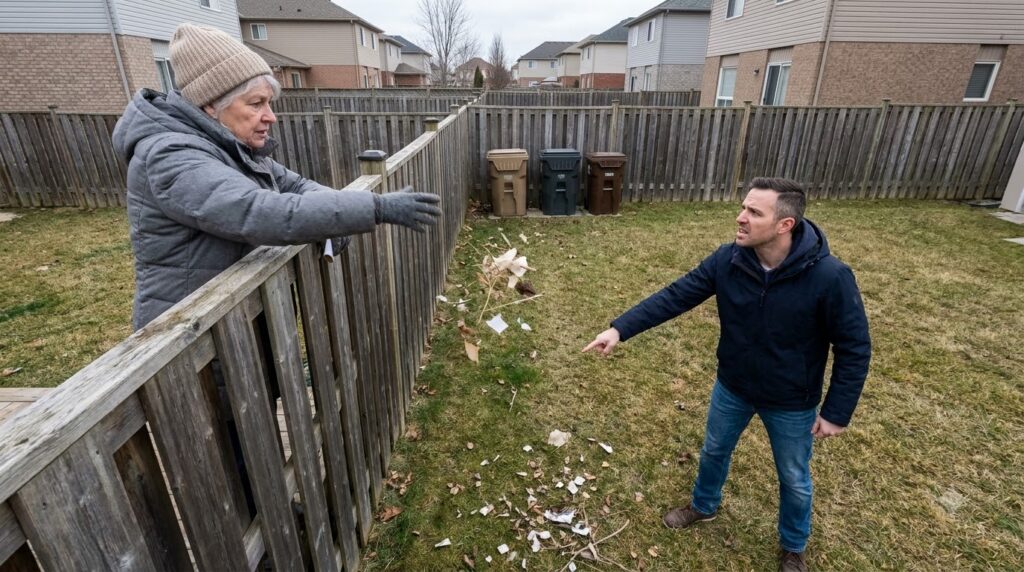
Morning had turned the sky into a sheet of cold lead. Three more neighbors had gathered near the curb, their hands shoved deep into heavy coats, watching in total silence as the municipal audit expanded across the lot line.
Inspector Miller stood at the corner post with a heavy brass magnetic locator in hand. The unit hummed, its needle vibrating violently as he swept the sensor head across the narrow trench Mark was clearing along the cedar line.
“Hold right there,” Miller commanded, tapping the toe of his steel-toed boot against the damp, overturned soil. “The magnetic signal is spiking at sixteen inches depth. It’s solid ferrous iron.”
Evelyn didn’t move from her porch steps. She stood wrapped in her gray wool coat, her hands clutching her elbows, her face pale as salt. Her gaze remained fixed on the corner fence post, where the open iron box sat like a black scar in the grass.
Mark drove the spade down two inches deeper, turning over a heavy wedge of dark, silt-heavy earth. The shovel blade struck hard metal with a high-pitched ping.
He dropped to one knee, his navy jacket cold against his thighs, his gloved fingers digging into the wet mud surrounding the strike point. He cleared away a handful of wet gravel, scraping back decades of compressed dirt and rotting pine needles.
Four inches beneath the floor of the decoy iron box—completely separate from the fake 1974 drainage collar—sat the authentic, undisturbed boundary pin. It was a three-quarter-inch solid iron rod, topped with a heavy oxidized orange surveyor’s cap stamped with crisp, indented block numbers: COUNTY BOUNDARY PIN – SEC 14 – OFFICIAL REGISTRATION #4821.
Mark wiped the mud off the cap with his thumb, exposing the bright orange epoxy seal preserved beneath the silt.
“There it is,” Mark said, his voice flat and unyielding. He didn’t look up at Evelyn. He looked at Miller. “The primary county survey pin. Exactly where the deed says it should be.”
Miller knelt beside him, bringing the tip of his steel tape measure down to the center of the orange cap. He locked the tape, pulled it straight across to the cedar fence, and took a precise reading.
“Zero offset,” Miller declared, his voice carrying clearly across the backyard to the onlookers at the curb. “The cedar fence sits precisely on the legal boundary line. Mark’s fence is one hundred percent compliant with municipal code.”
Miller stood up, pulled his metal clipboard from under his arm, and turned his full attention toward the sunken section of turf on Evelyn’s side of the line.
“Now let’s talk about the subsoil,” Miller said, his boots crunching over the frozen turf as he crossed the boundary line into Evelyn’s yard. He stopped right beside her garden bed, where the ground sloped visibly toward her cracking shed foundation. “The ground-penetrating radar scan Mark provided matches the physical void. This depression isn’t natural settlement. Fifty years ago, someone dumped an entire load of unpermitted demolition debris—plaster, roofing felt, and scrap timber—into this drainage swale and covered it with topsoil to avoid haul-away fees.”
The neighbors on the curb leaned in, exchange murmured whispers. The legend of the Vance family’s “historical block management” was unraveling into a cheap, illegal dumping scheme that had finally caught up with her.
Evelyn’s lips trembled. She took one step down off her porch, her eyes wide, staring at the bright orange cap gleaming in the mud at Mark’s feet.
“My husband… he said it was fine,” she whispered, her raspy voice breaking for the first time. “He said the county didn’t care about what was under the grass back then…”
“The county cares now, ma’am,” Miller replied coldly, tapping his pen against his clipboard. “The decaying material has created an active structural hazard that threatens both properties. Under Municipal Code 204, the legal responsibility for full site remediation falls entirely on the property where the fill originated.”
Miller began writing rapidly on a fresh carbon-copy form, the press of his pen making a sharp scratching noise in the quiet morning air.
Mark stood up from the trench, his boots planted firmly on his side of the orange survey pin. He held his spade loosely in his right hand, the cold steel head resting on the damp turf he had defended step by step. The decoy map, the fake valve, the skeleton key, and the years of entitled overreach had all collapsed under the weight of three inches of solid iron and cold, unvarnished proof.








