
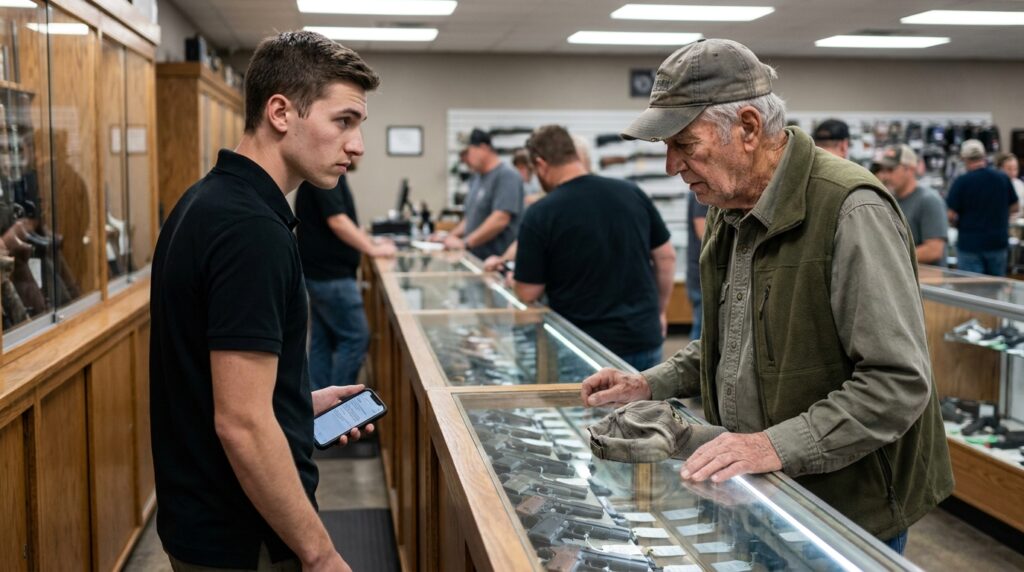
CHAPTER 5: THE COLD IRON RECKONING
The final step onto the front porch boards produced a dull, hollow groan from the dry-rotted cedar. Arthur stood in the complete dark, his left arm locked tightly over his fractured ribs, his breath a ragged, shallow wheeze that froze into tiny white plumes in the midnight air. The valley had gone entirely black. The power lines down the ridge had been cut cleanly, leaving his small house stranded like a concrete bunker in a dead sea.
He did not open the screen door. He didn’t need to.
A single spark fractured the darkness on the far side of the porch, followed by the oily, familiar smell of lighter fluid. The small yellow flame of a Zippo illuminated Garrett’s face from below, casting long, monstrous shadows up into the flaking paint of the porch overhang. The youth sat in Arthur’s old wicker chair, the bolt-action military rifle resting across his knees, its steel barrel catching a dull, yellow reflection.
“You’re late, Major,” Garrett said softly. He snapped the lighter shut, plunging the porch back into the cold grip of the moonlight. “I thought a military man lived by the clock.”
Arthur didn’t shift his weight. He kept his boots firmly planted on the gravel-dust surface of the boards. His right hand remained inside his vest pocket, fingers wrapped completely around the cold, textured slide of the service automatic, his thumb holding the safety down.
“A man walks slower when he’s carrying the dead, son,” Arthur said, his rasping voice steady, cutting through the mountain wind like an ungreased saw. “Your father didn’t go to prison for missing rifles, Garrett. You’ve spent your whole life feeding on a lie.”
The shadow in the wicker chair didn’t move for several seconds. Then, the wood creaked violently as Garrett leaned forward, his face emerging into the pale, blue illumination of the moon. His jaw was white, the skin stretched so tight over the bone it looked ready to tear.
“Don’t try to rewrite the ledger now,” Garrett hissed, his fingers tightening on the stock of the rifle until the wood groaned. “I found the report in the county archive. Your signature was on the discharge order. Your logbook entry sealed the cell door. He died with five dollars in his pocket and a throat full of dust because you needed the books to balance.”
“The books didn’t balance,” Arthur said. He slowly withdrew his left hand from his chest, ignoring the sharp, white-hot scream of his ribs, and pulled the brittle blueprint fragment from his pocket. He didn’t hand it over; he let the wind rustle its edges between them. “Look at the stamp on the upper quadrant. That wasn’t an arms storage facility. It was a disposal trench for chemical ordnance from the late seventies. The inventory your father tried to report wasn’t rifles. It was fifty tons of leaking toxic sulfur mustard that the department buried without a record.”
Garrett stood up, the rifle lifting an inch, the muzzle pointing directly at Arthur’s sternum. “You’re lying. You’re just trying to preserve your clean little legacy before I tear it down.”
“I was the presiding officer because I ordered him to stay silent,” Arthur said, his voice dropping into an absolute, chilling calm that carried the weight of thirty years of solitary guilt. “He refused. He wanted to blow the whistle to the state EPA because his friends were getting sick in the valley. If I hadn’t court-martialed him on a falsified inventory charge and hidden him away in a federal facility, they would have put him in a hole under the concrete three decades ago. I didn’t destroy his life to balance the books, boy. I broke his name to keep him breathing.”
The wind surged through the yard, rattling the dead branches of the elm tree with a sound like dry bones striking together.
Garrett’s posture shattered. The rigid, aggressive bravado he had worn like a shield since the gun store confrontation began to give way, his shoulders dropping as the structural logic of his entire life’s hatred evaporated into the cold air. The rifle muzzle wavered, dipping toward the floorboards.
“No,” Garrett whispered, his voice cracking, revealing the hollow, terrified boy underneath the tactical posturing. “No, he wouldn’t… he told me it was the old guard. He told me it was you.”
“He told you what he had to so you wouldn’t go digging in the dirt,” Arthur said, taking a slow, painful step forward, his boots crunching on the loose grit of the porch. “But you dug anyway. And now the gate is open.”
From down the ridge, the sudden, low rumble of two heavy diesel engines broke the silence of the valley. Headlights—harsh, high-intensity halogen beams—swept up through the timber road, cutting through the oaks and painting the front of Arthur’s house in a flat, blinding white glare. These weren’t local vehicles. They moved with a synchronized, disciplined velocity that Arthur recognized instantly.
The decoy secret was dead. The real alignment had arrived, and they had followed the boy’s tracking operation straight to the perimeter.
Arthur pulled his right hand from his pocket, the heavy steel automatic now visible in the white glare of the approaching lights. He didn’t point it at Garrett. He reached out and grabbed the front of the boy’s canvas jacket, his calloused fingers locking into the fabric with an iron grip that belied his age.
“Listen to me, son,” Arthur growled, his face inches from Garrett’s in the blinding light. “They aren’t here to protect my legacy. They’re here to clean the slate. If you want to fight for your father’s name, the posturing is over. Grab your bolts, get behind the kitchen counter, and don’t look at the light.”
The tires of the lead vehicle crunched into the gravel lot, the engines idling with a heavy, metallic throb that shook the old cedar porch. The final truth was unlocked, but the cost of the receipt was about to be collected in full.








