
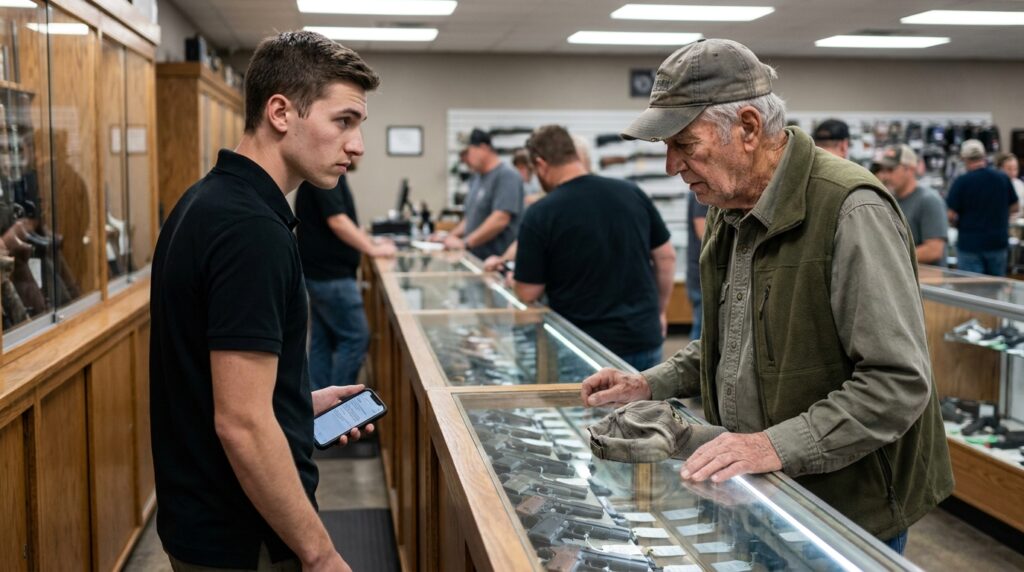
CHAPTER 2: THE AMBUSH OF THE SHADOWS
The gravel road leading up to Arthur’s homestead was a rib-ribbon of white limestone, chewed by decades of dry frost and the heavy treads of old farm machinery. It didn’t invite visitors. The dust kicked up by his truck settled slowly in the dead evening air, coating the wild blackberry briars along the ditch in a fine, chalky powder.
Arthur kept his eyes on the rearview mirror. The medical center receipt lay on the passenger seat, its crisp white edges stark against the cracked, sun-bleached vinyl. The name scrawled on the back—Garrett Vance—was a name he didn’t know, but the handwriting was aggressive, jagged, slanting hard across the paper like a wire fence cut in a hurry.
He parked beneath the skeletal branches of the dead elm near the tool shed. When he killed the engine, the sudden silence of the valley was absolute, save for the ticking of the cooling manifold. He didn’t get out right away. He sat in the cab, his calloused palms resting on the steering wheel, feeling the subtle vibration of the old truck as it settled into the dirt.
Through the windshield, his small, single-story house looked smaller than it used to. The green paint was flaking in long, brittle curls, exposing the gray cedar beneath. It was an old structure, held together by iron nails that had turned to rust inside the wood, stubborn but decaying.
His eyes scanned the tree line at the western edge of his property, where the timber thickened into second-growth oak and pine.
There. A quarter-mile down where the county blacktop met the gravel lane, a shape sat beneath the overhang of the brush. It was a black sedan, its low profile completely out of place against the rough dirt shoulders. No lights were on. The windshield reflected the desaturated orange of the dying sun, a flat, blind glare that gave no hint of who was sitting behind the wheel.
Arthur’s hand moved back to his vest pocket, his thumb tracking the knurled cap of the brass oiler bottle. The metal was warm now, heated by his own skin.
“Still posturing,” he murmured to the empty cab.
He climbed down from the truck, his left knee popping with a dry, internal friction that made him catch his breath. He didn’t look back at the black car. Instead, he walked with a deliberate, unhurried stride toward the side door of his house, his boots crunching rhythmically in the stones. Every step was an exercise in suppressed pain, a reminder that the frame holding him up was reaching its fatigue limit.
Inside, the kitchen smelled of cold chicory coffee and old wool. He didn’t turn on the overhead light. The room was drowning in gray dusk, the shadows stretching from the corners like grease stains. He walked to the window beside the sink, careful to stay two feet back from the glass, out of the direct line of sight from the road.
He reached up to the top of the refrigerator, his fingers searching behind a stack of dusty manuals until they found the cold, heavy steel of his old service automatic. It wasn’t a modern polymer weapon like the ones in the retail shop. It was an old frame, heavy, its bluing worn down to bare, silver metal along the slide from years of friction against canvas holsters. He dropped the magazine into his palm. The brass casings of the cartridges gleamed dull in the twilight, heavy and certain.
He didn’t chamber a round. He simply slid the magazine back into the well until it clicked with a solid, mechanical finality.
Outside, the black sedan had moved.
It wasn’t speeding. It was creeping up the gravel lane, its tires turning over the stones with a slow, grinding crunch that sounded like teeth on bone. The headlights remained off. It rolled past the dead elm, its dark shape sliding through the gloom until it stopped twenty yards from Arthur’s front porch.
Through the dirty glass of the kitchen window, Arthur watched the driver’s side door swing open.
The youth from the gun shop stepped out into the dry dirt. In the fading light, his black polo shirt made him look like a shadow with a face. He didn’t have a weapon drawn, but his hands were tucked into his pockets, his elbows flared out in that same aggressive, competitive stance. He stood there for a long moment, looking at the silent house, his head tilting as if he were listening for the old man’s pulse through the walls.
Arthur didn’t move. He stood in the dark kitchen, the weight of the steel pistol balanced in his right hand, his breathing slow and shallow. The boy was hunting, but he didn’t know the terrain. He didn’t know that the porch boards were dry-rotted near the steps, or that the gravel gave away every shift in weight.
The young man took three steps toward the porch, his boots kicking up small puffs of dust that hung in the air. Then, he stopped. His eyes drifted to the bed of Arthur’s old truck.
He didn’t approach the house further. Instead, he walked over to the rear wheel well of the pickup, ducked his head down, and reached his hand up into the dark space above the tire framework. It was a quick, familiar gesture, the movement of someone checking a snare.
Arthur watched, his brow furrowing as a new calculation entered his mind. The boy wasn’t looking for a fight tonight; he was checking something else. He was confirming a perimeter.
The youth pulled his hand back, tapped the side of the truck bed twice with his knuckles—a hollow, mocking metallic sound that echoed through the quiet yard—and then turned on his heel. He climbed back into the sedan, the engine catching with a low, muffled rumble, and backed down the gravel lane without ever turning his lights on.
Arthur waited until the sound of the tires had completely died away into the main road before he moved.
He walked out onto the porch, the screen door whining on its rusted spring. The air had turned cold, smelling of iron and damp earth. He walked straight to the rear tire of his truck, knelt down on the gravel—his joints protesting fiercely—and reached his hand up into the greasy cavity above the leaf springs.
His fingers brushed against something small, rectangular, and cold. It didn’t belong to the truck. It was held fast against the frame by a heavy magnet, its tiny housing encasing a solid, red light that blinked once every five seconds.
A tracker.
Arthur pulled it free, the magnet releasing with a sharp clack. As he held it up to the faint light of the moon, he noticed a small piece of faded white tape stuck to the side of the plastic casing. Written on it in the same jagged, frantic handwriting as the medical receipt was a single word: FOUND.
He turned the device over in his hand, the small red light casting a momentary, bloody glare across his old, scarred knuckles. The boy hadn’t just followed him home by chance. He had been monitoring every stop, every turn, every mile Arthur had driven for weeks.
The realization didn’t make his hand shake, but the brass oiler bottle in his pocket suddenly felt three times heavier. The boy wasn’t just an undisciplined provocateur from a retail store. He was executing a method, and Arthur was already inside the trap.








