
CHAPTER 3: THE FRICTION OF THE RECKONING
The magnetic tracker felt like a cold stone in Arthur’s palm as he drove into town the next morning. He didn’t leave it under the truck frame, nor did he smash it. It sat on the dashboard, its small red eye pulsing rhythmically against the grease-filmed glass of the windshield. If the boy was watching his screen, he would see Arthur moving at his usual, unhurried pace toward the center of the valley—a predictable old machine running on a predictable schedule.
The county hardware and agricultural supplier was housed in a cavernous, corrugated iron warehouse at the edge of the rail line. The exterior sheets of metal had turned a deep, textured orange from decades of rain, the rust flaking off in brittle scales that collected in the gravel below. Inside, the air was cold, thick with the dry, powdery smell of crushed grain, commercial fertilizers, and the heavy oil used to preserve bulk logging chains.
Arthur let the heavy wooden entry door slam shut behind him, the rusted spring groaning loudly before settling into its socket. He carried a worn burlap sack under his arm, his fingers tightly laced around the neck.
He didn’t look for the boy, but he knew the black sedan was already in the lot, parked near the propane tank refill station where the shadow of the building was deepest.
He walked down the third aisle—the heavy hardware section—where the shelves were stacked with iron bolts, massive zinc hinges, and oxidized steel cables. The floorboards beneath his boots were thick oak planks, saturated with fifty years of spilled hydraulic fluid until they were near-black. The ambient sound of the warehouse was low: the distant hum of a forklift out back, the click-clack of an old ceiling fan turning lazily in the high rafters.
A shadow fell across the row of zinc wash-basins three feet ahead.
Arthur stopped. He reached out, his hand grasping a massive, six-inch iron hinge from a bin. The surface of the iron was rough, cold, unpolished. He turned it over, testing its weight, listening to the dry scrape of his thick skin against the metal.
“You’re a long way from the retirement home, old man,” a voice murmured from behind the shelf.
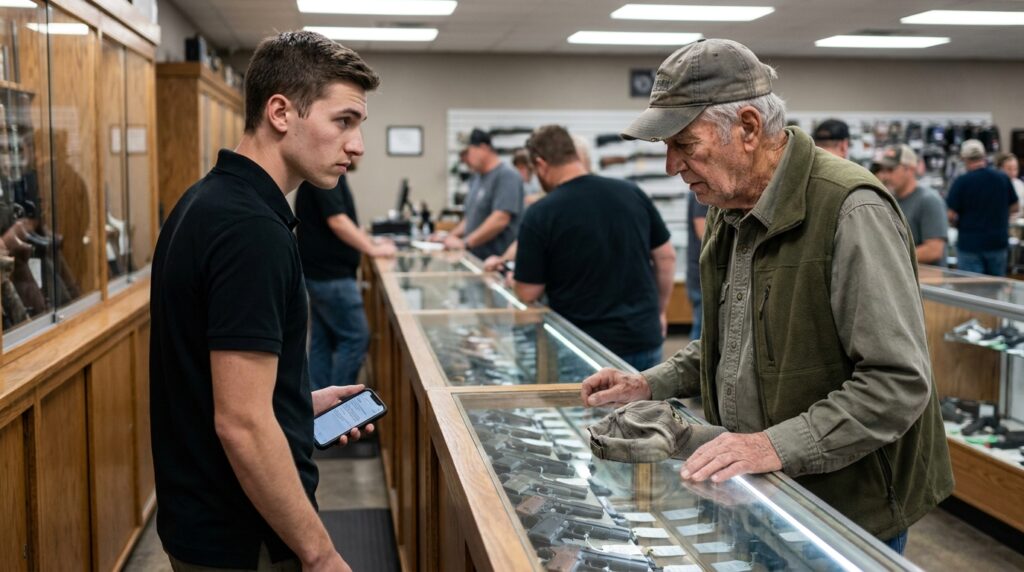
Garrett Vance stepped into the aisle from the intersecting row of fencing supplies. He wasn’t wearing his shop uniform today. He wore a faded canvas work jacket, but his hands were still buried deep in his pockets, his shoulders hunched forward like a young wolf tracking an aging buck through the brush. His eyes didn’t look at Arthur’s face; they dropped instantly to the veteran’s waist, scanning for the shape of the service automatic.
Arthur didn’t pull the gun. He kept his hands open, the heavy iron hinge resting flat across his palm.
“A man my age has a lot of projects to finish before the ground thaws, son,” Arthur said softly. The rasp in his chest felt dry, like sandpaper over old oak. “Some things require heavy hardware. Some things just require patience.”
Garrett let out a short, dry laugh that had no humor in it. He stepped closer, his boots kicking an unboxed iron bolt across the floor planks. The metallic skitter echoed down the narrow aisle. “Patience is just what people call it when they’re too tired to move. My old man had patience. Look where it got him. Left out in the dirt while the people who broke him kept walking.”
The subtext was a jagged, heavy thing between them, filling the space like carbon monoxide. Arthur observed the boy’s hands—the slight tremor in the fabric of his jacket pockets, the way his weight shifted constantly from heel to toe. Garrett wasn’t just posturing anymore; there was a desperate, focused venom in his eyes, an old grievance that had been kept cold for too long.
“Your father made his choices,” Arthur said, his voice dropping into a flat, level register that carried no emotion. It was a tactical guess, a probe into the dark space of the boy’s motivation. “Every man has to sign the receipt for what he buys.”
Garrett’s jaw tightened so hard the muscle beneath his ear throbbed. He took a full step forward, his chest nearly clearing the width of the display rack. “He didn’t buy what you gave him. You think because you’ve got a uniform in your closet and a patch on your vest that you get to decide who stays whole and who gets broken? You’re just an old relic holding onto a world that doesn’t want you.”
“Maybe,” Arthur replied, his thumb tracing the rough, unground weld on the iron hinge. “But a relic can still blunt an unpolished edge. Remember that.”
A clerk’s boots crunched on the gravel-strewn concrete at the front of the store, breaking the tight circuit of their standoff. Garrett didn’t back down immediately. He leaned in, his voice a sharp, whispered hiss that barely carried past the shelf of iron bolts.
“Check your truck again, Arthur. Make sure everything’s where you left it.”
The youth turned on his heel, his canvas jacket brushing against a row of hanging logging chains with a harsh, metallic rattle that lingered in the aisle long after his shadow disappeared through the rear exit.
Arthur stood alone for a minute, the iron hinge still heavy in his palm. He didn’t follow the boy outside. Instead, he walked toward the back wall of the warehouse, where an array of old, abandoned employee lockers sat against the corrugated siding, half-buried under surplus tarps.
One of the lockers—an old, olive-drab unit with a rusted latch—had been forced open recently. The paint around the lock was fresh-scratched, the bright silver steel showing through the dark green oxide.
Arthur reached out, his calloused fingers pulling the heavy metal door back. The hinges shrieked in protest. Inside, sitting on the top shelf amidst the mouse droppings and old oil rags, was a singular item that didn’t belong to the hardware store’s inventory.
It was a faded, grease-caked fragment of an old military blueprint—a schematic for a regional munitions storage facility that had been decommissioned back in the late nineties. Across the top corner, a bold, purple ink stamp had been struck through with two heavy lines, but the signature beneath the cancellation was still legible.
It was Arthur’s own signature from thirty years ago, when he still carried the rank of Major.
He pulled the paper free, the old fiber dry and brittle against his skin. Tucked behind the schematic was a single, spent brass casing from a 7.62mm rifle round, its primer struck deep and clean.
The boy wasn’t just tracking his movements to terrify him. He was digging up the old foundations, unearthing the specific, buried infrastructure of a past Arthur had spent three decades trying to let rust in peace. The decoy tracking device on the truck had been exactly what Arthur suspected—a loud, blinking provocation to keep his eyes forward while the real alignment was happening from behind.
Arthur folded the brittle paper, sliding it into his vest pocket next to the warm brass oiler bottle. The friction of the old secrets was getting hotter, and the small valley was rapidly running out of room for both of them.








