
CHAPTER 1: THE WEIGHT OF THE AGEING
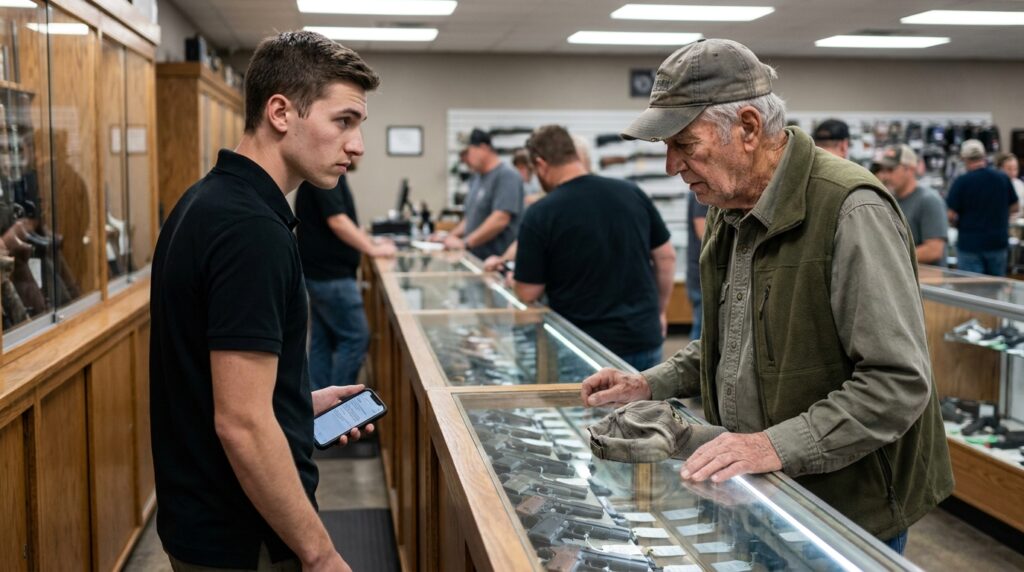
“Your kind built the world just to let it rot, old man,” the youth said, his voice cutting through the heavy grease-and-solvent air of the retail shop.
Arthur did not turn around immediately. He kept his calloused thumbs resting on the edge of the glass counter, right above a row of desaturated, black polymer frames. The glass was cool, smudged with the oil of a hundred anonymous palms. In the small shop, the hum of the fluorescent lights felt heavy, vibrating against the small of his back. He took a slow breath, inhaling the familiar, sharp scent of spent iron and gun oil, letting his lungs fill before he acknowledged the presence crowding his shoulder.
When he turned, the friction of his heavy canvas vest against his flannel shirt made a dry, scraping sound.
The boy was barely twenty-two. His black polo shirt was tucked tightly into a stiff tactical belt, everything about him too clean, too sharp, like an unissued blade. His chin was tilted up, his jaw clenched to mimic the hard lines of men who had actually seen the sun go down over a broken perimeter.
“My mother learned to clear a jam before your knees gave out,” the boy sneered, leaning an inch closer, trying to occupy the air Arthur was breathing.
Arthur looked at him through eyes surrounded by deep, weathered creases—lines earned by looking into the glare of desert borders while this boy’s parents were still children. He reached into his vest pocket, his fingers brushing against the cold, rectangular edge of the tarnished brass oiler bottle he carried for weight. He didn’t pull it out. He just held it, grounding himself against the sudden, familiar heat rising in his throat.
“You should think real careful before you talk to people that way, son,” Arthur said. His voice was low, a gravelly rasp that didn’t rise in volume but filled the small space between them like stones shifting under water. “The world isn’t a screen. Actions leave scars that don’t scrub out.”
The young man didn’t blink. A small muscle twitch near his left eye betrayed the adrenaline surging through him, but his mouth remained hard. He lifted his chin a fraction higher, a public posturing for the few silent customers who had stopped browsing the rifle racks against the back wall.
“Prove it,” the boy clipped out, his hands resting loose near his hips. “Prove you’re still worth the space you’re taking up.”
The air in the room went dead and cold. Arthur felt the old, dormant machinery in his chest click over—the calculation of distance, the weight of the young man’s stance, the vulnerabilities in a soft throat and an over-extended chest. It would be clumsy now; his knuckles were swollen with arthritis, his lower back a constant ache of iron-heavy fatigue. But the desensitization was still there, an ancient, rusted tool waiting to be used.
Arthur looked at the boy’s eyes and saw no real hatred—only a desperate, starving hunger for status, a localized displacement that needed a target. He was a mirror of everything the future was becoming: undisciplined, terrified of being small, and armed with an unearned bravado.
Arthur didn’t move his hands. He let the silence stretch until the boy’s posture stiffened with the realization that he wasn’t going to get a loud, theatrical reaction.
“Go home,” Arthur murmured softly, turning his back to the boy to look down at the display counter once more. “Before you find exactly what you’re looking for.”
He heard the youth’s boots click against the linoleum floor as he stepped back, a short, sharp retreat that felt like a tactical reset rather than a surrender. Arthur didn’t look up as the shop’s front door chimed, letting in a brief gust of dry, dusty wind from the blacktop outside.
He waited three minutes, his hand still gripping the brass oiler in his pocket, before he walked out to his truck. The afternoon sun was fading, casting long, desaturated shadows across the gravel lot. He climbed into the cab, the old springs groaning under his weight, and turned the key.
As he shifted into reverse, his eyes glanced at the rearview mirror.
Tucked into the sun-bleached visor above his head was a small, handwritten receipt from his morning errands—except it wasn’t his. It was a fresh parking stub from the medical center three miles out, dated two hours ago, with a name scrawled across the back in a messy, urgent handwriting that matched the name on the young man’s embroidered shop badge.








