
CHAPTER 4: THE BREACH IN THE STONE
The brake pedal went down without any resistance, a soft, sickening sink that ended with a dull metal thud against the floorboards.
Arthur’s boot didn’t hesitate. He pumped the pedal twice, but the system was empty, the pressure completely gone. The old truck was carrying forty miles an hour of momentum down the steep, gravel incline of Ridge Road, the heavy oak timber crowding the narrow ditches on either side like stone pillars.
He didn’t panic. The machinery of his mind simply adjusted the variables. He gripped the steering wheel with his left hand, the leather wrap dry and cracked against his palm, and used his swollen right hand to yank the manual emergency brake lever. The steel cable beneath the chassis screamed in protest, a dry, ungreased screech of metal stretching beyond its limits. The rear tires caught for a fraction of a second, fishtailing the heavy tail end of the pickup through the loose limestone before the drum shoes gave way under the friction, smoking and useless.
He shifted the transmission down into second gear. The engine roared, the RPMs spiking into a high, mechanical wail as the compression slowed the truck down just enough for Arthur to guide it into the soft mud of the drainage ditch. The front bumper plowed through a thick patch of sumac bushes, the branches slapping the windshield like skeletal fingers before the vehicle ground to an abrupt, violent halt against a half-buried limestone boulder.
The sudden stop threw Arthur forward, his chest slamming hard against the steering wheel. The impact knocked the wind from his lungs, a sharp, white-hot line of pain radiating through his ribs.
He sat still for several long seconds, waiting for his vision to clear. The air inside the cab was instantly thick with the smell of scorched clutch lining, hot coolant, and the unmistakable, sweet aroma of atomized brake fluid. Through the cracked passenger window, the only sound was the drip of fluid landing on the dry earth below.
Arthur forced his lungs to expand, swallowing the iron taste of rising bile. He opened the driver’s side door, the metal hinge bent out of alignment, requiring the full weight of his shoulder to shove it open.
He dragged his stiff leg down into the weeds of the ditch, kneeling on the cold grit of the roadside. Beneath the front axle, a clean, silver glint caught the low noon light. The braided steel brake line hadn’t burst from age. It had been sheared cleanly through, the copper fittings bright and unoxidized where a pair of heavy wire cutters had bitten through the metal.
“Garrett,” Arthur muttered, his voice barely a rattle in the wind.
The decoy tracker on the frame had been exactly what the boy wanted him to find—a simple piece of electronics to make Arthur look downward, to make him believe he had discovered the full extent of the intrusion. While Arthur had been inside the hardware supplier analyzing the old blueprint fragment, the boy had been beneath the truck bed with an open blade.
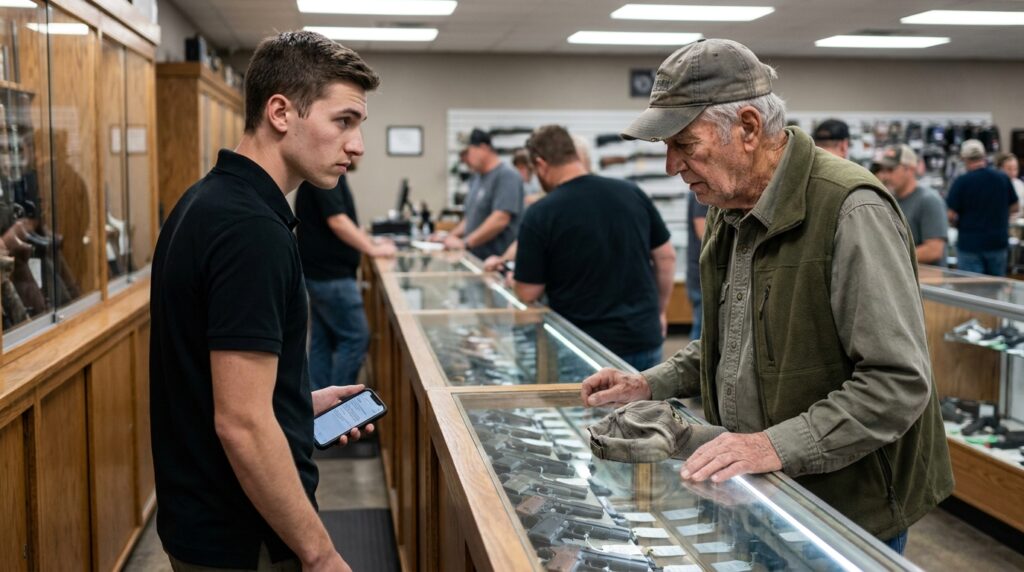
The realization came with a cold, heavy finality. This wasn’t a game of intimidation anymore. The youth wasn’t waiting for a public standoff in a gun store. He was systematically dismantling Arthur’s mobility, cutting his lines of supply, isolating the old man on his own property.
Arthur stood up, his hand automatically reaching into his vest pocket. His fingers bypassed the brass oiler and closed around the cold, checkered polymer grip of the small cellular phone he rarely used. The screen was dead. A jagged fracture ran from the charging port directly through the center of the liquid crystal display. It hadn’t happened during the crash; the impact point was a small, circular dent, the exact size of a punch tool. It had been disabled while the truck was parked at the hardware store.
He was two miles from his house. The sun was already starting its long descent behind the ridge, throwing the timber road into deep, indigo shadow.
He began to walk.
Every step down the gravel lane was a lesson in endurance. The pain in his ribs was a constant, sharp needle, forcing him to keep his left arm pressed tightly against his chest to stabilize the bone. His boots made a solitary, dragging sound in the dust, a slow rhythm that felt dangerously exposed in the quiet of the woods.
The forest on either side was too still. No birds called from the upper branches of the oaks; the squirrels had gone deep into the brush. It was the heavy, pregnant silence of a firing range before the targets are raised.
Halfway down the ridge, where the trees formed a dark canopy over the road, Arthur stopped.
A hundred yards ahead, parked broadside across the gravel lane, was the black sedan. Its nose was turned toward the ditch, completely blocking the path. The headlights were off, but the driver’s door was wide open, a gaping dark mouth in the side of the vehicle.
Garrett Vance was sitting on the hood, his boots dangling over the grille. He was holding a long, wooden cleaning rod, casually running a white cotton patch down the bore of an old, bolt-action military rifle that lay across his lap. The dry, rhythmic scritch-scratch of the cleaning patch was the only sound in the valley.
“You’ve got a bad oil leak, Major,” Garrett called out without looking up from his work. His voice carried an artificial lightness that didn’t reach his cold eyes. “I saw the fluid on the asphalt back at the store. Thought about warning you, but I figured a man with your experience knows how to handle a soft pedal.”
Arthur stopped twenty paces out. He didn’t reach for his sidearm. The distance was too great for a short barrel against a rifle, and his hands were stiff from the cold and the walk. He kept his posture vertical, despite the burning in his ribs.
“You’re meddling with things you don’t have the teeth for, boy,” Arthur said, his voice flat, retaining its command structure despite the physical strain. “The blueprint in the locker. The storage facility. Your father didn’t leave you a legacy, Garrett. He left you a graveyard.”
Garrett’s hand froze on the cleaning rod. He slowly lifted his head, his face half-hidden by the shadow of his cap. The mock-playfulness vanished from his expression, replaced by a raw, hollow bitterness that made him look older, his features hardened by a localized, focused hatred.
“He left me a name that people in this town spit on because of what you wrote in that logbook,” Garrett whispered, his voice sharp as a razor edge. He slid the cleaning rod out of the barrel with a dry, metallic hiss. “He spent twenty years in the dark because a ‘Sovereign Protector’ like you needed a scapegoat for the missing inventory. You closed the gate on him, Arthur. Now I’m closing the gate on you.”
The boy slid off the hood, the rifle balance-pointed in his right hand. He didn’t shoulder it, but his fingers were wrapped securely around the small of the stock, his thumb resting near the safety catch.
“Get back to your porch, old man,” Garrett said, gesturing with the barrel toward the remaining mile of road. “Go sit in your dark kitchen and wait for the sun to go down. I want to see how much of that iron discipline is left when the lights go out completely.”
He didn’t wait for Arthur to answer. He climbed into the black sedan, slammed the door, and backed the vehicle up into the brush just enough to clear a narrow path through the dirt before turning the car around and accelerating down the ridge, leaving a thick, choking cloud of limestone dust in his wake.
Arthur stood in the settling dust, his lungs burning as he inhaled the pulverized stone. He reached into his pocket and pulled out the blueprint fragment. The paper was fraying at the creases, the old purple stamp fading into the gray twilight. Garrett believed the old man had ruined his family over stolen inventory—a simple, dirty decoy secret that explained a lifetime of poverty and shame.
But Arthur knew what was actually buried under the concrete of that decommissioned facility. It wasn’t missing rifles. It was something far heavier, a reality that had required his father’s permanent silence to protect the very ground they were standing on.
He turned his face toward the ridge and continued his slow, agonizing march toward the house. The perimeter was breached, the decoy was set, and the final night was coming down fast.








