CHAPTER 8: THE COLD METRIC RESTART
The starter rope uncoiled with a wet, heavy rasp, the zinc-coated knot slamming back into the iron flywheel housing like a hammer blow. The engine didn’t hesitate this time. It caught on the first compression stroke, its exhaust punching a grey cloud of blue-black smoke straight into the dry blades of the fescue. The entire chassis of the red-and-black machine began to track sideways on the slope, its steel axle humping over a half-buried chunk of limestone mortar.
The sound swallowed the street. It cut off the crackle of the cruiser’s radio and flattened the distant hum of the valley traffic until there was nothing left but the steady, four-cycle vibration of sixty-four pounds of cast iron hitting three thousand revolutions per minute.
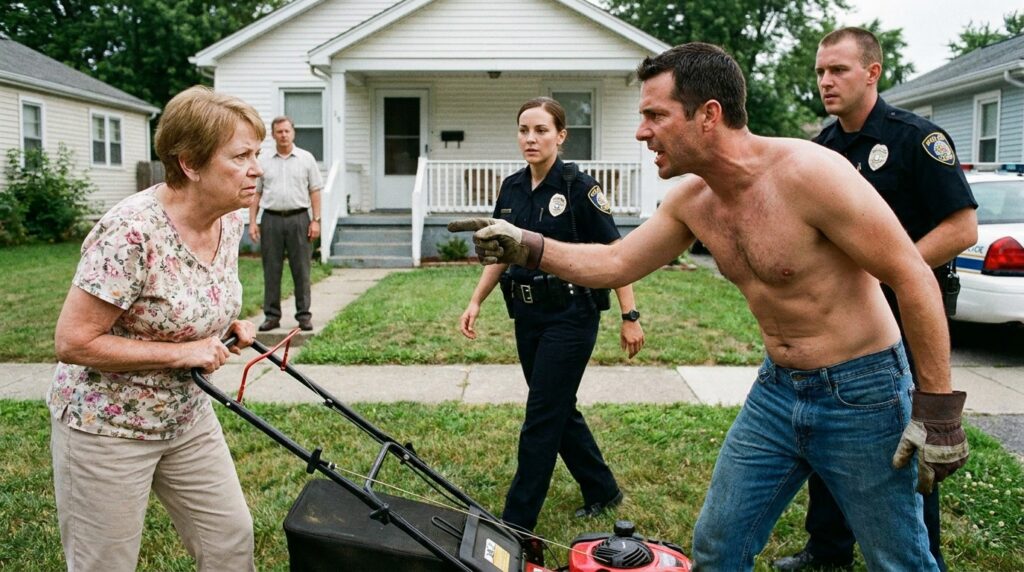
He clamped his leather-gloved hands back onto the black rubber handle crossbar. The hide was stiff, caked with dry clay and salt from his palms, but he didn’t adjust his grip. He leaned his bare torso forward, using the weight of his shoulders to force the front wheels down into the deepest trough of the drainage ditch. He wasn’t looking at Mrs. Gable. He was looking at the small, rusted head of the state corridor pin that sat six inches to the left of her walking shoes, clear and absolute under the glare of the afternoon sun.
“Ma’am, you need to step back to your own property right now,” the Patrol Officer shouted over the roar of the deck. Her voice had lost its administrative flatness, matching the mechanical pitch of the mower. She didn’t touch her belt, but her heavy leather boots moved deliberately, her body creating a solid, dark wall between Mrs. Gable’s floral blouse and the spinning discharge chute.
Mrs. Gable didn’t look at the officer. Her eyes stayed locked on the red steel housing as it crawled back toward the edge of her unpruned rose bushes. The silver clipboard remained tucked against her ribs, but the white pages of her municipal extracts were fluttering wildly in the draft from the engine’s cooling fan. Her face was hollow, her mouth working silently as she took three slow, heavy steps backward, her rubber-soled shoes slipping once on the coarse limestone sand she had hauled into the ditch three months ago.
The resident didn’t trace the line with his eyes. He kept his heels planted in the gravelly edge of his own driveway apron, letting the machine’s self-propelled drive wheels do the labor. The steel deck vibrated against his shins, a hard, relentless friction that smelled of hot oil and scorched weeds. He could feel the Backup Officer’s eyes on his back, a silent, tactical gaze tracking the alignment of his boots from the concrete curb, but no one reached out to touch his arm this time. The data had already cleared the terminal inside the unit. The sovereign authority of the lot lines had shifted back into the soil.
He pushed the machine through the final three feet of wild mustard, the blades making a thick, wet thwack-clack as they cleared the grass right down to the rusted zinc marker. The limestone blocks of her fraudulent retaining wall sat six inches to his right, their gray faces scored and white where his deck had bitten into the stone during the first pass. He didn’t stop to look at the damage. He tilted the mower back onto its rear wheels, swinging the chassis around in a tight, calculated arc until the nose pointed toward his own garage door.
Across the property line, the Sidewalk Witness stood perfectly still near the mailboxes, his hands tucked deep into his denim pockets. He didn’t speak as the resident throttled the engine down to a low, rhythmic sputter, but his chin dipped once—a slow, unyielding acknowledgment of a clean line established in front of the whole block.
Behind them, Mrs. Gable reached her porch steps, her floral sleeve disappearing into the dark shadow of her screen door without a backward look. The door didn’t slam; it clicked closed with a small, ungreased metallic slide that was instantly buried by the final, dying cycle of the resident’s engine.
The resident pulled his work gloves off one finger at a time, the leather making a dry, sticky sound against his sweat-slicked skin. He looked down at the grass clippings drying on his boots, then looked back at the Patrol Officer, who was clipping her digital terminal back into its heavy nylon pocket. The raw friction of the neighborhood dispute was over, the physical boundary secured by the metric of the code—but as he looked at the deep, systemic alignment of the curb stretching down the rest of the street, he knew the absolute truth of the block was still sitting locked beneath the hot asphalt, waiting for the next spade to hit the clay.