
CHAPTER 4: THE RESISTANCE OF BULK
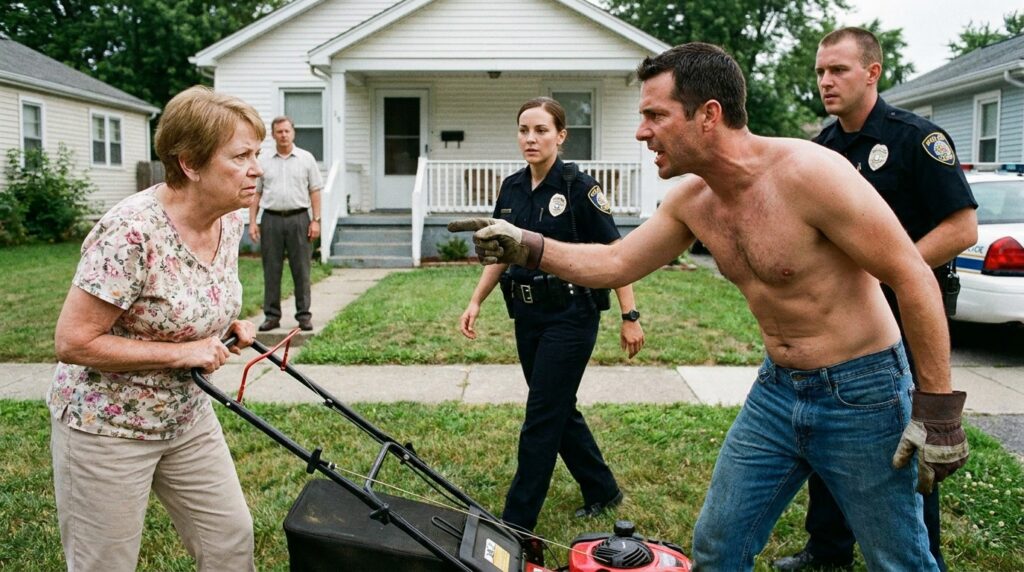
The red-and-black deck didn’t hit soil; it struck limestone with a hard, scraping shriek that sent a shower of pale dust across the dark weave of his work gloves. The impact traveled straight up the tubular steel handles, vibrating through the bones of his forearms like an electric shock before the blade could catch and stall against the rock.
Mrs. Gable had placed her weight right where the drainage slope flattened out into the primary swale. She didn’t jump back from the flying chips of stone. She stood balanced on the wide, sensible heels of her walking shoes, her lean torso pitched forward until her shadow completely blocked the view of the mower’s oil cap. Her silver clipboard remained wedged tightly under her arm, the metal corner pressing into the floral fabric of her blouse until the pattern distorted.
“You’ve just destroyed three structural blocks of an authorized boundary barrier,” she said. Her voice stayed low, matching the steady, oily thrum of the cruiser’s engine twenty feet away. She held her smartphone steady at waist level, the glass screen recording the small white gray line of scored limestone where the steel deck had bitten into the rock. “The code handles destruction of neighborhood property under malicious mischief guidelines. Officer, look at the alignment shift.”
The resident didn’t cut the ignition toggle immediately. He let the engine hunt at a low, ragged idle, the vibration making the green grass clippings on his bare chest shake down into the waistband of his jeans. He didn’t point his finger this time. He just leaned his weight against the upper crossbar, his leather gloves remaining clamped over the black rubber grip until the hide squeaked under the tension.
“The stone didn’t get here by itself, Mrs. Gable,” he said. The words came out slow, dry as the limestone dust hanging in the humid air between them. “This block was sitting twenty-four inches further north when the rain started on Friday. You can see the dead spot in the fescue where the mortar was tracking before you dragged it across the line.”
The Patrol Officer stepped into the interaction lane before the neighbor could raise her phone. Her heavy leather boots didn’t avoid the debris; they rolled right over the fresh stone chips, grinding the white powder into the damp clover. Her right hand remained loose at her waist, her thumb hooked over the thick nylon border of her notebook pouch. Behind her, the Backup Officer stayed planted on the concrete apron of the driveway, his large frame creating a permanent barrier between the yard and the public curb.
“Keep your hands on the crossbar, sir,” the female officer said, her voice dropping into that flat, clinical cadence that stripped the heat out of the grass before it could catch. She turned her head slightly, her focused gaze dropping to the point of impact where the red paint of the mower deck had left a long, bright smear against the gray face of the masonry. “Ma’am, step back onto the gravel walkway. We’re not doing this at the handle line.”
“He came across the survey stake deliberately,” Mrs. Gable said. She didn’t retreat more than six inches, her beige slacks catching on the low briars of her own unpruned rose bush. She tapped the silver clip of her board with her finger, a dry, metallic tick that matched the rhythm of her breathing. “The invoice from the surveyor clearly states that the variance includes the entire drainage shelf. He has no authority to clear the grading within the subdivision boundary.”
The resident let his grip slide down the steel tubing until his bare palms hit the hot metal near the engine shroud. He could feel the heat from the exhaust box radiating through his jeans, smelling of scorched oil and old ethanol.
“The survey invoice you keep shaking at the officer doesn’t have a county seal on it, Clara,” he said, his chin tilting toward the paper tucked under her arm. “I looked at the record book in the annex on Monday. The variance you’re talking about was denied by the district board in ninety-six because the culvert belongs to the regional water authority. You moved the stones because the line from the fiber installation showed exactly how much of my lot your driveway took when they poured the apron.”
The Patrol Officer didn’t look up from her digital terminal, but her thumb stopped its rhythmic tapping across the screen. The blue light from the GIS display caught the edge of her dark tied hair, reflecting two tiny squares of cold light in her eyes. She turned the terminal slightly, her shoulder blocking Mrs. Gable’s view of the live tracking map as she pulled up a scanned document from the county’s historical infrastructure file.
“Sir,” the officer said, her voice holding the same unhurried weight as the heat sitting in the ditches. “Did you verify the location of the original brass pin before you started the clearance this afternoon?”
“It’s under the third block of her wall,” the resident said, his hands tightening on the hot metal frame until the skin of his palms went white. “She didn’t just build over it. She used a cold chisel to knock the cap off the pin so the county crew couldn’t locate it with a magnetic wand when they ran the line.”
Mrs. Gable’s face went the flat, chalky color of the limestone dust on the grass, but her shoulders didn’t drop. She adjusted her glasses with her left hand, her fingers steady, her gaze remaining fixed on the Patrol Officer’s silver badge. “That is an unsubstantiated accusation from an unpermitted resident. The title office has no record of any historical brass pins on this section of the grade.”
The Patrol Officer didn’t answer her. She stepped past the mower’s front wheel, her boots sinking into the soft mud of the swale, and bent down until her hands were level with the bottom row of stones. Her fingers didn’t touch the rock; they traced a fresh, bright line of orange utility paint that had been hidden beneath a layer of rotting lawn clippings—a mark that didn’t use the standard city coding for water or gas, but the specific, three-dot sequence used by private title investigators when they checked for structural overreach.








