CHAPTER 7: THE REVERSAL OF AUTHORITY
“Step back now, both of you, let us handle this!”
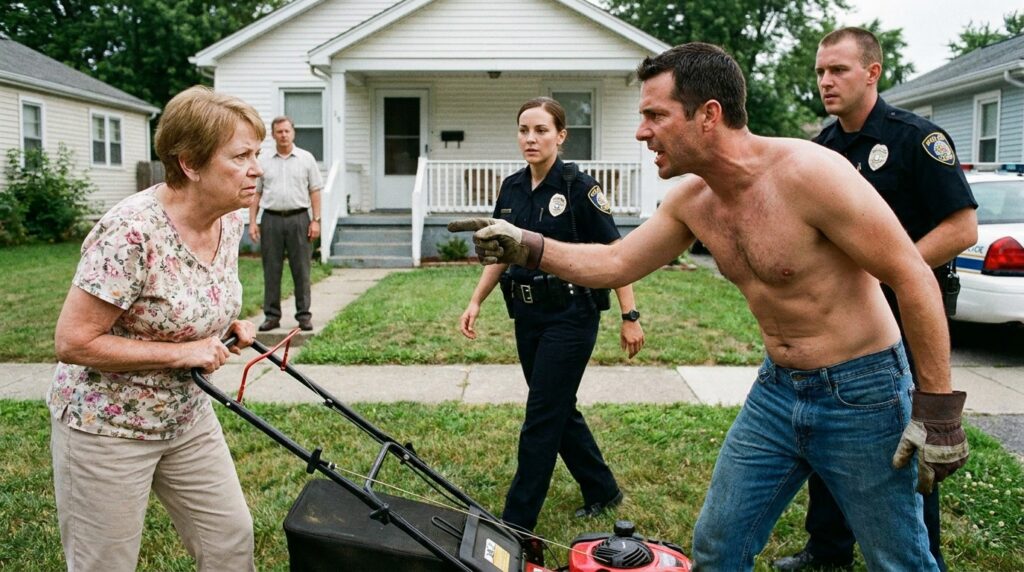
The Patrol Officer’s command cut cleanly through the stagnant afternoon heat, her boots shifting on the dry, weed-choked lawn as she stood directly between the resident’s shirtless frame and Mrs. Gable’s floral sleeve. The black nylon of her uniform tactical vest held a light dust from the road, dry and smelling of vehicle heat. Her focus stayed locked on the physical space dividing them, ignoring the phone Mrs. Gable continued to thrust forward.
To the right, the Backup Officer maintained his steady posture, his boots planted firmly near the mower’s red deck. His right hand remained loose but steady against his belt line, ensuring the resident didn’t bridge the four-foot gap toward the neighbor. He didn’t use force, but his large frame completely blocked the path to the resident’s front porch.
“Stay over here, sir,” the male officer said, his voice flat, matching the steady drone of the cruiser’s radiator behind them. His eyes tracked the wet leather of the resident’s gloves, looking for any shift in weight. “Let her clear the terminal checks first.”
The resident allowed the distance to remain, his bare shoulder blades pressing slightly against the cold steel of his truck’s side panel. The heavy iron bolt inside his pocket felt like a cold stone against his thigh. He didn’t raise his voice; he kept it low, deep in his chest to maintain the measured rhythm of his breathing.
“Look at the screen, Officer,” the resident said. He shifted his chin toward the Patrol Officer’s digital reader, where the blue mapping links were still pulsing against the glass. “She knows exactly where the iron pin is. She’s been standing directly on top of the municipal marker since your car hit the curb.”
Mrs. Gable’s clipboard rattled against her ribs, the metal clip making a sharp, dry sound that mirrored the rattle of the box elder leaves at the edge of the lot. Her face had gone the color of gray limestone under her light-brown hair, but her shoulders remained pinned back, her posture mimicking the absolute certainty of an official building inspector.
“The survey was certified by the neighborhood board during the phase three development,” she said, her voice rising until it hit the white vinyl siding of the resident’s garage. Her fingers were tight against the edge of her phone, her thumb covering a dark smudge on the casing. “He has no administrative clearance to remove or alter the masonry along this drainage line.”
The Patrol Officer didn’t look up from her handheld terminal. Her thumb traced a blue vector line on the screen, cross-referencing the district’s historical engineering file against the live GIS plot map. The cold light from the display caught the dark edge of her tied hair, cutting across her face in sharp, geometric lines.
“Ma’am,” the officer said, her voice dropping into a procedural flatness that signaled an administrative shift. She didn’t look at Mrs. Gable’s phone. She looked at the base of the stone retaining wall, where the fresh gray clay had been turned up along the roots of the fescue. “According to the master infrastructure ledger, the 1985 benchmark pin doesn’t stop at your decorative barrier. The state utility easement requires a six-foot clear path from the centerline of this swale.”
“The board granted a variance in ninety-six,” Mrs. Gable said immediately, her speech pattern accelerating as she stepped six inches to her left, her sensible walking shoes grinding into a clump of dried clover. “It’s signed by the development clerk. The copy is in the central file.”
“The development clerk didn’t hold the deed to the regional drainage grid, Mrs. Gable,” the resident said. He didn’t step out of the shadow of his truck, but his posture went hard against the painted metal. “The city infrastructure remains sovereign. And that notched piece of zinc you tried to bury under the mortar shows exactly where the state crew set the high-pressure marker before your family poured the concrete driveway.”
The Patrol Officer looked up from the terminal, her eyes narrowing as she looked past the red-and-black mower deck toward the edge of the limestone blocks. She turned to the Backup Officer and gave a short, horizontal gesture with her hand.
“Miller, call the county dispatcher,” she said, her voice carrying the unyielding weight of a standard state citation. “Tell them we have a code-four boundary obstruction on a designated municipal easement. We need a supervisor from the code enforcement branch on-site with the physical plot logs.”
Mrs. Gable’s mouth opened slightly, but the frantic performance of authority collapsed into a rigid silence. Her short fingers froze against the silver clip of her folder, her silhouette looking heavy and small against the vast, sun-baked landscape of the subdivision.
The resident watched her face, his calculation tracking the small lines around her jaw where the tension had settled. He had won the immediate physical standoff on the grass, but his internal logic was already tracking the deeper problem hidden within the officer’s blue display screen. If the 1985 master benchmark was out of plumb, the shifted wall was just a fraction of the error. The true baseline of the entire block was detached from the physical deeds, and the ground beneath his feet was legally moving before the supervisor could even clear the station house yard.