CHAPTER 5: THE SEPARATION OF PRESSURE
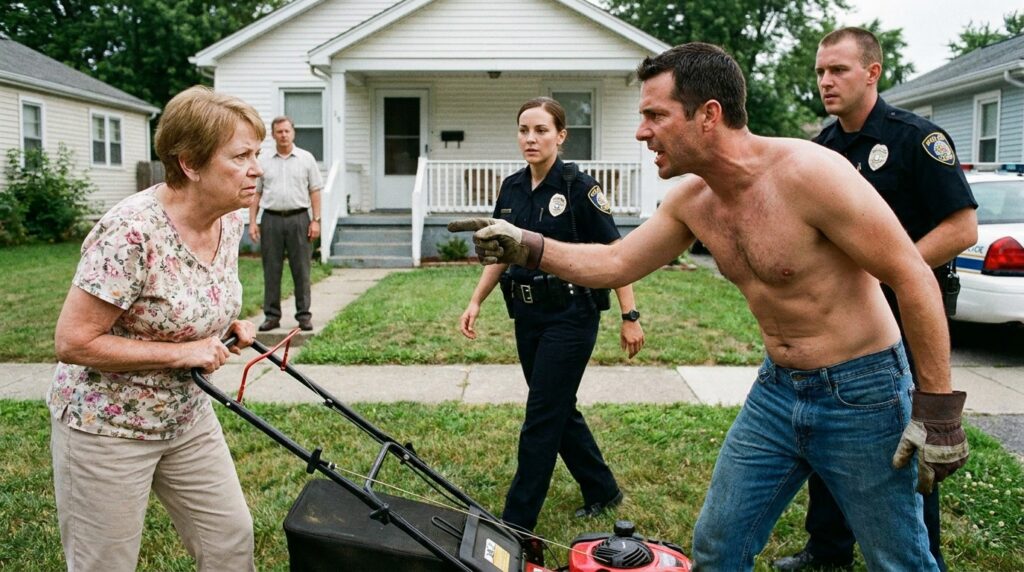
“Step back now, both of you, let us handle this!”
The Patrol Officer’s boots slammed into the mud, forcing her frame directly into the narrow interaction lane between the resident’s bare torso and Mrs. Gable’s floral sleeve. The black weave of her uniform sleeve brushed the handle bar of the mower, leaving a clean trail through the limestone dust. Her voice carried the weight of an unyielding state machine, dropping between them like a concrete barrier before the shouting could spill over into physical contact.
To the right, the Backup Officer didn’t hesitate. His large, thick-fingered hand caught the resident by the upper arm, not with a strike, but with the steady, hydraulic pressure of a professional restraint. His boots ground a patch of crabgrass into dark juice as he used his bulk to guide the shirtless homeowner backward, forcing a four-foot gap between the man and his equipment.
“Stay over here, sir,” the male officer said, his breath hot and smelling of stale gas-station coffee against the resident’s neck. His eyes tracked the wet leather of the resident’s gloves, watching the fingers for any twitch that looked like a pivot. “Don’t lean into the lane. Keep your feet planted right on the gravel.”
The resident allowed the leverage to push him back, his spine contacting the sun-heated frame of his truck’s side mirror with a dull thud. The iron bolt inside his pocket pressed hard into his hip bone. He didn’t struggle against the officer’s weight; he let his shoulders drop, absorbing the friction of the gravel beneath his work boots while his eyes stayed fixed on the Patrol Officer’s terminal.
“I’m not moving, Officer,” the resident said, his words coming out in clipped, short measures through his teeth. His chest was covered in red-brown rust from the starter assembly, the sweat cutting clean tracks down his ribs. “But she’s standing directly on the infrastructure line. Look at her left foot. Look at what’s under the turf clippings.”
Mrs. Gable didn’t step back until the Patrol Officer’s arm extended, the stiff nylon edge of her glove nearly brushing the silver clip of the neighbor’s folder. The confident, upright posture that had held the lawn line for forty minutes began to stiffen into something brittle. Her phone was still up, its lens tracking the Backup Officer’s boots, but her fingers were shaking against the plastic casing.
“He targeted the retention structure deliberately,” she said, her voice rising an octave, thinning out like wire under tension. “He’s been undermining the base with a spade since Friday. This isn’t a civil matter anymore—he’s creating a hazard for the entire common drainage line.”
The Sidewalk Witness stepped closer to the property boundary, his hands tucked deep into his pockets, his weight leaning over the concrete curb. “The only hazard in that ditch is the stone she hauled in from the quarry three months ago, Officer. The whole street knows the water’s been backing up into his garage since the last freeze.”
The Patrol Officer didn’t look at the witness. She remained crouched near the wheel of the push mower, her hand hovering two inches above the orange utility mark she had uncovered beneath the dead clippings. Her fingers were gray with dry clay as she scraped away another layer of loose earth, exposing a thick, square head of oxidized iron that sat hidden between two limestone blocks.
“This pin isn’t from the 2014 county file,” she said, her voice completely neutral, a clinical observation that ignored the heat radiating from the driveway. She held her digital screen closer to the iron cap, cross-referencing the stamped numeric code with the regional infrastructure database. “This is a private registry mark. It belongs to the state utility corridor.”
The resident’s gaze locked onto the orange paint. His memory shifted back to the midnight rains from the previous month—the sound of a metal shovel hitting stone while his porch light was dark. He had assumed she was simply repairing the wall after the frost heaved the mortar, but the position of the iron head didn’t line up with any residential boundary. It was six inches deeper than his own deed measurements allowed.
“She didn’t just move the wall to take my grass, Officer,” the resident said, his body straining against the Backup Officer’s passive block. “The fiber contractor ran the line through the swale because the city map showed it was clear. She covered the iron marker so the utility company would think the easement was two feet further south, right under my concrete apron.”
Mrs. Gable’s clipboard slipped from her forearm, the bottom edge catching on her beige slacks before she pinned it back against her side with a sharp, defensive jerk. Her short hair was damp from the humidity, sticking to her forehead in thin, light-brown streaks. “The contractor had a waiver from the association board. The alignment was verified by the neighborhood development committee before the first trench was cut.”
“The development committee doesn’t have the authority to alter a state utility corridor, ma’am,” the Patrol Officer said. She stood up slowly, her knee joints popping with a dry sound that carried clearly across the quiet lawn. She didn’t look at Mrs. Gable’s phone; she looked directly at her eyes, her focused expression dropping any pretense of an ordinary neighborhood dispute. “If this pin was altered or concealed to redirect a utility installation, that’s a class-four state infrastructure violation.”
The neighbor’s mouth opened, but no sound came out—only a short, subvocal hitch in her breath that made the floral fabric of her collar shake. She looked at the Sidewalk Witness, then down at her own shoes, her weight shifting as if the very ground beneath her was beginning to give way.
The resident didn’t celebrate the shift in the officer’s tone. His fingers remained jammed into his denim pockets, his thumb tracing the rough thread of his jeans. The discovery of the utility pin seemed to resolve the immediate crisis of his lawn mower, but his mind was already tracking the next calculation: if the state corridor marker was inside his lot line, then the original 1980 plat map wasn’t just inaccurate—it was completely decoupled from the actual engineering layout of the entire cul-de-sac.