CHAPTER 3: THE EXCAVATION OF SUBTEXT
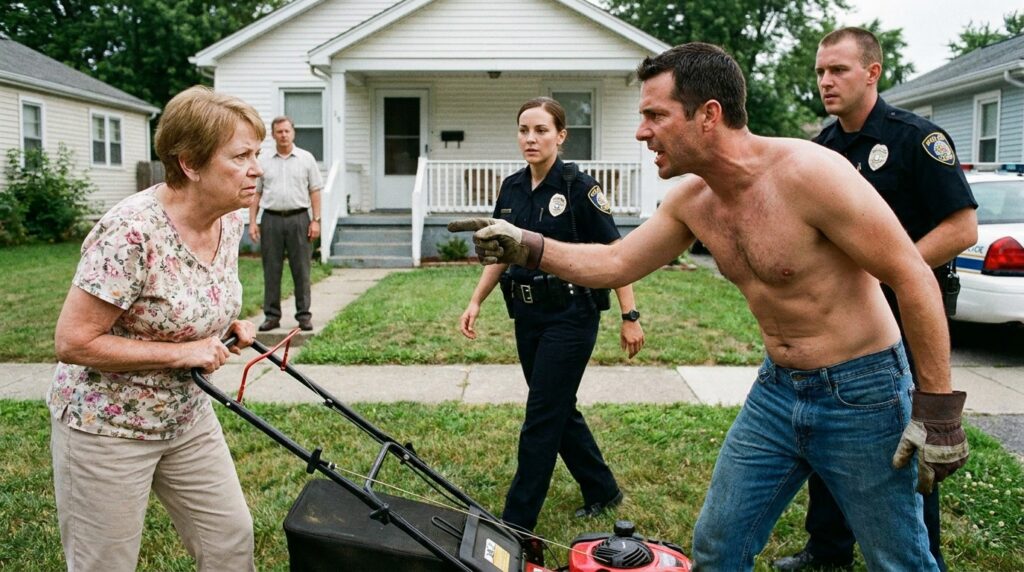
“That notched piece of zinc isn’t a land marker, Clara,” the resident said, his weight grinding down through his work boots until a dry root snapped underneath his heel. He didn’t bend down to touch it. He kept his hands high, the leather of his gloves catching the thick, greasy dust kicked up from the patrol unit’s idling exhaust. “That’s an old grade tie from the municipal culvert layout. It was driven before the subdivision even laid its first foundational grid.”
The Patrol Officer didn’t answer immediately. Her boots made a dry, rhythmic scraping sound against the gravelly edge of the turf as she shifted her focus from Mrs. Gable’s rigid silhouette down to the dirt. The sun hit the oxidized metal, casting a tiny, jagged shadow across a patch of dead dandelions. With an unhurried, mechanical precision, she unclipped the heavy tactical terminal from her vest. The screen flared a hard, high-contrast blue against the humid afternoon air, throwing its cold reflection across the dull alloy of her chest badge.
“The 2014 reassessment isn’t the primary operational map for this quadrant, sir,” she said, her voice remaining perfectly level, a flat instrument tuned to procedural codes rather than neighborly venom. Her thumb traced a line across the glass, pulling up the district’s historical GIS data overlay. “We look at the recorded easements from the civil engineering phase. Everything else is secondary until the court issues an injunction.”
Mrs. Gable’s hand tightened around her silver clipboard until the white knuckles of her fingers looked like small bone pegs beneath her skin. The printed sheets of code rattled against her ribs, a dry, papery sound that mimicry-matched the rustle of the parched box elder trees at the property line. “The district engineer signed off on the original retaining wall alignment forty years ago. The stone footings are anchored into the grade. You cannot alter the operational boundaries of a residential lot based on a buried piece of construction scrap.”
The resident took a long, calculated breath through his nose, swallowing the taste of dry clay and iron dust. He didn’t look at Mrs. Gable’s face; he looked at the base of her decorative stone wall, where the limestone blocks had been scrubbed clean of moss only three months ago. He could see the faint, dark waterline where the soil had once sat three inches higher, before someone had cleared the trench with a spade under the cover of a midnight rain.
“The stone footings aren’t original, Mrs. Gable,” he said, his voice dropping into the steady, mechanical cadence of a man who spent his weekends with an iron pry bar and an unyielding level. “You reset those blocks when the utility crew ran the new fiber line through the ditch. You shifted the entire retention line twenty-four inches to the south to swallow the municipal drainage stake.”
The Backup Officer moved his bulk slightly to the left, his heavy duty belt clinking with a dull, leaden weight. His eyes tracked the edge of the red-and-black mower, then drifted toward the small trench the resident had been clearing before the call came in. “Sir, step over to the driveway line. Let the officer cross-reference the plat files without any spatial interference.”
The resident obeyed without a word, his boots dragging through the dry rye grass until the concrete of his own driveway burned through the rubber soles. He was the active driver of this metric now, his internal focus calculating the precise grid of the lot lines while the system caught up to the physical reality of the turf. He reached into his pocket, his gloved fingers touching the rough edge of a heavy iron bolt—the spare shear pin for the mower deck—feeling its weight as an anchor against the volatile theater on his lawn.
The Patrol Officer’s terminal gave a short, digital chirp. The cold blue light on her face shifted as she tapped a deep-link file inside the county’s archive registry. Her focused expression didn’t change, but her thumb paused on a scanned, hand-drawn blueprint from 1985—a document that didn’t match the clean, standardized lines of the current subdivision map.
“Ma’am,” the officer said, turning her shoulder toward Mrs. Gable until the silver badge on her chest cut off the neighbor’s view of the screen. “According to the original civil registry, the drainage swale is an unalterable easement. No structures, including decorative masonry or temporary retaining walls, are permitted within six feet of the central flow line.”
“That wall has stood for three decades,” Mrs. Gable replied, her voice thinning until it sounded like wire drawn too tight across a fence post. She took a step toward the officer, her floral blouse catching the draft from the idling cruiser. “The homeowners’ association approved the landscape variance. It’s in the minutes from the ninety-six meeting.”
“The association doesn’t hold the deed to the city’s water infrastructure, Mrs. Gable,” the resident cut in, his posture straightening against the sun-baked vinyl of his garage door. He could see the Sidewalk Witness nodding slowly from the curb, his eyes still fixed on the blue light of the terminal. “The city infrastructure remains sovereign. And that notched zinc tie shows exactly where the original culvert pipe was laid before your uncle revised the phase three boundary line.”
The Patrol Officer looked up from the screen, her dark tied hair pulled back so tight her forehead caught the harsh glare of the sky. She didn’t offer the terminal to either of them. Instead, she looked at the Backup Officer and gave a single, unhurried nod toward the base of the stone wall.
“Let’s check the municipal code marks on the utility box at the corner,” she said, her voice holding the flat finality of an administrative hammer. “If the grade has been artificially elevated over the drainage intake, this isn’t a property dispute anymore. It’s an unpermitted code violation on public infrastructure.”
Inside his leather gloves, the resident felt his grip loosen slightly. The small micro-mystery of the zinc tie was beginning to pull the narrative apart, but as he looked past the officer’s shoulder toward the older neighbor’s property, he noticed something else—a fresh line of orange utility paint buried deep beneath the grass clippings at the very edge of the stone wall, a mark that hadn’t been made by any city worker this season.