CHAPTER 2: THE MEASURE OF THE TREAD
“He’s within the boundary line, Officer,” a new voice cut across the humidity before the cruiser’s doors could even finish clicking open.
The Sidewalk Witness hadn’t moved from his patch of dying fescue near the curb, but his boots had shifted, his weight leaning hard toward the red-and-black deck of the mower. He was looking at his own phone, fingers tracing a digital plat layout with the practiced indifference of someone who had watched three layout revisions on this block fall into the county’s default drainage category.
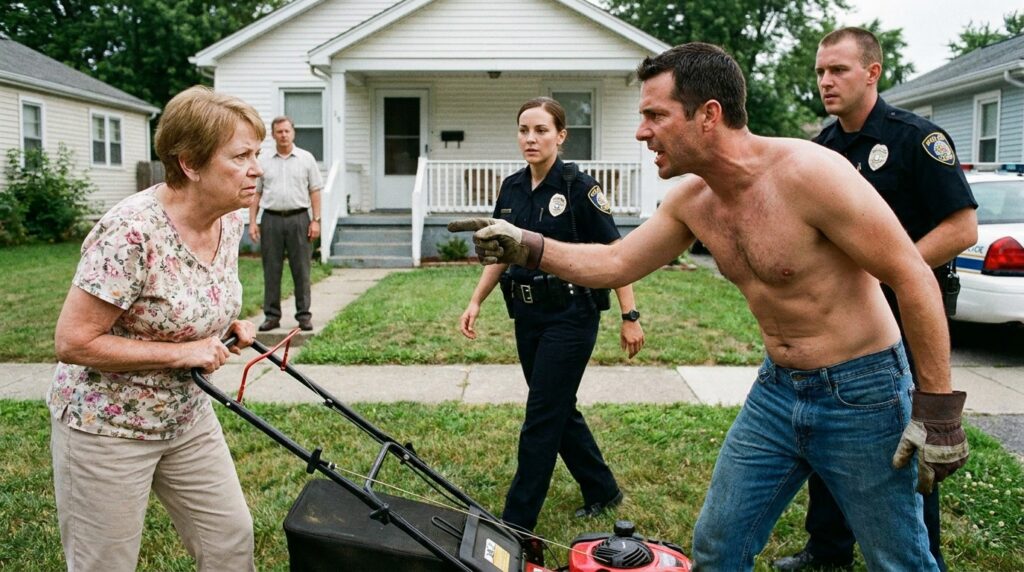
The Patrol Officer didn’t look up as her boots hit the grass. The black leather of her tactical gear didn’t give; it creaked, dry and thick with the smell of vehicle vinyl and standard-issue chemical cleaner. Her hand didn’t drop to her holster, but it stayed high, her thumb hooked into the heavy nylon utility belt just above her taser casing. Behind her, the Backup Officer took a wider loop, his larger silhouette cutting off the clear line of sight toward the resident’s concrete porch steps.
“Step back from the equipment, sir,” the female officer said. Her badge, stamped from a heavy, dull alloy that caught the glare from the midday sun, didn’t shine; it held the grease of the heat, unblinking. “Keep your hands where we can see them. Both of you.”
The resident didn’t pull his hands from the rubber-coated handle grips immediately. He let the engine’s dead silence do the talking first. The iron blades beneath the steel housing were still spinning down, a faint, rhythmic clack-whir of metal hitting the thicker weeds before everything went solid. His leather gloves stayed clamped on the bar, the hide dark with sweat across the knuckles.
“Look at where her heels are, Officer,” the resident said. His voice stayed low, the words dragged through the gravel of his throat. He didn’t point. He just shifted his chin toward the line where his manicured rye met the patchy clover of her frontage. “She’s three feet over the 1982 layout marker. She knows where the iron pin is. She’s standing on it.”
Mrs. Gable didn’t retreat. She adjusted the silver clipboard against her ribs, the thin sheets of white paper rattling under the pressure of her forearm. Her face had gone the color of skim milk under her short, light-brown hair, but her eyes held that fixed, unyielding gleam of a woman who had a direct line to the administrative assistant at the county courthouse.
“This is a shared municipal easement under Code Section Four,” she said, her voice rising just enough to carry to the next driveway. She tilted the screen of her phone toward the Patrol Officer, the glass smeared with sunscreen. “He’s deliberately executing a mechanical clearance during restricted utility hours. Look at the turf damage. He’s destroying the grading.”
The Backup Officer stepped between them, his bulk breaking the spatial tension like an iron wedge driven into green timber. His boots were larger, the heavy rubber treads grinding a patch of wild mustard into green mush against the dirt. “Sir, I told you to step back from the mower. Now.”
The resident slowly peeled his fingers off the rubber grip. The release made a dry, sticky sound. He took two steps backward, his bare chest rising and falling against the white siding of his house. The sun was directly behind his chimney now, throwing a long, dark shadow that swallowed the front half of the red-and-black machine. As his hand dropped to his side, his thumb caught on the edge of his pocket, where the stiff corner of a blue-ink county map was folded into a small square.
The Patrol Officer didn’t take the phone Mrs. Gable was offering. She stopped two feet short of the mower’s front wheels, her gaze dropping to the dirt. Her eyes tracked the small white plastic stakes Mrs. Gable had driven into the lawn the previous autumn. They weren’t straight. One of them was leaning at a twelve-degree angle, its pointed tip showing the clean, yellow clay that only existed beneath the top six inches of topsoil—the kind of clay that came up when someone used a pry bar to reset a line in the middle of the night.
“Who drove these markers?” the female officer asked, her voice dropping into that neutral, rhythmic drone used by people who spent forty hours a week filling out incident logs that nobody read.
“The survey company,” Mrs. Gable said immediately. She didn’t blink. “The certified invoice is on file with the homeowners’ association board.”
The resident let out a short, dry breath that wasn’t a laugh. He reached into his back pocket, his leather-gloved fingers clumsy against the denim, and pulled out the folded map. The paper was old, yellowed at the creases where the grease from his palms had soaked into the fiber over the last twenty-four months.
“That’s the 2014 reassessment map,” the resident said, his voice hard against the silence of the cul-de-sac. “The one before the county discovered the creek bed shifted three yards to the east. The real pin—the one with the brass head—is six inches under her left heel right now.”
The Patrol Officer turned her head slightly, her dark tied hair shifting against her collar. She didn’t look at the map yet. She looked at Mrs. Gable’s shoes—the thick, sensible rubber soles of her walking shoes, pressed firmly into a small depression in the dirt where the grass refused to grow.
“Ma’am,” the officer said, her voice dropping another octave. “Step two feet to your right.”
Mrs. Gable didn’t move. Her posture went rigid, her shoulders squaring until the floral fabric of her blouse pulled tight across her chest. “I have the documentation from the title office. This property has been in my family since the original grading was approved by the district engineer.”
The Sidewalk Witness took two slow steps forward, his boots hitting the concrete curb with a solid, echoing thud. He didn’t look at Mrs. Gable; he looked at the Patrol Officer’s vehicle terminal inside the open door of the cruiser, where the blue lights of the county GIS system were still flickering against the steering wheel.
“The district engineer died in ninety-four, Clara,” the witness said, his voice flat as salt. “And his nephew was the one who drew the fence lines for the third phase.”
The resident watched the Patrol Officer’s face. He didn’t look for sympathy; he looked for the precise moment the administrative weight shifted from the resident’s shirtless torso to the silver clipboard under the neighbor’s arm. But the female officer didn’t look angry; she just looked tired, her fingers tapping a slow, unhurried rhythm against the side of her nylon belt as she reached into her pocket for her own digital terminal.
Inside his glove, the resident’s knuckles were still burning from the strain of the starter rope, but he kept his eyes locked on the dirt under Mrs. Gable’s shoes. There was something else down there, right at the edge of the patched clover—a small, notched piece of oxidized zinc that didn’t belong to any residential survey kit he had ever seen.