CHAPTER 8: THE SUBSURFACE RESET
A single, metallic crack echoed up the shaft of the T-handle key as the frozen iron threads of the valve casing finally yielded to the leverage.
The sound didn’t ring out; it was flat, choked off by the heavy grey mud packing the vault. Mark threw his entire weight across the iron crossbar, his boots grinding down into the gravel edge of Laurel Court until his soles burned. The cold metal bar bit deep into the raw, split skin of his left index finger, but the sharp ache was distant now, swallowed by the massive, shifting inertia of the water main six feet under the bluegrass.
Time seemed to slow, expanding into the space between the mechanical pulses of the line. The gray water that had been geysering up around the white vinyl post suddenly hesitated. It hung for a fraction of a second in the midday air—a dirty, silty plume mirroring the blue strobe light of the cruiser—before it lost its velocity and collapsed back into the ditch with a wet, hollow slap.
Deep down in the dark clay, the violent, rhythmic thrumming in the galvanized pipe began to die. The sub-surface hiss of escaping water faded into a dull, low gurgle, followed by a heavy, mechanical clunk as the internal gate valve seated perfectly into its iron housing, sealing the leak and isolating the broken lateral.
Mark stayed bent over the tool for three slow breaths, his chest heaving under his damp dark T-shirt, his sweat dripping into the grey ooze around his boots. The structural tension in his arms slowly released. He lifted the long T-handle out of the trench, the wet iron rod scraping against the lower rail of the fence with a dry, hollow rattle.
Across the vinyl panels, the absolute silence of the street was heavier than the noise of the repair.
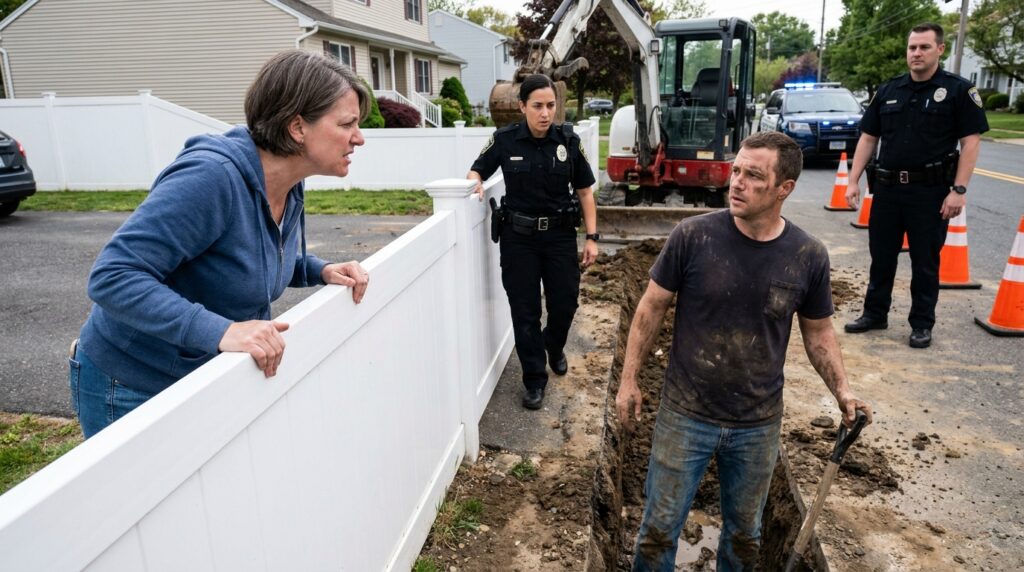
The homeowner stood completely still on her manicured grass, her fingers loosely tracking the crinkled edge of the yellow municipal warning sheet she held against her thigh. She wasn’t tracing the gold seals of her old covenants anymore. Her eyes were fixed on the bottom section of her property line, where the white vinyl post had begun to settle into a permanent, two-inch slant toward the ditch, its alignment ruined by the washing away of the sub-surface silt.
The small group of neighbors gathered at the edge of the asphalt stood in total stillness, their phone screens reflecting the lazy, spinning amber light from Mark’s utility truck. No one spoke. The elderly man from two doors down lowered his silver device, his eyes sliding from the leaning white fence to the dark, exposed scar of the public trench, before he turned on his heel and walked slowly back up his driveway. The illusion of an unblemished, private enclave had been dismantled in front of the entire block.
The intervening officer stepped past the bowing rail, her heavy black boots lifting out of the mud with a clean, dry snap. She tucked her pen back into her utility vest, her face remaining a mask of neutral, professional finality as she adjusted her duty belt.
“The main line is stable, ma’am,” the officer said, her voice carrying across the quiet lawn without rising. “The municipal water supervisor will be out with a restoration crew tomorrow morning to stake the permanent city markers. Any structural fence elements currently sitting inside that three-foot easement buffer will need to be moved back to the legal boundary line by the weekend.”
The homeowner didn’t answer. Her jaw was tight, her lips pulled into a thin, bloodless line that remained locked as she stared at the leaning post. She turned slowly, her deck shoes tracking grey, clotted prints across her perfect green lawn as she walked toward her front porch. The white vinyl door swung open, its mechanical latch clicking shut behind her with a sharp, hollow sound that echoed off the neighboring garages.
Mark picked up his galvanized spade, the iron blade heavy and cold in his leather gloves. He didn’t look up at the empty porch, nor did he check the sidewalk where the last of the onlookers were drifting back to their properties. He stepped back down into the ditch, his boots finding a solid anchor in the drying clay as he began to clear the remaining silt from the exposed main, his labor returning to the quiet, thankless rhythm of the road.