CHAPTER 6: THE UNSEALED FAULT
The hardened steel teeth of the socket wrench stripped across the corroded iron nut with a high, metallic shriek that left a smell like burning copper in the grass.
Mark’s shoulder slammed into the wet sod as the tool slipped, his knuckles raking along the rough flange of the buried valve box. He didn’t swear. He just rolled onto his knees, his grease-blackened leather gloves glistening with the foul-smelling, sulfurous ooze that had begun to pool inside the broken turf. The old scar on his index finger throbbed with a sharp, white heat, its jagged line tightening as the mud seeped through the seams of his work glove.
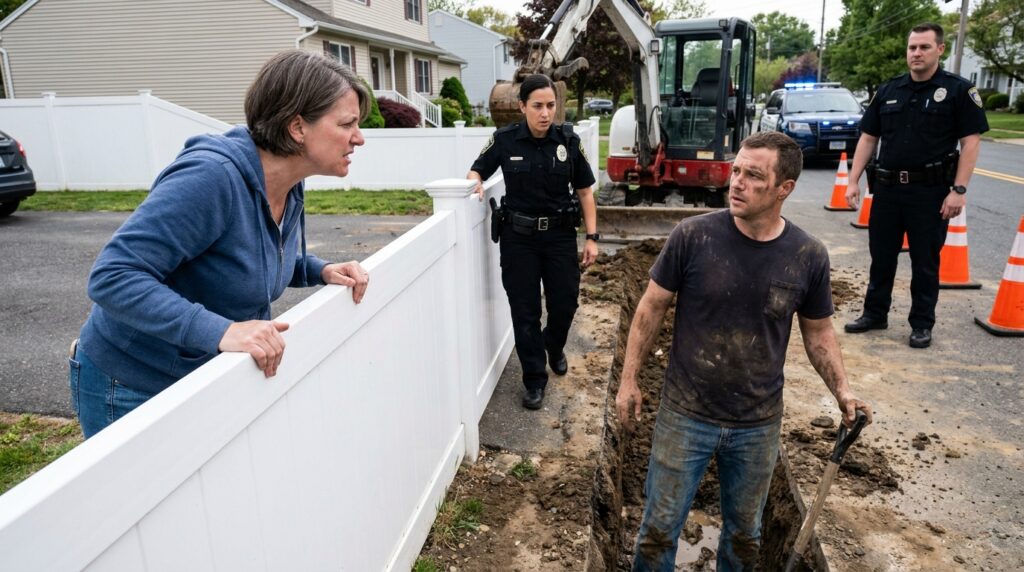
The backup officer took a fast half-step backward, the dry fescue flattened beneath his duty boots as he tracked the grey, pressurized water now spurting from the split seal in rhythmic, pulsing jets. “The pressure’s climbing,” he called out, his hand instinctively dropping to steady his utility belt against his hip. “That main isn’t bypassing—it’s locking up.”
Across the fence line, the homeowner didn’t move. She stood behind the white vinyl panels, her sunglasses pushed all the way down to her shirt collar, her bare eyes wide as she watched the grey liquid bubble up over her manicured bluegrass. The old manila folder was pressed flat against her ribs, but her fingers had begun to sweat through the paper, leaving wrinkled, dark crescents along the edges of her two-thousand-and-two subdivision deed.
“Turn it off,” she said, her voice dropping its brittle, bureaucratic clip and turning reedy. “You’re flooding the drainage channel. My crawlspace sump pump can’t clear a full line release. If that water backs up into the foundation piers, the warranty is void.”
“I can’t turn it off because your landscapers buried the secondary isolation sleeve under four inches of dyed mulch,” Mark said. He didn’t look at her face. He stood up, his lower back popping with a dry, gravelly click that matched the grinding of his boots on the road gravel. He grabbed a five-foot T-handle key from the back of his utility truck, the long iron rod clattering against the rusted wheel wells of his service bed. “The main valve is locked open. The city hasn’t serviced this line casing since ninety-nine because your association built this entire perimeter layout right over the access vault.”
The intervening officer stepped into the center of the lane, her black uniform vest smeared with the fine grey lime silt that was misting from the leaking joint. She pulled a heavy police radio from her shoulder lapel, her thumb clicking the side button with a sharp, mechanical snap. “Dispatch, this is Unit Four. We have an active infrastructure rupture at forty-four Laurel Court. Notify the municipal water supervisor. We have a non-compliant residential perimeter blocking the main shut-off.”
“This is a private easement!” the homeowner cried out, her foot stomping against the turf as if she could physically force the rising water back into the clay. “The township signed the subdivision release. We have a legal exemption from municipal structural entry!”
Mark didn’t argue the text. He walked back to the valve box, his boots sinking two inches deeper into the gray ooze with every stride. He jammed the iron jaws of the T-handle key through the mud, feeling the cold, metallic clunk as the tool finally found the subterranean valve head. He threw his weight against the crossbar, his shoulders tightening until his dark T-shirt strained against his shoulder blades.
The iron didn’t budge. Instead, the rusted valve casing beneath the grass gave a low, sickening ping—the sound of aged iron crystallizing under shear stress.
Below the grass line, a secondary piece of metal broke free. A small, circular brass plate, corroded to a deep verdigris green and encrusted with dried lime, floated up through the grey froth of the puddle. Mark reached down, his bare fingers scooping the metal disc out of the sludge. He wiped the surface across his jeans, exposing a deeply stamped alpha-numeric code: AQ-BUFFER-99.
It wasn’t a water main code. It was a geological survey marker—a designation reserved exclusively for subterranean water table controls.
The intervening officer knelt beside Mark’s boots, her shadow cutting across the pulsing water. Her eyes tracked the stamped brass disc in his hand, then shifted back to the unrolled GIS maps on the hood of the cruiser where the blue strobe lights were still cutting their silent, rhythmic circles through the air.
“That’s not an infrastructure layout line,” she said, her voice dropping into a flat, calculating whisper that didn’t clear the ditch. She looked up at the white vinyl fence, tracking the way the posts hummed with the internal vibration of the buried pipe. “The city didn’t just run a line here three years before she bought the lot. They locked down this entire section of the ridge. The whole block is sitting on a moving aquifer zone.”
Mark looked at the woman behind the fence. She was staring at the brass disc in his hand, her lips parted, the manila folder finally slipping from her fingers and dropping into the wet, gray mud at her feet. She wasn’t looking at a contractor anymore; she was looking at a truth that made her signed neighborhood covenants look like nothing more than wet paper.