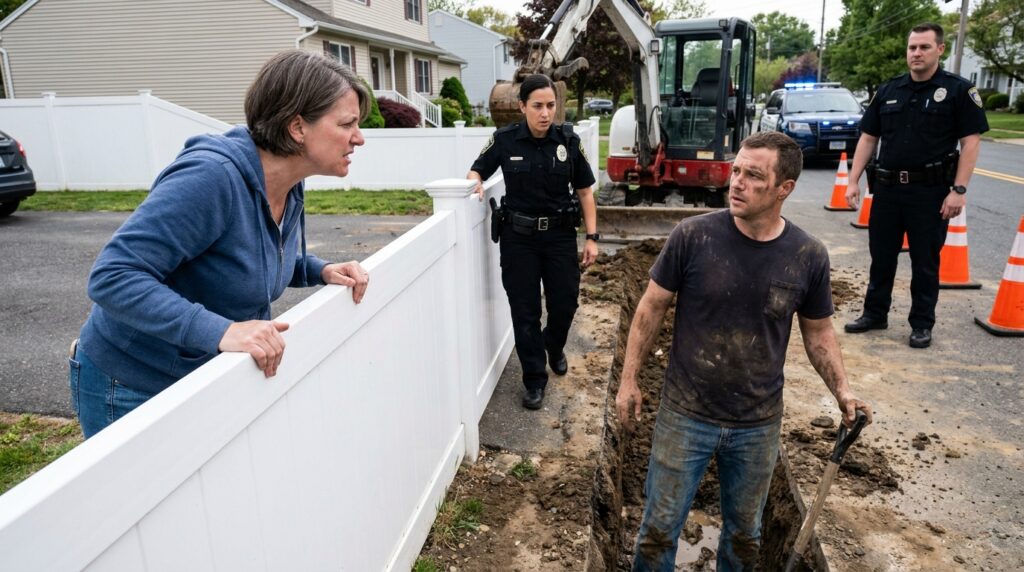
CHAPTER 7: THE ULTIMATUM ON LAUREL COURT
The wet, gray folder lay half-submerged in the churned clay, its blue notary seal dissolving into the silt like old ash.
Mark stood with his boots planted on the solid edge of the roadway, his forearms resting on the horizontal crossbar of the five-foot T-handle key. The heavy iron tool thrummed with a low, sub-surface vibration as the water main underneath continued its deep, rhythmic choking. Every pulse of the subterranean leak forced a thin, muddy geyser through the space where the homeowner’s vinyl post met the turf. The old scar across his index finger was tight, cold, and entirely numb from the spray of the grey water.
The intervening officer stepped back from the cruiser’s hood, her heavy leather boots clicking once against the asphalt before sinking into the ruined lawn strip. She held a thick, yellow carbon pad in her left hand, her pen poised above the lines with a cold, administrative finality.
“Ma’am,” she said, her voice flattening out until it carried the exact weight of a county summons. “The master survey lines are verified. The town council locked down this infrastructure lane five years ago to stabilize the ridge aquifer. Your neighborhood association’s covenants are secondary to an active municipal safety order. You are currently maintaining a structural barrier inside an emergency service easement.”
The homeowner didn’t reach for the ruined papers in the mud. She stayed behind the white vinyl fence, but her posture had changed; the aggressive forward thrust of her shoulders had collapsed into a rigid, hollow stance, her hands hanging loose near the pockets of her blue hoodie. The oversized sunglasses had slipped entirely down her nose, exposing the sharp, tired creases around her eyes to the glare of the strobe bar.
“We were never served with a rezoning notice,” she said, though the words lacked the brittle, sharp entitlement of her morning demands. They came out flat, hollowed out by the rhythmic, heavy thump of the mini excavator idling behind her. “We paid our assessment fees to the developer. The board cleared the lot borders.”
“The developer went under during the ninety-nine aquifer slide, ma’am,” Mark said. He didn’t lift his hands from the iron key. He pointed his chin toward the base of the white post where the stamped identification serial was now entirely clear of dirt. “The town took over the utility buffer before they ever poured your driveway. The board knew it. The handwritten entries on that old carbon copy you dropped were code violations from the county engineering pool, not an exemption.”
The backup officer stayed near the rear quarter-panel of the Explorer, his watch posture steady as three more neighbors walked down the cul-de-sac asphalt to watch the state vehicle. The presence of law enforcement had turned the property-line fight into a permanent record; the elderly man from two doors down had pulled out a silver flip-phone, his arm raised to catch the image of the mud-stained contractor standing beside the city’s open layout maps.
The intervening officer ripped the yellow sheet from her citation pad with a single, crisp snap that sounded like dry kindling breaking in the quiet lane. She didn’t stretch her arm over the rail this time; she held the document flat against the vinyl panel, her knuckles resting against the white plastic until the homeowner slowly reached out to take it.
“This is an official warning for easement obstruction and delaying municipal infrastructure repairs,” the officer stated, her gaze locking onto the woman’s bare eyes. “The city owns three feet past your fence, ma’am. If you interfere with this excavation or refuse to clear the workspace for the utility crew, you will be cited under the county civil code and the contractor will be authorized to remove the paneling at your expense.”
The woman’s hand closed over the yellow carbon sheet. The paper crinkled under her thumb, the ink-stamped warning lines reflecting the steady blue pulse of the cruiser’s roof bar. She looked down at the mud trench, then at the heavy iron T-handle key wedged deep into her lawn, and finally at the small crowd of neighbors watching from the curb. Her mouth opened to voice a final objection, but the mechanical grunt of the utility truck’s hydraulic pump cut the air, terminating the conversation before it could begin.
Mark didn’t wait for her to step back from the rail. He gripped the crossbar of the iron key, his shoulders bunching as he prepared to turn the frozen valve head against the weight of the rising main.