CHAPTER 2: THE HEAVY SILHOUETTE
The heavy crunch of gravel under a low-profile tire killed the homeowner’s next sentence before it could clear her lips.
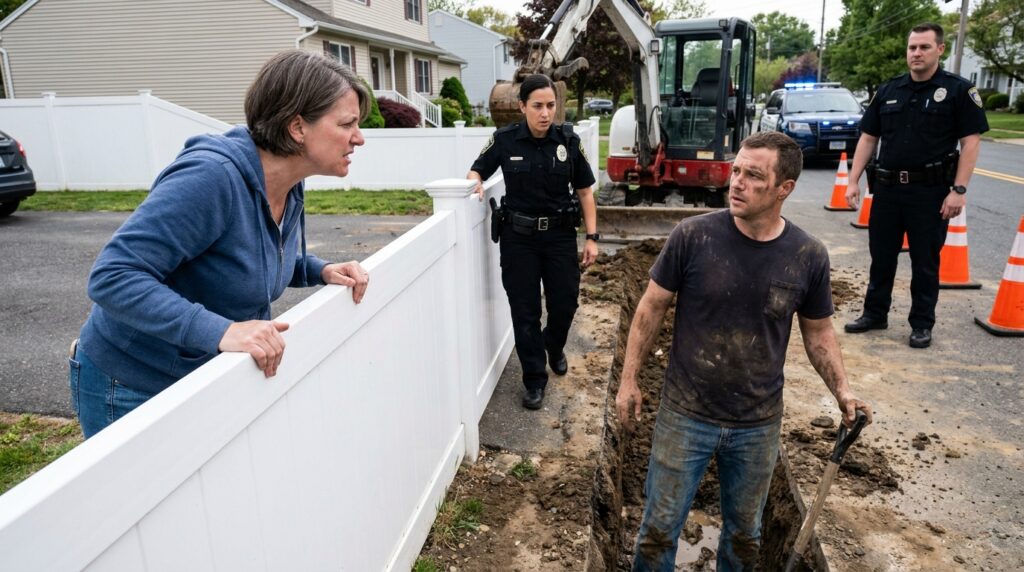
Mark didn’t shift his boots from the clay. He kept his left hand clamped onto the worn hickory shaft of the shovel, feeling the heat of his palm sink into the grain. The Ford Explorer didn’t bounce as it took the rolled curb; it settled into the dry grass with the slow, oily weight of a machine built for containment. The driver’s side door swung open with a dry, mechanical hinge-groan that spoke of dust-choked county roads and ungreased latch pins.
The woman behind the fence didn’t pull back. Instead, her fingers tightened on the top vinyl rail until the white plastic creaked under the leverage. She adjusted her sunglasses with her free hand, the small manila folder rattling against her thigh like dry husks in a draft.
“Officer,” she called out, her voice dropping its frantic edge and picking up the smooth, practiced cadence of a person who knew how to file an official report. “Down here. Right now, please.”
Mark watched the silhouette slide out from behind the steering wheel. It wasn’t the sheriff’s deputy she’d threatened him with. The patch on the shoulder was blue and gold—municipal police. A female officer, early thirties, her utility belt clicking with a rhythmic, metallic density as she stepped into the gap between the gravel shoulder and the yellow cones. Behind her, from the passenger side, a larger frame moved into the background—the backup officer, his black uniform stiff, his hands resting naturally near his belt line, taking up position near the rear quarter-panel of the cruiser where the blue strobe lights began their silent, rhythmic pulse against the clean white fence.
The intervening officer didn’t look at the house, and she didn’t look at the folder. Her eyes went straight to the excavation lane—to the raw, three-foot ditch where the wet clay was already beginning to seep a dark, oily sheen of stagnant water from the split main.
“Ma’am,” the officer said, her voice small but perfectly centered in the open air. “Step back off the fence line.”
“I am on my own property, Officer,” the homeowner said, her body remaining rigid, though her weight shifted slightly back toward her heels. “This man is operating unvetted commercial machinery inside a private subdivision. He’s already destroyed forty feet of established sod, and he refuses to produce an HOA variance. I want him cited for criminal trespass and malicious mischief.”
Mark spit a dry grain of dust onto the tarp at his feet. He didn’t reach for the truck pocket where his paperwork sat. He just lifted his left foot, letting the weight of his boot settle back onto the shovel’s iron collar. “The valve box under her driveway is choking out the lower pressure loop,” he said to the dirt between them. He didn’t look up to see if the officer was listening. “If I don’t clear this lateral by noon, the line’s going to blow forty psi of gray water straight through her basement drain.”
“There is no leak,” the woman said, her voice rising an octave, the manila folder swinging out to point directly at the exposed roots of her lawn. “It’s a manufactured utility pretext. They want an anchor for the eastern expansion line, and they’re using my yard to bypass the county easement. I have the original residential plat right here.”
The intervening officer took two steps forward. The soles of her boots didn’t click on the asphalt; they made a heavy, flat thud against the soft turf of the shoulder. She didn’t look at the paper the woman was trying to shove over the rail. Her eyes were fixed on the base of the white vinyl fence, right where the plastic sleeve met the freshly turned dirt.
Mark noticed it then, too—a detail he’d missed while clearing the first layer of bluegrass. The bottom edge of the vinyl post wasn’t resting in a standard concrete footer. It was pinned to a rusted steel survey stake with a length of braided wire, the iron oxide bleeding a dark, orange stain into the clean white PVC. On the lower flange of the post, stamped into the plastic in tiny, dirt-clogged numbers, was a regional utility serial—not a residential manufacturer’s mark.
The officer stopped exactly one foot from the trench edge, her body forming a solid, dark wedge between the fence and the pit. She didn’t reach for her sidearm, but her right hand stayed clear of her torso, her thumb hooked into the webbing of her vest.
“Sir,” she said to Mark, her gaze still tracking the rusted wire at the base of the post. “Turn the excavator off. Let’s get the boots on dry ground first.”
Mark didn’t move immediately. He let his eyes trace the line of the trench back to his truck, where the yellow light on the cab was still spinning its lazy, amber warning against the afternoon shadow. The woman was already unlatching the folder, her thumb hooking into a faded blue legal seal at the bottom of a oversized map. She was smiling now—a small, sharp pull of the lips that didn’t reach past her jaw. She thought the blue uniform was her leverage.
Mark slowly let go of the shovel. The wood slid through his leather gloves with a dry hiss, leaving a trace of gray clay along his palm. He reached up, his fingers catching the cold iron handle of the mini excavator’s cabin frame, his boot finding the mud-slick track as he prepared to pull his weight out of the hole.