CHAPTER 5: THE BOUNDARY SHIFT
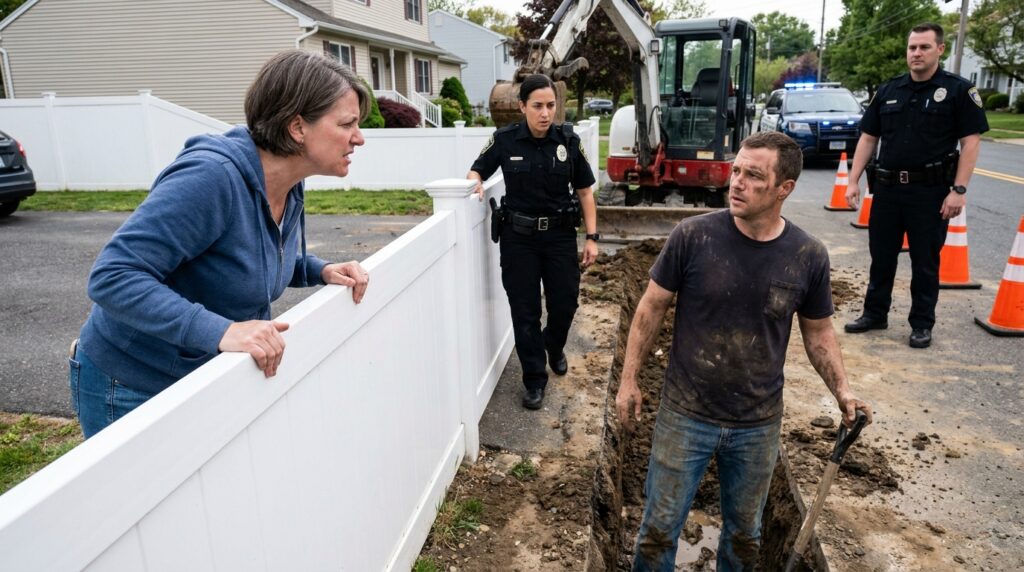
The white paper blueprint didn’t flutter under the officer’s palm; she pinned it flat against the warm, gritty hood of the cruiser while the blue strobe bar overhead sliced across the clean engineering grids.
Mark wiped a smear of dark clay from his temple with the back of his wrist, leaving a chalky gray trail against his skin. He didn’t look at the homeowner, whose shadow still stretched long and rigid across the vinyl panels. His attention remained fixed on the lower right corner of the city’s master document—specifically the tiny, ink-stamped seal of the Municipal Water District that bore a revision date from October of ninety-nine.
“This is the active registration,” the intervening officer said, her voice dropping into a professional, hollow clip that left no room for neighborhood interpretation. She traced a heavy finger along the shaded blue boundary indicating the town’s primary utility easement line. “The easement isn’t measured from the curb, ma’am. It’s anchored to the sub-surface bedrock main. The twenty-four-inch right-of-way extends three feet into this turf lot.”
The homeowner’s fingers slipped from the vinyl top rail. She didn’t retreat up her driveway, but her weight shifted back into the dry fescue, her leather deck shoes sinking slightly into the manicured sod. “The association title office assured us that all municipal entries were closed out when the second phase of construction was finalized in two thousand and two. That seal hasn’t been verified by a residential surveyor in twenty years.”
“A city easement doesn’t expire because you built a fence over it,” Mark said. He leaned his hip against the cruiser’s steel bumper, feeling the engine’s low, internal thrum vibrate through his grease-stained jeans. He unhooked a heavy iron flashlight from his belt, pointing its narrow beam into the bottom of the open trench where the sluggish pool of dark groundwater was beginning to rise. “Look at the casing down there. That’s three-inch galvanized pipe. You don’t lay that for a private sprinkling system. That’s a high-pressure bypass, and the joint is failing right underneath your third post footer.”
The woman pulled her blue hoodie tighter around her throat, the manila folder shaking against her ribs like dry parchment. Her eyes darted toward the sidewalk, where two more neighbors had paused their lawnmowers to watch the state vehicle. “If you undermine that post, the entire eastern section of this perimeter will lean. The structural integrity of the vinyl is guaranteed by contract. Any modification by an outside crew violates our neighborhood warranty.”
The backup officer stepped away from the orange safety cones, his boots grinding a dry crunch into the gravel shoulder. He reached down to adjust his duty belt, his eyes shifting toward a rusted, iron valve box cover that sat flush with the soil just two feet behind the homeowner’s fence line. He used the toe of his heavy boot to scrape away a layer of dead crabgrass, exposing a corroded brass bolt head that had been painted over with green lawn dye.
“Ma’am,” the backup officer called out, his voice a low baritone that rumbled under the drone of the idling cruiser. “Is this valve assembly registered with your association’s architectural committee?”
The homeowner stiffened, her jaw tightening until the tendons in her neck showed thin and pale under the midday sun. “That’s an old agricultural drainage cap from the original farmstead. It was deactivated before the cul-de-sac was paved. It has nothing to do with our current plumbing.”
Mark walked toward the exposed valve casing, his heavy boots leaving dark, clotted prints on the dry grass. He knelt down, the joints in his knees popping like dry twigs. The iron cover was choked with mineral rust, the scale flaking off in flat, bitter-smelling red discs as he tapped the side with the butt of his flashlight. It wasn’t an agricultural cap; the hexagonal lock-bolt was deeply scored with the distinct three-groove configuration used exclusively by municipal main line inspectors.
“This line isn’t dead,” Mark muttered, his thumb tracing the crust of dried green paint that had failed to seal the iron threads. “It’s pressurized. And it’s running hot.”
The intervening officer stepped back from the hood, rolling the blueprint tube shut with a quick, practiced twist of her wrists. She looked at the homeowner, then at the rising pool of dark water inside the mud ditch. The neutral demeanor she had maintained since her arrival began to harden into something far more restrictive.
“Ma’am,” she said, her voice dropping any trace of casual inquiry. “We have a municipal infrastructure failure occurring inside a verified public access zone. If your fence is preventing this contractor from accessing the shut-off sleeve, you’re not just dealing with an HOA dispute anymore. You’re actively interfering with an emergency service response.”
The homeowner took her phone out of her pocket, her thumb hovering over the glass screen, but she didn’t tap the surface. Her gaze was locked onto the rusted iron valve box behind her fence—a piece of municipal iron she had spent ten years pretending didn’t exist, now bleeding a thin, steady trickle of gray water through the sod and straight toward her foundation.