CHAPTER 3: THE BURIED EDGE
The key snapped left in the ignition, and the diesel rattle died with a shudder that vibrated through Mark’s boot soles.
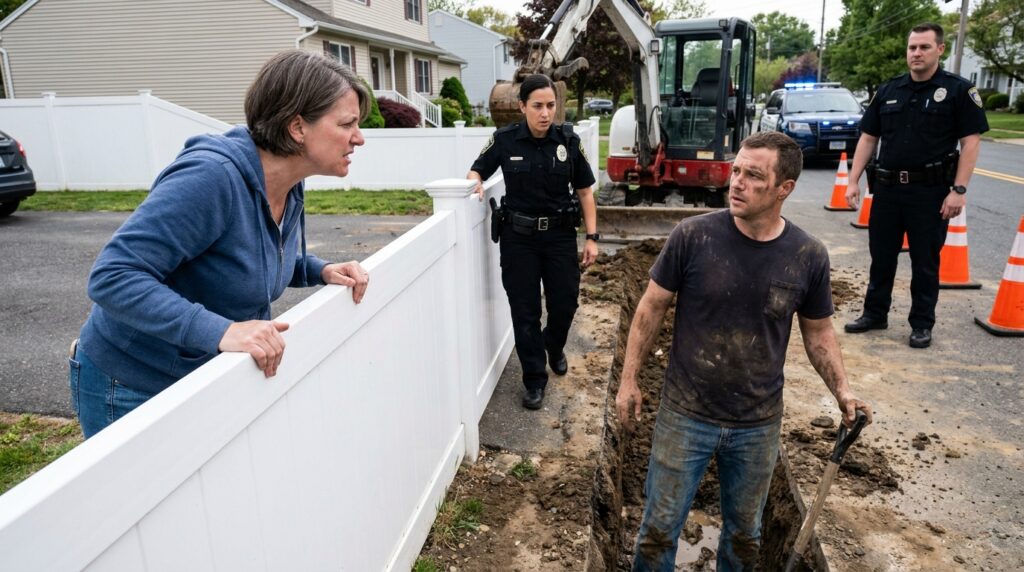
Silence rushed back into the suburban easement, heavy and thick with the smell of scorched hydraulic oil and damp earth. Mark slid out of the mini excavator’s steel seat, his hip brushing the cold, rusted track frame as he dropped down into the three-foot trench. The sun-baked clay at the top was hard as brick, but the deeper he sank, the softer the walls became. Near the base of the white vinyl fence, the mud was cold, clinging to the sides of his heavy leather work boots with an unyielding, thick suction.
The homeowner didn’t move from her perch. She held the manila folder over the white rail, the paper edge trembling slightly as a light breeze picked up from the eastern cul-de-sac.
“The machinery is quiet now, Officer,” she said, her fingers tracing the edge of the blue legal seal at the bottom of her document. “Now we can document the unauthorized damage to the perimeter. My husband and I didn’t spend twelve thousand dollars on premium fencing just to have a municipal subcontractor scrape the structural post footers bare.”
Mark leaned down, his gloved fingers brushing against the lower flange of the white vinyl post where the dirt had been scraped away by his spade. He didn’t look up at the woman, nor did he look at the intervening officer who was now checking the edge of the pit with a slow, disciplined stride. Mark’s focus remained entirely on the small, stamped numbers embedded in the plastic sleeve.
“This isn’t a standard residential post,” Mark muttered, his voice gravelly from the dust. He scraped away a crust of orange iron oxide with his thumbnail, exposing a clean section of the stamp. “District Four infrastructure mark. Stamped ninety-nine. This sleeve was set by a county crew before this development ever broke ground.”
The woman’s hand went rigid against the rail. “That’s an absurd lie. The homeowners association handled the layout for the entire block in two thousand and two. Every inch of this boundary falls under our residential restrictive covenant. The developer signed off on it, and the original plat is right here.” She thrust the folder forward, the paper rattling. “Look at the signature, Officer. It extends our private maintenance line right to the asphalt gutter.”
The intervening officer didn’t take the document. Instead, she knelt by the side of the trench, her black uniform trousers stretching tight over her knees as she leaned down to inspect the rusted wire pinned to the survey stake. Her fingers didn’t touch the mud, but her gaze was sharp, tracing the line where the vinyl sleeve met the iron rod.
“Ma’am,” the officer said, her voice dropping into a low, even register that cut across the woman’s sharp cadence. “Who installed this wire at the base of your post?”
The homeowner paused. The sunglasses masked her expression, but the skin around her jaw tightened, the muscles bunching under the pale skin. “The landscaping crew reinforced the line after the heavy rains last spring. The soil was shifting near the curb. It’s a standard property maintenance measure.”
Mark stood up slowly, the wet clay making a wet, tearing sound as his boots broke free from the bottom of the ditch. He wiped his hands on his thighs, leaving dark streaks of mud across his blue jeans. He looked at the folder she was holding. Tucked behind the main plat map was a smaller, yellowed slip of carbon paper—an old code-enforcement warning from nearly a decade ago, its edges frayed and stained with old watermarks. At the very top of that yellow slip, a sequence of handwritten figures matched the brass serial numbers stamped into the base of the city’s infrastructure valve.
“Your landscapers didn’t touch this,” Mark said, his eyes locking onto the corner of the folder. “That stake is a benchmark marker from the county engineering division. It’s pinned there because this whole three-foot strip isn’t part of your residential lot. Your covenant map is old text, ma’am. It doesn’t include the public easement update from ninety-nine.”
The woman drew her shoulders back, her chest thrusting against the vinyl rail as she pulled the folder close to her body. “I don’t care what kind of bureaucratic marks you think you’ve found in the mud. The association rules are clear. No excavation within five feet of an established residential structure or boundary fence without a forty-eight-hour written notice to the board. You didn’t file. You just showed up with a trailer and started tearing into the sod.”
The backup officer stayed near the orange cones, his upright watch posture unbroken, his eyes tracking a delivery truck that had slowed down at the corner to watch the blue lights strobe against the houses. The presence of law enforcement was drawing attention now; two doors down, an elderly man in a gray fleece vest stepped out onto his porch, his hands shoved deep into his pockets as he stared toward the yellow mini excavator.
“Officer,” the homeowner demanded, her voice dropping the smooth report cadence and turning brittle. “Are you going to let him continue to destroy my yard, or are you going to do your job and enforce the county code?”
The intervening officer stood up, brushing a speck of dry clay from her knee. She looked from the woman’s tense, white-knuckled grip on the fence down to the open trench where the dark water was slowly gathering around the cracked main line.
“We’re going to verify the layout right now,” the officer said, turning her head toward Mark. “Sir, get your permit folder out of the cab. Let’s see what the city stamped on your work orders before we pull any more dirt out of this hole.”
Mark nodded once, his jaw set. He climbed up out of the trench, his muddy boots heavy on the grass as he walked toward the utility truck. He knew exactly what was in his glove box, but as he reached for the rusted handle of the passenger door, he noticed something else—the yellowed slip of carbon paper inside the woman’s folder had a specific municipal department code printed on the side, one that hadn’t been active since the city council reorganized the infrastructure budget five years ago.