
CHAPTER 4: THE ANCHOR INCIDENT
“You cannot just come onto my property and dig beside my fence!”
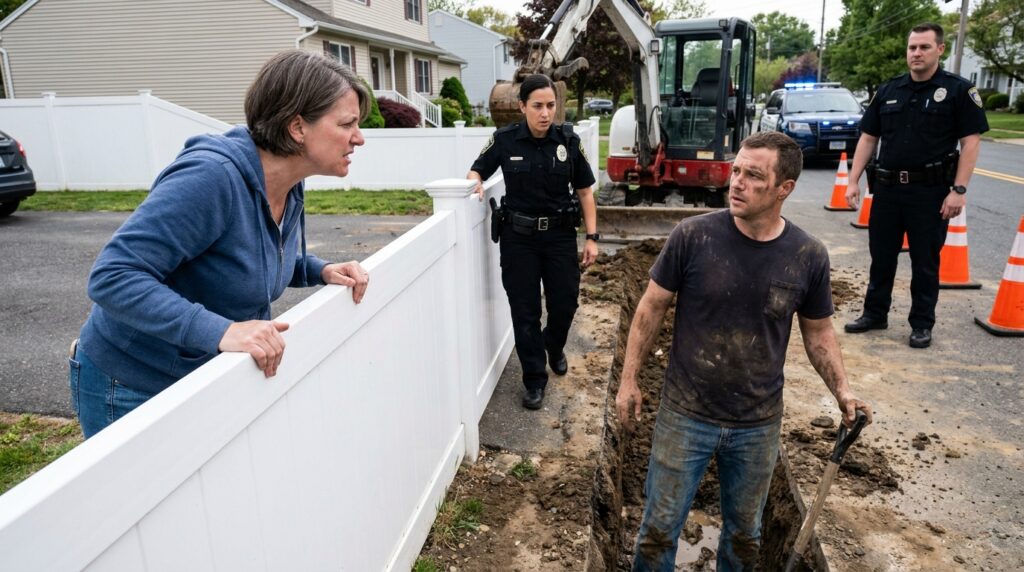
The scream didn’t just clear the fence line; it hit the street with the force of an indictment. The homeowner leaned so far over the white vinyl rail that the plastic bowed beneath her sternum, her hands white-knuckled where they bit into the top cap. Her sunglasses had slipped down her nose, revealing wide, manic eyes that locked onto Mark like twin crosshairs.
Inside the trench, Mark froze. The galvanized spade of his shovel remained wedged deep into the wet, dark clay, the suction of the mud holding the blade rigid. His hands came up instinctively, fingers open, elbows tucked low—the universal posture of a blue-collar worker trying to drop the temperature of a scene before someone loses their mind. The old, thick scar across his left index finger hummed against his knuckle, a jagged line of heat triggered by the sudden jump in atmospheric tension.
“Ma’am, step back from the edge, let us sort this out now.”
The intervening officer didn’t wait for a compliance check. She slid her torso into the two-foot gap between the bowing vinyl fence and the crumbling lip of the trench, her black utility vest forming a stark, shadow-like wedge between the two factions. Her palm was out, a flat, non-negotiable barrier pushed directly toward the homeowner’s face. Behind her, the backup officer drifted three paces to the right, his boots crunching methodically over the dead fescue as he mirrored the crowd of three neighbors now gathering at the edge of the asphalt.
The homeowner didn’t step back. Instead, she slapped the manila folder flat onto the vinyl rail, the impact sounding like a pistol shot in the small yard. “I have the original subdivision layout from two thousand and two, Officer! Look at the stamp! Look at the gold seal from the county registry! The developer signed over this entire turf buffer to the association covenants. This man’s dig order is a complete overreach!”
Mark hoisted his right boot, the heavy leather releasing from the gray ooze with a wet, wet slap. He didn’t climb all the way out of the ditch yet; he just stood on the lower shelf of the excavation, his chest level with the raw sod line. His face was gray with stone dust, his dark T-shirt streaked with grease from the excavator’s swing gear.
“The covenant paper she’s holding is an old draft,” Mark said, his voice dropping into a flat, gravelly register that didn’t rise to meet her volume. He pointed a mud-caked thumb toward the utility truck parked by the orange cones. “I’ve got the city engineering survey from ninety-nine inside the cab. The public main loop was locked in three years before her developer even bought the farm.”
“Don’t talk to him, look at the signature!” The homeowner thrust the document packet under the officer’s chin, her thumb anchoring the pale blue page.
The intervening officer didn’t blink. Her left hand reached up, her fingers sliding over the edge of the blue carbon page with a slow, grinding precision. She didn’t pull the folder away from the homeowner, but she used the leverage of her forearm to force the woman’s chest three inches back from the workspace line. Her eyes scanned the text, tracking the faint, faded ink of a notary seal that had turned brown with twenty years of storage.
“This is a signed property deed, ma’am,” the officer said, her tone level but tight as she noted the handwritten text at the margin. “But the layout lines here terminate at a municipal utility anchor point. See this brass sleeve number in the legend? That matches the stamp at the base of your fence.”
Mark pulled himself onto the dry turf, his knees cracking as his boots hit the solid ground. The friction of the morning’s labor had settled deep into his lower back, a familiar, dull ache that made his movements deliberate. He walked to the driver’s side of his service truck, flipped the galvanized latch on the side tool box, and hauled out a heavy, transparent plastic tube. The blueprints inside were crisp, printed on heavy white bond paper that didn’t rattle in the breeze.
As he unrolled the map across the hood of the police cruiser, the strobe of the blue lights washed over the clean, digital lines of the city’s updated GIS grid. The neighbors on the sidewalk stepped closer, their phones rising in unison to catch the shift in the dynamic.
The homeowner’s mouth opened, then clicked shut. She looked from the map on the cruiser’s hood to the tiny, stamped numbers on her own folder, her fingers beginning to slide against the wet plastic of the fence cap as she realized the physical boundaries she had spent twelve thousand dollars to defend were built over a municipal void.
“We need a full survey check,” the worker said, his hand flattening the center of the updated plot map. “Because according to this seal, your entire fence line is sitting twenty-four inches inside the city’s primary access lane.”








