
CHAPTER 6: THE BLOODLINE LEDGER
The rear door of the staff vehicle clicked shut with a deadened, pressurized thud, instantly slicing through the grinding roar of the vehicle yard’s multi-fuel engines. Inside, the air conditioning hummed, a thin, clinical stream of chilled air that did nothing to lower the hot, suffocating burn in Miller’s chest. The desaturated gray upholstery felt unyielding against his dirt-caked camouflage trousers. General Brooks sat rigidly beside him, his gaze fixed on the heavy canvas binder resting across Miller’s trembling knees. The leather bindings of the book looked impossibly thick, its edges frayed into coarse, grey threads that caught on the synthetic weave of Miller’s uniform.
“Open it,” the General said. His voice was no longer a command meant for the public squares of the yard; it was flat, heavy with a jagged, structural fatigue.
Miller thumbed the corroded brass latch. As the heavy parchment pages fell open toward the red-circled layout of Route 9, the sharp motion dislodged a second document that had been jammed deep behind the ledger’s rear reinforcement strip. It was a charred, dog-eared field manifest, its top margin stained with black soot and oil rot. Miller pulled it out mechanically, his thumbs scraping against the coarse paper grains. His eyes scanned the unpolished, typewritten print at the top: Joint Logistics Task Force – Off-Grid Deployment, Sector 4.
“Look at the unit routing logs at the bottom, Specialist,” Brooks murmured, his gray eyes darkening as he leaned closer, the silver stars on his shoulder line casting a hard shadow across the desk plate. “The network failure isn’t something we are anticipating. It already happened.”
Miller’s gaze dropped to the casualty summary appended to the back of the manifest. His eyes locked onto a single name: Staff Sergeant David Vance. Lost in transit, Sector 4 operational corridor. Structural bridge failure during fuel asset retirement.
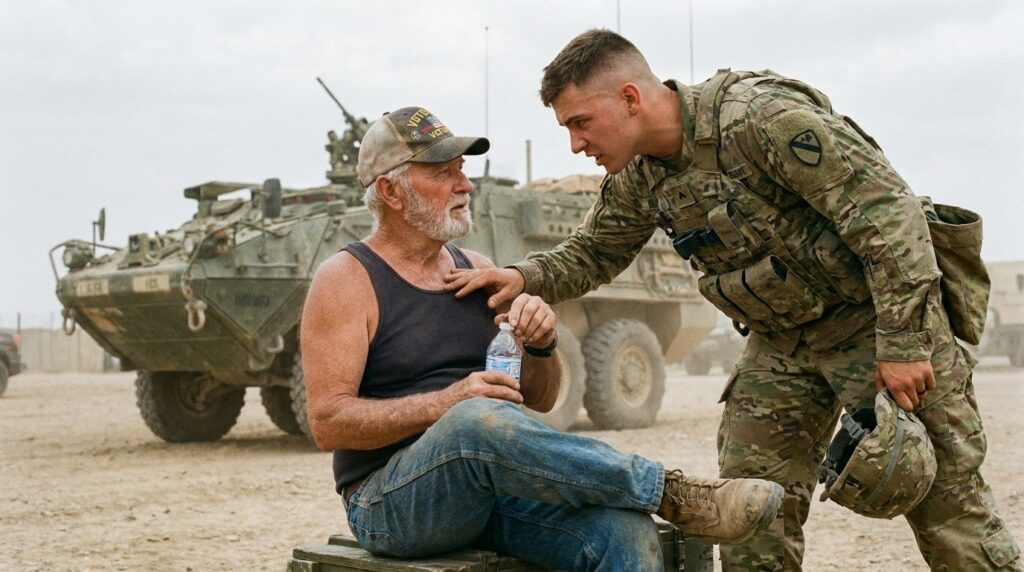
The dry air in Miller’s lungs seemed to turn to solid stone. Vance. His mind reeled back to the yard outside—to the old man sitting on the concrete barrier with his weathered cap, and to Sergeant Vance, the bay manager, who was currently out there tracking shipments with a grease pencil.
“David was Marcus’s eldest grandson,” General Brooks said, his hand coming down onto the top of the canvas binder with a dull, hollow thud. The iron rings of the binder groaned under the pressure. “Three weeks ago, our central automated routing system sent David’s logistics column across an unverified secondary bridge in an off-grid sector. The computerized manifest marked the route clear based on drone photography. It didn’t factor in the physical decay of the foundational pilings beneath the waterline. The entire platform folded under the lead truck. David went down with the cargo.”
The silence inside the staff vehicle became absolute, a suffocating weight that crushed the remaining remnants of Miller’s institutional entitlement. He looked out the tinted glass window, where the old veteran was still visible through the haze of diesel exhaust. General Marcus Vance hadn’t driven down to this dusty staging yard to protect an obsolete manual or to demand unearned deference from active-duty specialists. He had come because the system’s digital blindness had already cost him his blood—and because he knew that the modern fleet, running blindly on automated telemetry, was about to send another forty men down the exact same fatal corridor on Route 9.
“Marcus built these supply lines thirty years ago with his own hands,” Brooks continued, his fingers tracing the hand-inked initials M.V. on the 1974 blueprint. “He knew every bolt, every structural tolerance, and every weakness in the bedrock. When the automation took over, we quarantined his original logs because they didn’t fit the new network format. We locked the truth in the bottom locker of a maintenance shack and called it progress.”
Miller looked down at his own dust-stained sleeves, the white limestone grit embedded in the fabric looking less like a badge of labor and more like the residue of a profound, dangerous ignorance. His digital tablet, still pulsing with automated alerts in his cargo pocket, felt entirely useless—a flat, glass toy that had nearly led him to enforce a perimeter rule at the expense of an entire column’s survival. The old man’s tactical reversal out in the dirt hadn’t just been an act of self-defense; it had been the first necessary fracturing of a young soldier’s blind faith in an unyielding, unverified network.
“The system doesn’t know pain, Specialist,” Brooks said, his voice dropping into a low, scraping register that mirrored the old general’s tone outside. “But the men inside the uniform do. Marcus came here to fix the line because nobody else has the memory left to do it.”
Miller gripped the edges of the canvas binder until his calloused knuckles turned white against the stained fabric. The true architecture of the conflict was finally bare before him—not a simple clash of generations or institutional authority, but a grim, pragmatic race to save a modern peacetime force from the fatal weight of its own digital hubris. He didn’t say a word. He simply closed the ledger, the heavy brass latch clicking back into place with a definitive, metallic snap that signaled the absolute end of his ignorance.








