
CHAPTER 4: THE DECOY BLUEPRINT
The maintenance shack smelled of fifty years of trapped humidity, old gear oil, and decaying wood pulp. Inside, the roar of the staging yard’s diesel engines dropped into a muffled, rhythmic thrumming that vibrated through the cracked concrete floor beneath Miller’s boots. Dust motes danced lazily in the thin shafts of orange light cutting through the high, reinforced windows. Miller lunged toward the back corner where the old steel lockers stood, their green enamel finishes blistered with patches of dark, scabby rust that scraped painfully against his knuckles as he yanked at the handle. The locking mechanism was seized, jammed tight by years of non-use and fine yard grit that had packed into the tumblers.
Miller cursed under his breath, his chest burning with the raw remnants of his humiliation out on the line. He didn’t use a key. He grabbed a rusted iron pry-bar from a nearby workbench, wedged the flat edge into the seam of the bottom locker, and threw his weight against it. The metal screamed—a sharp, tearing sound of rivets giving way—before the door burst open with a dull clang, dumping a cloud of gray, chalky dust over the knees of his already ruined trousers.
At the bottom of the locker, buried beneath a heap of dried-out neoprene gaskets and brittle fan belts, sat the heavy canvas binder Sergeant Vance had demanded. The fabric was stiff, discolored by water rings, and secured by a heavy brass latch covered in a thick layer of green oxide. Miller dragged it out, the weight of the book surprising him; it felt like a chunk of ballast stone rather than a routing index. He slammed the binder down on the grease-stained workbench, the impact sending a small shockwave of grit across the polished screen of his digital tablet.
He popped the corroded latch, the dry hinges scraping like bone, and flipped the heavy parchment pages. These weren’t standard military shipping logs. They were meticulously hand-drawn engineering schematics and operational flowcharts of the entire regional logistics grid, executed in fading blue ink. His fingers traced the rigid, crisp lines of the mountain routes, tracking the precise geographical choke points until he found Route 9.
The entry for the three-span iron truss bridge was flagged with a heavy red grease pencil circle. But it wasn’t the load rating that caught his eye; it was a physical document folded neatly into the sleeve of the binder page. Miller pulled it out, unfolding the stiff paper with shaky fingers. It was an unredacted structural blueprint revision from 1974, detailing the bedrock foundations of the base’s main supply routes. Down in the bottom approval block, stamped in faded purple ink, was an official military logistics design registry. The signature initials in the box read M.V.—the exact same font structure and alignment as the identification insignia on the vintage transport truck outside.
Miller’s breath caught. He shifted the document closer to the light. The blueprint explicitly showed that the modern computerized routing architecture—the system he had been trained to consider infallible—had completely overwritten a vital structural routing vulnerability. The server networks were routing the heavy modern fuel convoys based on modern concrete freeway specifications, completely blind to the fact that the actual underlying physical infrastructure of the regional pipeline junctions sat directly underneath the degrading foundations of Route 9’s iron bridges. If those trucks crossed, the weight variance would shatter the old pilings, triggering a catastrophic back-pressure collapse that would sever the fuel supply lines to every forward operating location across the eastern seaboard.
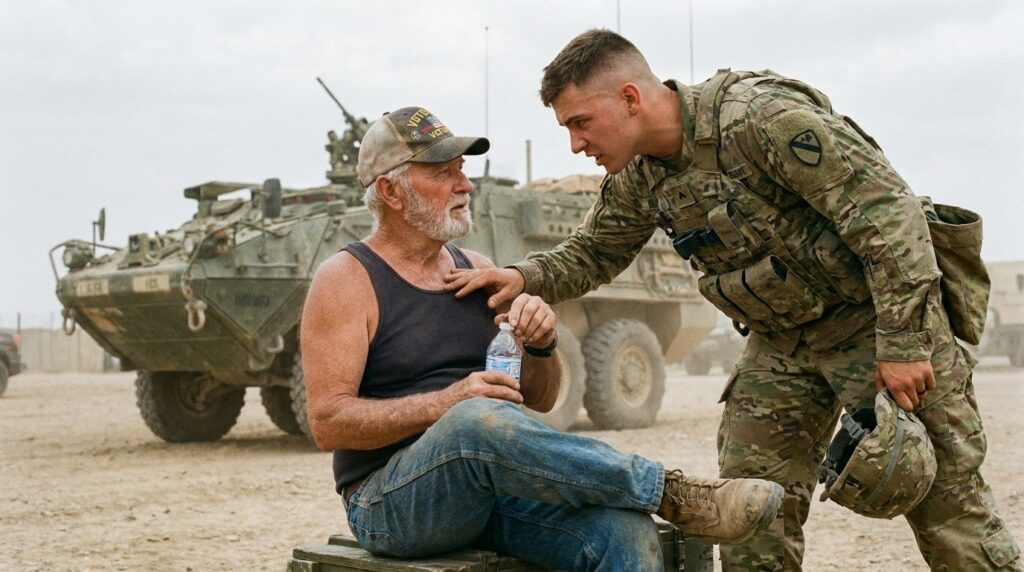
The old man wasn’t a random veteran loitering in the dust. He was the original architect who had physically mapped the structural limits of this entire operational sector. He didn’t need a digital biometric pass to know the line was failing; he had drawn the line before the modern network even existed.
Miller stared at the paper, the dry grain rough beneath his thumbs. The realization felt like a heavy, physical blow to his sternum, harder than his fall in the dirt. The digital system pulsing in his left hand suddenly looked shallow, a superficial layer of pristine, automated data laid over a cracking, rusted reality that was only held together by the unwritten memory of the man he had just tried to bully. He had been looking at the old man as an obsolete relic, totally blind to the fact that his own modern logistical prime was running headlong into a disaster that only that relic could prevent.
He snatched the canvas binder off the bench, his thumb pinning the 1974 document against the cover as he turned back toward the door. The friction of his starched uniform against his skin felt tight, restrictive, and suffocating. He didn’t walk; he ran back out into the blistering noon heat of the yard, the bright glare hitting his eyes as he hurried back toward the transport vehicle where Vance and the veteran were waiting.








