
CHAPTER 1: THE PRESSURE LANE
The heat in the vehicle staging yard didn’t just radiate from the sky; it rose from the sun-baked iron of the flatbeds and the heavy, ticking engines of the modern transport fleet. Everything smelled of unrefined diesel, ozone, and the sour tang of industrial grease. Specialist Miller wiped a streak of gritty condensation from his forehead, his thumb catching on the stiff, unwashed collar of his pristine camouflage utility uniform. The logistics tracking screen in his hand was flashing a persistent, rhythmic amber—three late shipments, a fouled manifest, and a supply chain backup that reached all the way to the state line. His combat boots felt heavy, the leather rigid and unyielding against the cracked gravel. He needed a clearing in the noise. He needed everyone to move precisely where they were told, when they were told.
Instead, he found the old man.
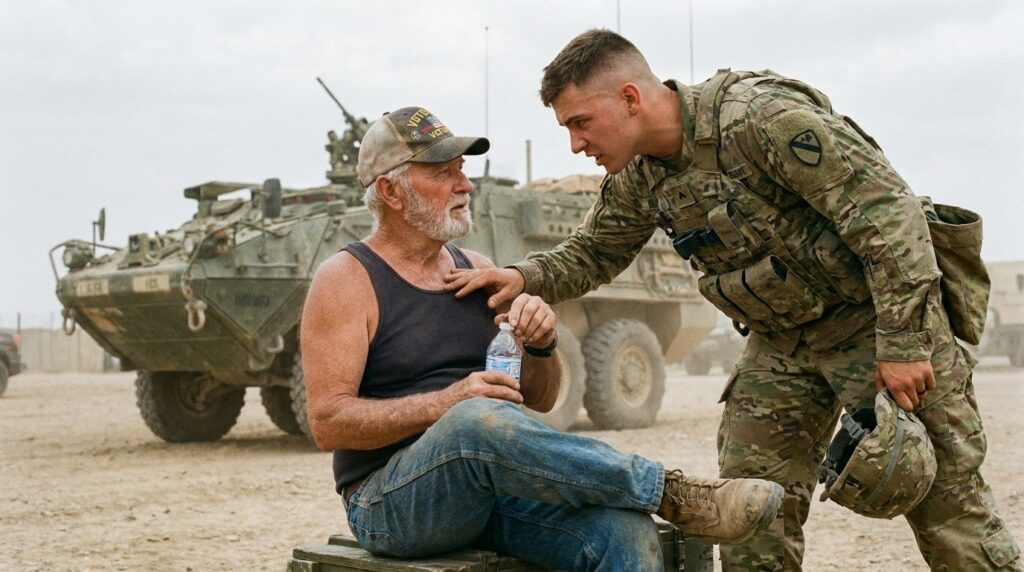
He sat on a low concrete barrier right in the shadow of a heavy Oshkosh transport vehicle, a massive relic of green steel that looked like it had been dragged out of a Cold War motor pool. The old man didn’t belong to the system. He wore a dark, threadbare tank top that exposed shoulders like knotted oak roots, a pair of grease-stained jeans, and heavy work boots that had seen decades of dry earth. On his head was a faded, oil-spotted veteran cap, its brim low enough to cast a deep shadow across his face. He wasn’t tracking the digital screens or listening to the screech of pneumatic wrenches. He was just holding a simple, unbranded plastic water bottle, his calloused fingers wrapped around the ridges with a steady, unblinking stillness.
To Miller, the man was a blockage in the throat of the yard. A civilian loiterer watching the frantic choreography of active-duty soldiers with a quiet, maddening detachment.
Miller marched across the lane, each step kicking up fine plumes of white dust that settled on the polished leather of his boots. His chest tightened with the dangerous, defensive energy of a man who believed his uniform gave him a monopoly on the local gravity.
“Old man,” Miller said, his voice cutting through the distant whine of an impact driver. “This is an active staging area. If you don’t have a modern biometric pass, you’re interfering with federal logistics. Stand up.”
The veteran didn’t move. He didn’t blink. He slowly tilted his head back, just enough for the noon sun to catch the hard, silver stubble along his jawline. His eyes were a pale, desaturated blue—clear, cold, and entirely devoid of the frantic panic that Miller was used to seeing in the junior ranks.
“The trucks are running three hours behind, son,” the old man said. His voice had the dry, scraping texture of gravel being shifted by a shovel. “Your tracking system is looking at the wrong hub. You should look at the line before you cross it.”
The dismissal was total. It wasn’t loud, but it carried the weight of a man who had commanded perimeters before Miller’s parents were born. Miller’s face flushed a deep, hot crimson beneath his short military haircut. His fingers twitched against the plastic edge of his digital tablet. The presence of the mechanics and junior troops in the background—suddenly slowing their work, their eyes turning toward the barrier—only sharpened the edge of his humiliation. He couldn’t let a civilian break the hierarchy. Not today.
Miller dropped the tablet onto the hood of the transport, stepped into the old man’s personal space until the heat of his starched uniform pressed against the cool shadow of the concrete, and reached down. His hand, thick and athletic, balled into a fist, grabbing a fistful of the old man’s dark tank top right at the throat.
“Get up and show some respect right now,” Miller barked, pulling upward to force the veteran to his feet.
The veteran’s hand didn’t drop the water bottle. But underneath the faded cotton of his shirt, the old man’s frame didn’t yield an inch. It felt like grabbing a rusted iron stanchion bolted deep into the bedrock of the base.








