
CHAPTER 3: THE ECHOING YARD
The heat seemed to compound inside the silence, pressing down on the open expanse of the staging area until the air itself felt heavy enough to fracture. Miller remained flat on his back for two more jagged inhalations, his shoulders grinding against the sharp crushed limestone. The dust he had stirred up settled over his eyelashes and into the open pores of his skin, gritty and sour with the chemical residue of standard-issue industrial runoff. No one moved. Across the lane, a mechanic holding a high-torque pneumatic wrench froze with his forearm resting over the hot, exposed block of a generator engine. The dull, green-painted metal surfaces of the surrounding fleet seemed to absorb the glare of the noon sun, radiating a dry, choking warmth that turned the fine sweat on Miller’s neck into a paste of fine earth and salt.
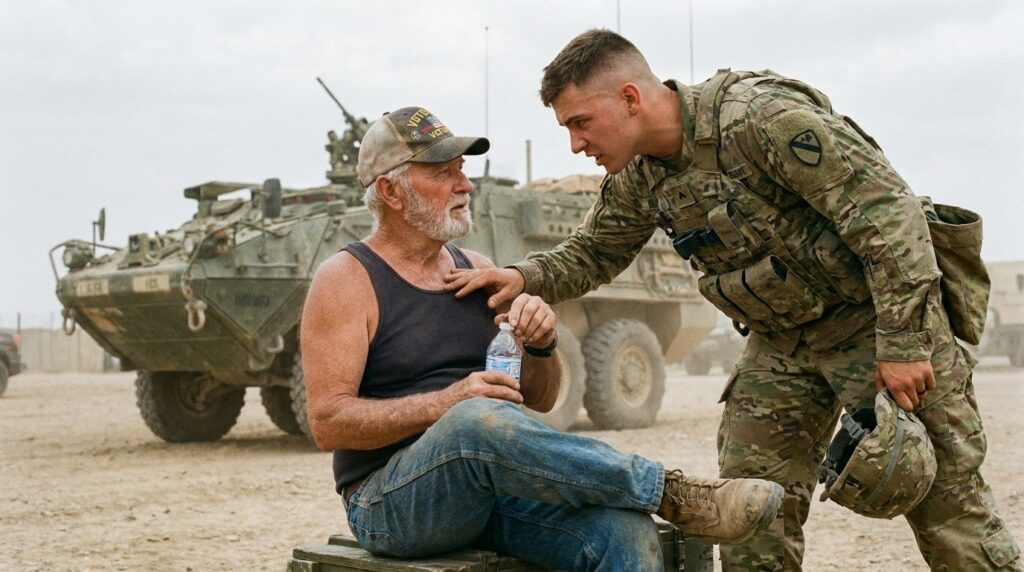
The old man didn’t offer a hand. He didn’t adjust his stance. He stood over Miller like an old piece of structural iron left out to weather in the high desert, his knuckles loose around the body of his water bottle. The shadow of his cap remained fixed across Miller’s chin, an unmoving border between the baking gravel and the cool, silent authority that had just dropped an active-duty specialist onto his spine.
Miller’s left elbow dragged across the stones as he forced his torso off the deck. His muscles rebelled, a deep, hot ache blooming between his shoulder blades where the physics of his own momentum had driven him home. He reached out, his fingers brushing against the cold, scarred rubber of the Oshkosh truck’s front tire to steady his weight. His knuckles scraped against a jagged, raised seam on the steel fender—a heavy, hand-stamped serial sequence that didn’t match the standardized laser-etched barcodes of the modern supply vehicles. It was primitive, deep, and deeply oxidized, the orange flakes of rust transferring to his sweat-slicked thumb like dried blood.
“Get up,” a voice called out from the edge of the line. It wasn’t the veteran. It was Sergeant Vance, the bay manager, stepping out from the shade of the tool locker with his sleeves rolled tightly past his elbows. His boots didn’t pace; they thudded against the dirt, hard and fast, his face pulled into a tight, gray grimace that spoke of forty-eight hours without sleep and a manifest that was still short five thousand gallons of jet fuel. “Get up and clear the lane, Miller. You’re holding up the transport tracking cycle.”
Miller pushed himself into a low squat, his knees popping with a loud, distinct snap in the quiet yard. His pristine camouflage trousers were grayed from hip to ankle, the fabric stiffened by the dirt until it rustled like heavy paper with every motion. He retrieved his helmet, his fingers trembling slightly as he jammed the nylon straps into the plastic lining. The baseline humiliation wasn’t a sudden explosion; it was an abrasive, grinding realization that every eye in the logistical lane had seen his authority completely dismantled without a single punch being thrown.
“He doesn’t have an active biometric pass, Sergeant,” Miller said, his voice sounding thin, dry, and alien in his own ears. He pointed a stiff finger toward the concrete barrier, though he kept his distance from the old man’s reach. “He’s loitering near a high-priority asset. The system flagged the perimeter twenty minutes ago.”
Vance didn’t look at Miller’s digital screen. He didn’t even look at Miller’s dust-covered chest. He stopped three feet from the old man, his hands dropping to his sides in a posture that wasn’t standard military attention, but carried the quiet, heavy compliance of an operator who recognized a permanent fixture when he saw one.
“The system doesn’t know what it’s looking at, Specialist,” the old man said, his gravelly tone cutting through Vance’s approach before the sergeant could speak. He didn’t raise his voice, but it carried across the bay, stopping a junior private who had been creeping closer to listen. “You’ve got six flatbeds sitting at the north checkpoint because your modern digital routing network doesn’t recognize the weight variance of the old steel bridges on Route 9. They’re going to sit there until the tires rot if you keep trying to push the manifest through a server in Virginia.”
Vance’s jaw tightened, the skin around his temples turning a dark, congested red. He didn’t correct the civilian. He didn’t demand to see an identification card. Instead, he reached into his top pocket and pulled out a grease-stained notebook, his pencil hovering over the page with a raw, physical urgency.
“The bridge at the river mile marker twelve?” Vance asked quietly.
“The three-span iron truss,” the veteran nodded, his thumb tapping the side of his water bottle. The grooved brass casing welded to the cap gleamed once under the direct light. “The county lowered the load rating four years ago when the abutment started to shift. Your computerized system thinks it’s still rated for eighty tons because nobody bothered to punch the physical inspection logs into the database. If you send that fuel convoy over the ridge, you’re going to drop twenty thousand gallons of diesel into the creek and lose the entire logistics lane for six months.”
Miller watched the interaction with a growing, cold friction in his chest. His digital tablet sat on the hood of the Oshkosh, its screen still pulsing with the amber warning lights of the delayed shipments, completely blind to the physical reality the old man had just laid out from memory. The world wasn’t running on the smooth, polished data Miller had been trained to trust; it was grinding along on old iron, structural limits, and the unwritten memory of men who knew how much weight the earth could bear before it buckled.
“Miller,” Vance said without turning his head, his pencil scratching furiously against the paper. “Go down to the maintenance shack. Grab the legacy hard-copy routing manuals from the bottom locker under the old master grease charts. The ones with the canvas binders.”
“Sergeant, those are obsolete,” Miller began, his hand dropping back toward his tablet. “The new fleet protocols strictly state—”
“I didn’t ask for a data report, Specialist,” Vance interrupted, his voice dropping into a low, dangerous register that echoed the hard stillness of the old man beside him. “Move your boots. Bring the manuals out here before I have you cleaning the inside of every oil separator on this line with a toothbrush.”
Miller held his breath, his eyes shifting from Vance’s weathered face back to the veteran. The old man hadn’t moved from his spot near the concrete barrier, his posture as immovable as the heavy green transport behind him. The young soldier reached out, grabbed his tablet off the hot steel of the hood, and turned on his heel. Every step toward the maintenance shack felt like dragging his boots through wet cement, the dry grit of the yard crunching under his soles as he carried his stained uniform and his fractured ego away from the line.








