
CHAPTER 15: THE UNPOLISHED RETURN
The sun had shifted past its zenith, casting long, angular shadows of green steel across the parched expanse of Staging Area 4. The heavy 1960s-era military recovery crane sat at the center of the yard, its massive 12-cylinder engine ticking loudly as it cooled, radiating waves of heat that smelled heavily of scorched sulfur grease and ancient hydraulic seals. Miller stood by the driver’s side fender, his hands shaking slightly as he peeled away his torn, oil-slicked uniform gloves. The dried, dark crust of blood across his left palm ground against the fine white limestone dust that had settled into every fiber of his camouflage utility trousers.
The yard was no longer silent, but the noise had changed. The clanking of pneumatic wrenches had returned, yet the rhythm was different—deliberate, metered, stripped of the frantic, automated choreography that had defined the morning.
Sergeant Vance stood at the door of the maintenance shack, his grease charts pinned flat against the corrugated iron siding by a heavy, rusted crescent wrench. He wasn’t tracking the digital screens. His pencil moved with an unpolished, physical weight across the parchment sheets, manually recording the axle configurations and dead-weight thresholds of every logistics tractor in the lane. Behind him, three junior specialists were pulling old canvas-bound manuals from the lower lockers, their hands stained gray by the ancient graphite grease that preserved the physical inspection logs.
Miller walked across the lane, his combat boots dragging through the loose stone with the heavy, unyielding cadence of a man who had left his blind institutional pride down in the canyon. He stopped beside the low concrete barrier near the old Oshkosh transport.
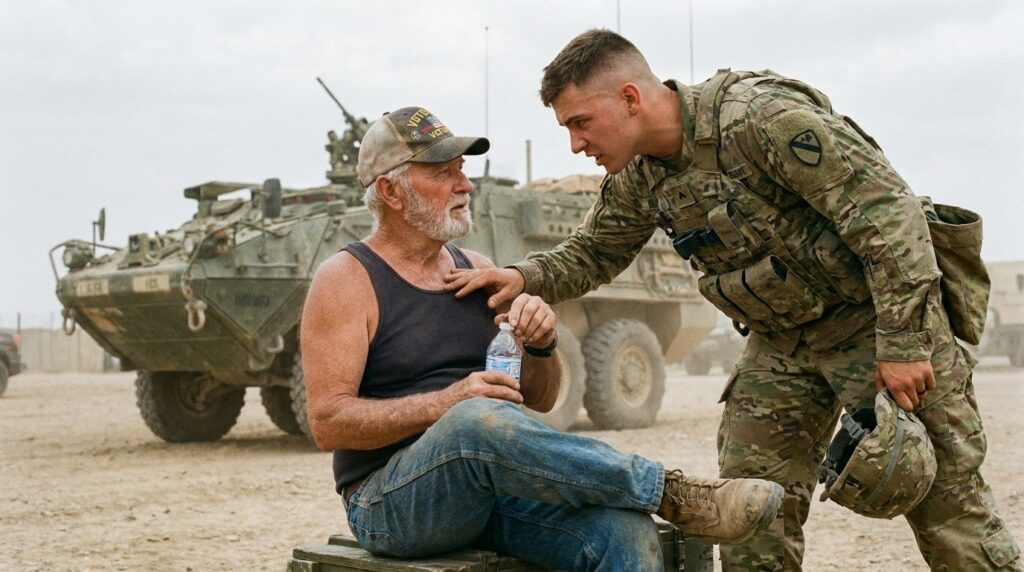
General Marcus Vance sat exactly where he had been four hours earlier, a simple unbranded plastic water bottle cradled loosely in his thick-veined fingers. The shadow of his faded veteran cap fell completely across his face, obscuring his pale blue eyes, but the hard, silver stubble along his jawline glinted under the late afternoon light. The grooved brass casing welded to the twist-top caught the glare—a tiny, permanent reminder of David Vance’s final station that no longer felt like a mystery to the young soldier.
Miller didn’t drop his tablet or check a tracking notification. He slowly reached down and placed the frayed canvas binder onto the concrete barrier beside the old man’s boots. The cover was stained with red hydraulic fluid and marked with the gray grit of the riverbank, its brass latch scratched down to the raw, unpolished copper beneath.
“The convoy is reorganized, sir,” Miller said, his voice dropping into a low, transactional rasp that carried the deep, internal quiet of a man who had seen the foundations yield. “We’re routing the fuel assets through the old eastern ridge line by line. Every vehicle is being spaced according to the 1974 structural tolerances.”
The veteran didn’t open the book. He didn’t look up at the starched, dirt-stained uniform of the specialist standing before him. He reached out, his thick, calloused thumb tracing the rough, torn fabric of the ledger’s binding spine with a slow, heavy stillness that seemed to absorb the entire heat of the yard.
“You don’t build a legacy on a green screen, son,” the old man said, his gravelly tone cutting through the distant rumble of an idling generator like a spade hitting bedrock. “The data changes when the servers cycle, but the iron stays exactly where you bolt it. If you don’t know what’s holding the road up from the bottom, you have no business commanding the top.”
Miller stood steady, the wind from the staging yard blowing fine plumes of gray limestone dust across his boots. He looked toward the gate, where the matte-black staff vehicle was pulling out toward the perimeter fence, its tires chewing through the gravel with a low, heavy crunch. General Brooks had left the yard, but the unwritten memory he had saluted remained fixed in the center of the line, bolted deep into the bedrock of the base by the presence of the man who had laid the first stone.
The active-duty specialist reached up, his fingers catching the brim of his helmet to adjust its seat against his short military haircut. He didn’t feel the dangerous, entitled gravity that had pulled him into the lane that morning. The uniform still fit tightly against his shoulders, but it no longer felt like a license to dictate the space. It felt like an obligation—a heavy, unpolished duty to look at the cracked surfaces, to measure the friction, and to honor the rusted truth of the men who had paved the way before him. He turned back toward the maintenance line, his boots grinding into the parched earth as he stepped back into the lane to check the next truck by hand.








