Chapter 9: The Road Left Open
By the following spring, Willow Creek Estates looked much as it always had.
The lawns were green.
The ornamental trees along the entrance road were flowering.
Children rode bicycles past the pond, and retirees walked their dogs beneath the shade of mature oaks.
But one thing had changed.
The concrete barriers were gone.
In their place, the HOA had installed low landscaping features outside the required emergency-access area, following a reviewed plan that preserved the roadway’s full usable width.
A small sign near the entrance reminded drivers not to obstruct emergency access.
It did not threaten fines.
It explained why the road needed to remain clear.
Thomas Reed had completed his term as interim president and was elected to a full term by the residents.
He had no interest in becoming a powerful neighborhood figure.
He preferred quiet meetings, clear records, and decisions that could be explained without shouting.
Under his leadership, the HOA continued reviewing its governing documents and enforcement practices.
Residents still disagreed.
But they had begun treating disagreements as problems to solve rather than battles to win.
George Miller occasionally joked that the neighborhood had finally remembered it was a place to live, not a military installation.
Helen Brooks became involved in a volunteer committee that checked on older residents during severe weather.
The committee helped coordinate emergency contact lists and encouraged neighbors to look out for one another.
It was not an official enforcement body.
It had no power to issue violations.
Its purpose was simply to make sure people were not forgotten.
Eleanor moved into a smaller single-story home three streets away from Helen.
She had chosen it herself.
The new house had wide doorways, an accessible bathroom, and a kitchen with updated electrical systems.
Margaret helped arrange the move, but Eleanor selected the furniture and decided where everything belonged.
Thomas Whitmore’s cedar chest stood at the foot of her bed.
The family photographs were displayed in the living room.
A framed picture of the old Willow Creek house hung near the fireplace.
Eleanor missed her former home sometimes.
But she did not regret leaving.
She had discovered that memories could survive a change of address.
Margaret visited regularly.
Their relationship was not magically repaired.
There were still awkward moments.
Sometimes Margaret slipped into giving instructions.
Sometimes Eleanor reminded her that she was perfectly capable of making her own decisions.
But they were learning to speak to one another differently.
Margaret no longer served on the HOA board.
She had completed the required portion of her community service and continued volunteering afterward.
She kept a low public profile.
Some neighbors greeted her politely.
Others avoided her.
She accepted both reactions.
She understood that rebuilding trust would take longer than paying a fine or writing an apology.
One Saturday afternoon, the local fire department hosted a community safety event at a park near Willow Creek.
Families gathered around fire engines while firefighters demonstrated smoke alarms and explained household escape planning.
Daniel Hayes was helping supervise the event.
He had nearly forgotten that Margaret lived nearby.
Then he saw her standing beside Eleanor near the information table.
Eleanor approached first.
She moved slowly with her cane, but her smile was warm.
“Captain Hayes?”
Daniel turned.
She introduced herself.
He recognized her name immediately.
For a moment, he remembered the smoke-filled hallway, the cane on the floor, and the relief of carrying her outside.
Eleanor took his hand.
“I’ve wanted to thank you properly.”
Daniel smiled.
“I’m glad you’re doing well, ma’am.”
She told him about her new house.
She explained that she had working smoke alarms, an escape plan, and neighbors who checked on her.
Daniel listened with genuine pleasure.
Those were the outcomes firefighters hoped for.
People surviving.
People recovering.
People becoming safer.
Then Margaret stepped forward.
She looked different without the navy blazer and pearls.
She wore simple trousers, comfortable shoes, and a pale blue cardigan.
Her expression was nervous.
“Captain Hayes, I wrote you a letter.”
“I received it.”
Margaret nodded.
She had rehearsed this moment many times, but the words she had prepared suddenly seemed unnecessary.
“I was wrong,” she said. “And I’m sorry.”
Daniel looked at her for a moment.
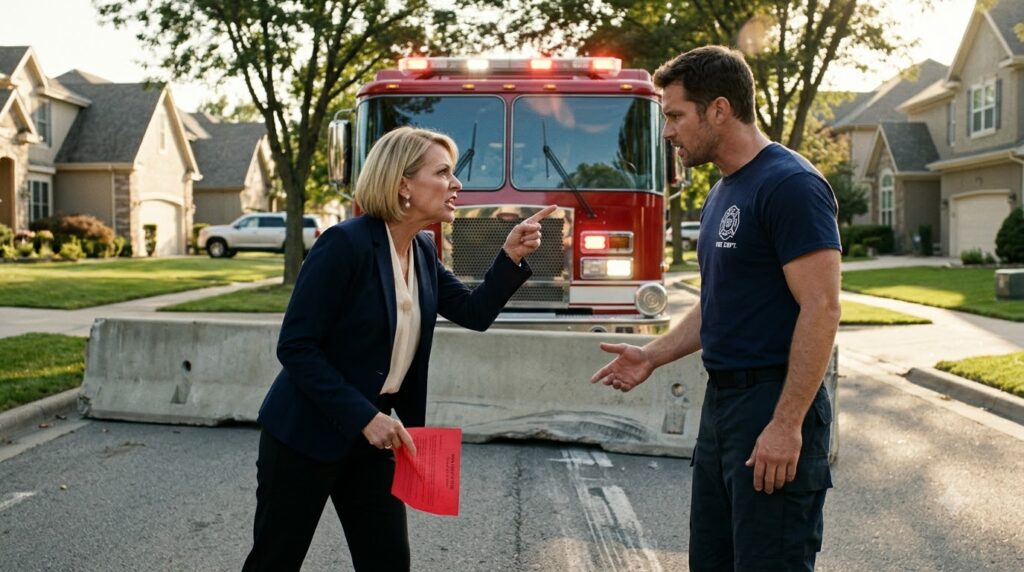
He remembered the concrete barrier.
The emergency call.
The urgency of knowing someone was trapped.
He also remembered that Eleanor had survived.
“I appreciate you saying that,” he replied.
There was no dramatic embrace.
No public declaration of forgiveness.
No applause.
Daniel simply acknowledged her apology.
For Margaret, that was enough.
She had finally learned that an apology was not a transaction that entitled her to a particular response.
It was an obligation she owed because of what she had done.
Eleanor thanked Daniel again, and the two women moved toward a nearby bench.
Across the park, children laughed as they examined the fire engine.
A young boy asked a firefighter whether the truck could drive through anything.
The firefighter smiled and explained that even powerful emergency vehicles needed safe, clear roads.
Margaret heard the answer.
She looked toward the red engine.
For a moment, she remembered the terrible sound of concrete striking asphalt.
Then she looked at her mother, sitting comfortably in the sunshine.
She understood how close she had come to losing her.
And she understood that no position, title, or set of neighborhood rules could ever justify putting someone’s life at risk.