Chapter 3: The Minutes That Could Not Be Returned
The first thing Daniel noticed inside Eleanor’s house was the heat.
It pressed against his protective equipment and made every movement deliberate.
The second was the silence.
Outside, neighbors were shouting, sirens were approaching, and Margaret was calling for her mother.
Inside, the house seemed strangely still.
Daniel and Luis moved according to their training, staying low and maintaining contact as they searched the accessible area.
They were operating under difficult conditions with limited resources, and Daniel knew their options would narrow quickly if the fire intensified.
The smoke was dense near the kitchen.
They avoided the worst of the heat and searched toward the den, where Helen believed Eleanor might have gone.
Daniel called out.
No answer.
Luis swept the beam of his light across the floor.
A cane lay near the hallway.
Daniel recognized it from Helen’s description.
He moved toward the den.
There, partially hidden behind an upholstered chair, he found Eleanor.
She had apparently tried to crawl away from the smoke after becoming dizzy. Her face was pale, and she was barely responsive.
Daniel checked her condition.
She was breathing, but her breaths were shallow.
He radioed the discovery and requested immediate medical support at the front entrance.
Luis helped position her for removal.
Together, they carried her toward the doorway, moving as quickly as conditions allowed.
Outside, Helen saw the firefighters emerge.
She raised both hands to her mouth.
Margaret rushed forward.
Daniel carried Eleanor down the porch steps and toward the arriving medical crew.
“Give us room,” he ordered.
Paramedics placed Eleanor on a stretcher and began administering oxygen while assessing her airway and breathing.
Her eyes remained closed.
Margaret followed the stretcher, asking questions no one could answer yet.
Was her mother alive?
Would she recover?
Had she been burned?
Daniel answered only what he knew.
Eleanor had been found alive.
She needed urgent hospital care.
That was all.
The second engine finally reached the house, followed by additional firefighters. Crews established a water supply and began controlling the fire.
The flames had spread from the kitchen wall into nearby cabinetry and part of the ceiling, but the structure remained standing.
Within twenty minutes, firefighters had knocked down the main body of the fire.
The house was badly damaged.
The kitchen was destroyed, and smoke had spread through several rooms. Water soaked the hardwood floors. Family photographs lay beneath broken glass.
But Eleanor was on her way to the hospital.
Margaret climbed into her car and followed the ambulance.
She drove without turning on the radio.
Her hands shook against the steering wheel.
At the hospital, doctors explained that Eleanor had suffered significant smoke inhalation. Her oxygen levels were improving with treatment, but her age and underlying respiratory vulnerability made the situation serious.
She would remain under close observation.
Margaret sat beside her mother’s bed as evening settled over Raleigh.
The machines were quiet except for occasional electronic tones.
Eleanor looked smaller than Margaret remembered.
Her silver hair lay against the pillow. A hospital bracelet circled her wrist. There was a faint bruise on one forearm where she had apparently struck a piece of furniture while trying to escape.
Margaret reached for her hand.
For years, she had imagined herself as the responsible daughter.
The one who managed appointments.
The one who made sure the bills were paid.
The one who insisted that everything be done correctly.
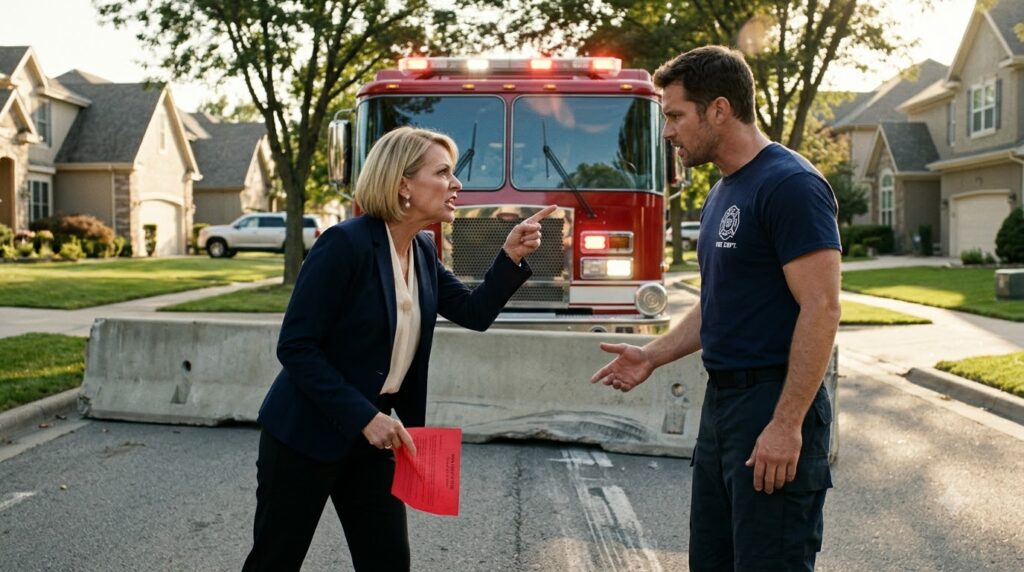
Now she could not stop thinking about the fire engine’s brakes.
The dust rising from the concrete.
The violation notice she had slapped against its door.
She had been so determined to prove her authority that she had failed to ask where the firefighters were going.
At 8:15 that evening, a police officer arrived at the hospital.
His name was Sergeant Robert Collins.
He was in his early fifties, with close-cropped gray hair and the measured manner of someone who had spent decades dealing with people on their worst days.
He asked Margaret to step into the hallway.
She immediately straightened her blazer.
Old habits returned.
“Officer, I assume you’re here about the fire.”
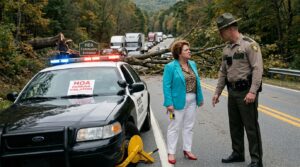
“I’m here about the road obstruction.”
Margaret felt her stomach tighten.
Collins explained that police had received statements from firefighters and several residents.
There was also video footage.
Margaret remembered her own recording.
She had posted it to the neighborhood’s private social media group just before her mother called.
In the video, she could be heard boasting about stopping the fire engine.
The footage showed the barrier falling, the truck braking, and Margaret waving the HOA notice.
Collins told her the matter was under investigation.
Deliberately obstructing an emergency response could have serious legal consequences.
Margaret tried to explain that the barrier belonged to the HOA.
Collins listened.
Then he asked a question she could not answer.
“Who authorized you to block a public emergency route?”
Margaret opened her mouth.
Nothing came out.
She had assumed that because the HOA maintained the entrance landscaping, it controlled everything surrounding it.
She had never checked the legal documents.
Collins handed her his card.
He advised her to preserve any recordings and communications related to the incident.
Then he left.
Margaret returned to her mother’s room.
Eleanor was awake.
Her voice was weak, but her eyes were clear.
“I heard the firemen were delayed.”
Margaret looked down.
Eleanor watched her for a long moment.
Then she asked the question Margaret had feared most.
“Was that because of you?”