Chapter 4: The Rules Beneath the Rules
Margaret did not answer her mother immediately.
For most of her adult life, she had been able to explain away uncomfortable situations.
When neighbors accused her of being unreasonable, she said they disliked accountability.
When contractors complained about fines, she said they lacked professionalism.
When board members questioned her decisions, she accused them of being afraid to enforce standards.
But there was no explanation that could make the afternoon’s events harmless.
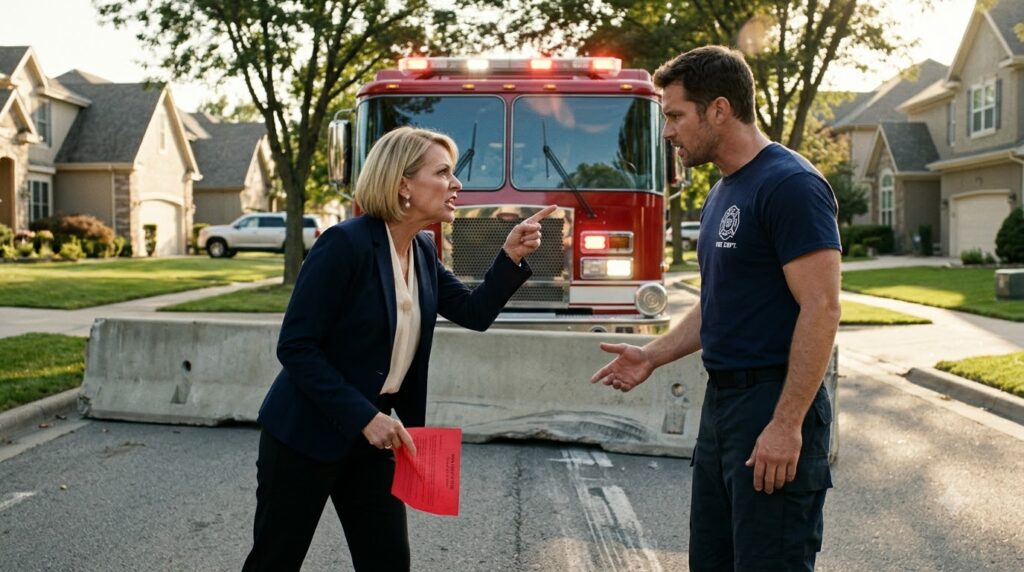
She had blocked a fire engine.
Her mother had been inside the burning house.
And Eleanor was asking for the truth.
“Yes,” Margaret finally whispered.
Eleanor closed her eyes.
She did not shout.
She did not ask why.
That silence was worse than anger.
Margaret sat beside the bed until a nurse came to check Eleanor’s breathing. Then she stepped into the hallway and cried for the first time in years.
Across town, the Willow Creek HOA board was holding an emergency meeting.
The board had five members.
Margaret was president.
The vice president was Thomas Reed, sixty-three, a retired civil engineer who had lived in Willow Creek since its earliest development.
The treasurer was Patricia Lawson, a widowed accountant known for asking careful questions about every expense.
The remaining members were James Porter, a local insurance broker, and Susan Delgado, a former school principal.
All four had received calls from frightened residents.
Several had also seen Margaret’s video.
Thomas placed his laptop on the conference table in the neighborhood clubhouse.
The recording began with Margaret standing beside the entrance road.
She described the fire engine as an unauthorized vehicle.
Then came the sound of concrete hitting pavement.
The camera shook as the fire truck stopped.
Margaret’s voice rang clearly through the speakers.
She was proud of what she had done.
When the video ended, nobody spoke.
Patricia finally broke the silence.
“We need to know whether that barrier was even supposed to be there.”
Thomas opened a folder containing the neighborhood’s original site plans.
He had spent the afternoon reviewing documents stored in the county’s online records.
The entrance road, Willow Creek Lane, had been constructed as part of the subdivision’s original development.
Although the HOA maintained the landscaping, the road itself was subject to a recorded emergency-access easement.
The easement gave fire, police, and emergency medical vehicles the right to use the entrance without interference.
It was not a minor technicality.
It had been a condition of the development’s approval.
Thomas pointed to the relevant section.
The access lane had to remain unobstructed.
Patricia leaned forward.
“Then why was there a concrete barrier beside it?”
Thomas had asked himself the same question.
He had found an invoice from a local landscaping contractor dated six weeks earlier.
The invoice described the delivery and placement of three decorative concrete traffic blocks near the main entrance.
The total cost was $4,860.
It had been charged to the HOA’s maintenance account.
Patricia checked the financial records.
There was no board vote approving the purchase.
No recorded motion.
No authorization beyond Margaret’s signature.
Susan looked troubled.
“She told us those were temporary landscaping protections.”
Thomas nodded.
That was what Margaret had said.
She had claimed residents were driving over the grass near the entrance and damaging irrigation lines.
But the contractor’s work order contained a different description.
The blocks had been requested as movable barriers to prevent unauthorized vehicle access.
Thomas turned another page.
Attached to the work order was an email from Margaret.
She had instructed the contractor to position the barriers so they could be moved into the roadway when necessary.
The message was dated nearly a month before the fire.
James rubbed his forehead.
“This wasn’t something she decided in the heat of the moment.”
Nobody answered.
The evidence suggested planning.
Margaret had not simply lost her temper when she saw a fire truck.
She had arranged for heavy concrete objects to be available for blocking vehicles.
The board voted unanimously to suspend Margaret’s authority to act on behalf of the HOA pending a formal removal process and legal review.
They also ordered the remaining barriers removed from the entrance area immediately.
Patricia contacted the association’s attorney.
Thomas contacted the fire marshal.
Susan prepared a notice to residents explaining that emergency vehicles had unrestricted access and that the board was reviewing the incident.
By midnight, the story had spread beyond Willow Creek.
A neighbor’s security camera had recorded the barrier falling and the fire engine stopping.
The footage had been shared with a local television station.
The next morning, the video appeared online with a headline describing an HOA president blocking firefighters during a house fire.
Margaret’s name was everywhere.
But the board had not yet discovered the most troubling document.
It was buried in the previous year’s correspondence.
A letter from the county fire marshal had warned the HOA that the entrance must remain clear after an earlier complaint about temporary obstructions.
The letter had been addressed directly to Margaret.
And she had signed the delivery receipt.