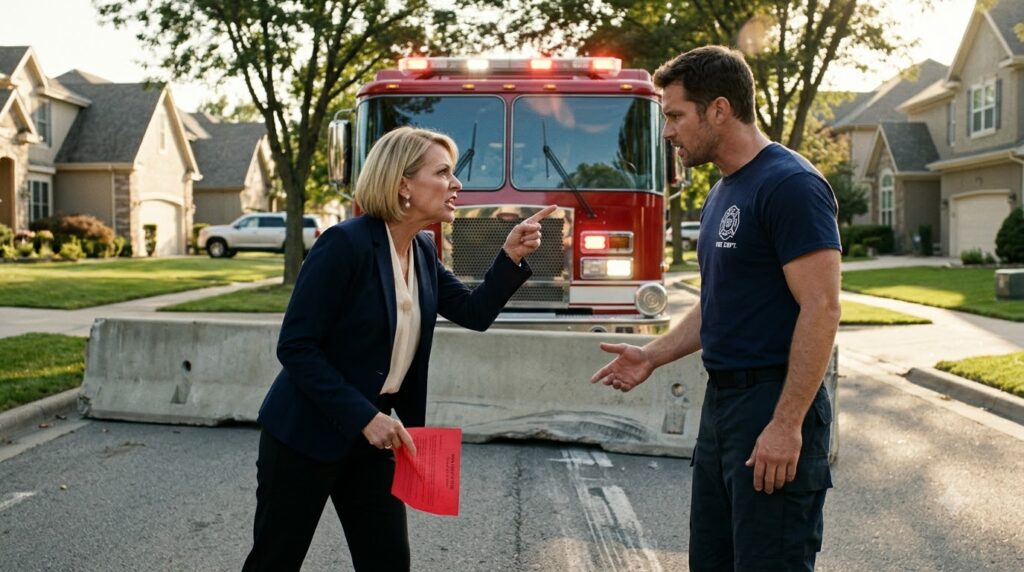
Chapter 6: What Her Mother Remembered
The hospital room was bright with morning sunlight when Margaret arrived.
Eleanor was sitting upright in bed, supported by two pillows.
Her breathing was still labored, but she no longer needed the same level of oxygen support she had required immediately after the fire.
A small vase of yellow flowers stood on the windowsill.
Helen had brought them.
Margaret noticed that before she noticed anything else.
For years, she had treated Helen as a troublesome neighbor.
Helen’s flower beds occasionally extended beyond the approved landscaping boundaries. Her grandchildren sometimes left bicycles near the front porch. She had once challenged a fine issued to a young family.
Margaret had described her as someone who encouraged disorder.
Yet Helen had been the first person to call for help when Eleanor’s house caught fire.
She had stayed on the lawn, trying to reach her friend.
She had gone to the hospital.
And she had brought flowers.
Margaret sat beside the bed.
Eleanor studied her daughter.
“You look tired.”
Margaret gave a small, humorless smile.
“I haven’t slept much.”
Eleanor nodded.
Neither spoke for a while.
Then Eleanor asked about the firefighters.
Margaret told her that both men were safe.
She explained that the fire had been contained and that the house was still standing, although repairs would be extensive.
Eleanor listened quietly.
Finally, she asked whether Margaret had apologized to the firefighters.
Margaret looked away.
“Not yet.”
“Why?”
Margaret struggled for an answer.
She had spent two days imagining what she would say to Daniel Hayes.
Every possible apology seemed inadequate.
She could acknowledge blocking the road.
She could admit that she had been wrong.
But she could not give back the minutes he had lost.
And she could not erase the fear she had caused.
Eleanor reached for her daughter’s hand.
“When your father was alive, he used to say that a person’s character isn’t measured by how they behave when everyone agrees with them.”
Margaret remembered the saying.
Thomas Whitmore had been a quiet man.
He worked as a building inspector for most of his career and believed deeply in doing things properly.
He respected regulations because he understood their purpose.
A building code could prevent a collapse.
A fire exit could save a life.
A road easement could allow an ambulance to reach someone in trouble.
He had never confused following rules with exercising power.
Eleanor continued.
“Your father believed the important test was what someone did after discovering they were wrong.”
Margaret’s eyes filled with tears.
She had spent years believing that admitting mistakes would weaken her authority.
Now she understood how much damage that belief had caused.
Eleanor squeezed her hand.
“I love you, Margaret. But loving you doesn’t mean pretending you didn’t do something terrible.”
The words were gentle.
They were also unmistakable.
Margaret lowered her head.
“I know.”
Eleanor looked toward the window.
For a moment, her expression softened.
She spoke about the house.
She wanted the family photographs saved if possible. She wanted Thomas’s cedar chest inspected before anyone discarded it. She wanted someone to check whether the old maple tree in the backyard had been damaged.
Margaret promised to arrange everything.
Then Eleanor surprised her.
“I don’t know if I want to move back.”
Margaret looked up.
Her mother had refused every suggestion of assisted living or downsizing for years.
Now, after the fire, she was reconsidering.
Not because Margaret had persuaded her.
Because the experience had frightened her.
Eleanor admitted that living alone in a large house had become more difficult than she wanted to acknowledge.
The jammed back door was only one example.
She had struggled with the lock for months but had never asked anyone to repair it.
She did not want to be a burden.
Margaret felt a fresh wave of guilt.
She had inspected her mother’s lawn, mailbox, and porch furniture repeatedly.
But she had never asked whether the doors opened easily.
She had been so concerned with how the house looked from the street that she had overlooked how safely her mother could live inside it.
That realization hurt almost as much as the fire itself.
Over the following days, Margaret began making calls.
She arranged for a restoration company to assess the damage.
She contacted Eleanor’s insurance provider.
She asked Helen to help identify which personal belongings mattered most to her mother.
For once, Margaret did not issue instructions.
She asked questions.
And she listened.
Meanwhile, the investigation continued.
Fire investigators determined that the blaze had originated in an electrical fault within the kitchen wall. There was no evidence of arson.
The delayed fire response had not caused the fire, but investigators documented the obstruction and its effect on the initial response.
Daniel’s incident report described the blocked entrance, the alternate route, and the decision to send two firefighters ahead on foot.
The report would become important evidence.
Margaret knew she could not avoid the consequences.
She contacted an attorney and agreed to cooperate with the investigation.
Then she wrote a letter to Captain Hayes.
She did not ask for forgiveness.
She simply described what she had done, acknowledged that it was wrong, and thanked him for helping save her mother.
She placed the letter in an envelope.
For several minutes, she held it without moving.
Then she addressed it to the fire station.
It was the first apology she had written in years that contained no explanation of why someone else had made her behave badly.