Chapter 7: The Cost of Being Right
Six weeks after the fire, Margaret appeared in Wake County District Court.
She wore a plain gray suit.
There were no pearls.
Her hair was neatly styled, but the confidence that once defined her public appearances had faded.
She sat beside her attorney while the prosecutor outlined the case.
The state had reviewed the video recordings, witness statements, HOA records, and fire department reports.
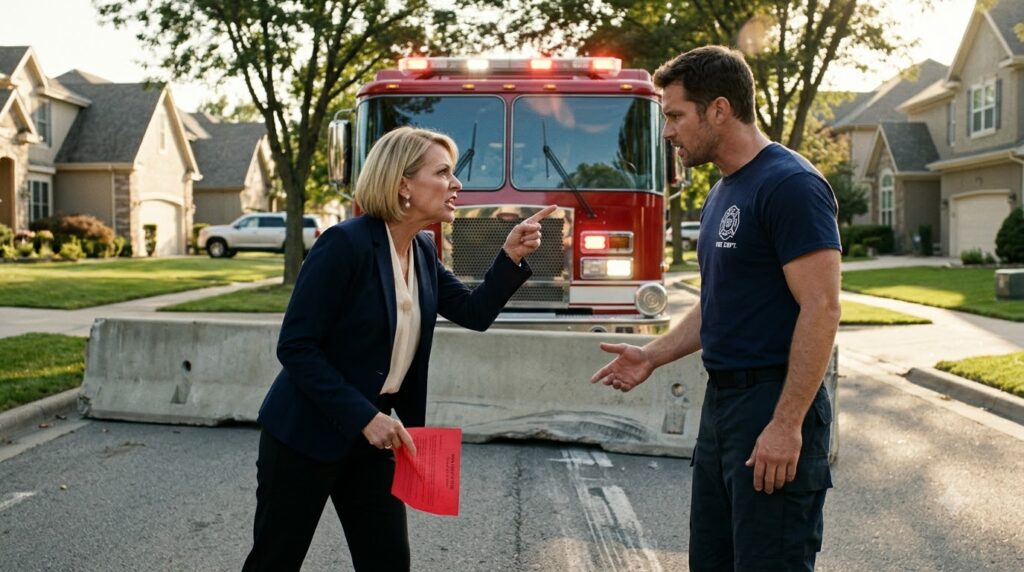
The evidence showed that Margaret had deliberately pushed a concrete barrier into the path of an approaching emergency vehicle.
It also showed that she had been previously warned about keeping the entrance clear.
The prosecution emphasized that her actions had created a serious public safety risk.
Margaret’s attorney did not dispute the essential facts.
Instead, he explained that she had accepted responsibility, cooperated with investigators, and begun addressing the harm she had caused.
Under a negotiated resolution, Margaret entered a guilty plea to a misdemeanor obstruction-related charge.
The court imposed a suspended jail sentence, supervised probation, a substantial fine, and community service.
She was also ordered to complete a court-approved decision-making program and comply with restrictions intended to prevent further interference with emergency operations.
The precise legal consequences were less dramatic than some online commentators had demanded.
But they were real.
Margaret now had a criminal conviction.
Her reputation had been damaged.
And her authority over Willow Creek was gone.
At a special HOA membership meeting, residents voted overwhelmingly to remove her from the board.
Thomas Reed was elected interim president until the next regular election.
The association’s attorney also reviewed the unauthorized barrier purchase.
Margaret agreed to reimburse the HOA for the improperly approved expenditure as part of a separate civil settlement.
The board worked with its insurer and legal counsel to address remaining claims and reduce the financial burden on residents.
No special assessment was ultimately required.
For many homeowners, that was a relief.
For others, it was not enough.
They wanted to know why the board had allowed Margaret to accumulate so much unchecked authority.
Thomas did not avoid the question.
At the next community meeting, he admitted that the other directors had been too willing to accept Margaret’s assurances.
She had handled complaints, contractor communications, and enforcement decisions with little oversight.
Because she was energetic and organized, they had allowed convenience to replace accountability.
That had been a mistake.
The board introduced new procedures.
Major expenditures required documented approval.
Enforcement notices had to cite specific governing provisions.
Homeowners received clearer appeal rights.
Emergency access and safety concerns were placed under formal review.
The association also hired an independent management company to handle routine administrative matters.
The changes did not eliminate disagreements.
Neighbors still argued about fences, landscaping, and parking.
But the process became more transparent.
Residents could challenge decisions without feeling that they were personally challenging one powerful individual.
George Miller received a refund for the fine imposed on his grandson’s work truck.
The widow who had been penalized over a medical transport van received a written apology and reimbursement.
Several other questionable fines were reversed.
Helen Brooks attended the meeting where those refunds were announced.
She had never wanted to destroy the HOA.
She wanted it to behave fairly.
As she listened to Thomas explain the new procedures, she thought about Eleanor.
Her friend had been discharged from the hospital and was recovering at a short-term rehabilitation facility.
Her lungs were healing, but she tired easily.
Doctors expected further improvement, though they warned that recovery could take months.
The house was another matter.
Restoration crews had removed the damaged kitchen and opened sections of wall and ceiling.
Smoke had reached places no one initially expected.
The repair estimate was substantial.
Eleanor’s insurance covered much of the covered loss, subject to policy terms and deductibles, but the work would take time.
Margaret had offered to pay the remaining expenses.
Eleanor had accepted help with the practical arrangements but insisted on making her own decisions.
That was new for both women.
Margaret was learning that helping someone did not mean controlling them.
Eleanor was learning that accepting assistance did not mean surrendering independence.
Meanwhile, Captain Hayes returned to ordinary duty.
He responded to vehicle accidents, medical emergencies, and residential fires.
He had received dozens of messages from strangers praising his restraint during the confrontation.
He appreciated the support but disliked being treated as a celebrity.
He had not entered the fire service to become part of an internet argument.
He had entered it because, when someone called for help, he wanted to be the person who arrived.
One afternoon, his station commander handed him an envelope.
Inside was Margaret’s letter.
Daniel read it alone.
The words were simple.
She acknowledged that she had endangered people, interfered with his crew, and acted as though her personal authority mattered more than a human life.
She thanked him for rescuing Eleanor.
She did not ask him to excuse her conduct.
Daniel folded the letter.
He was glad she had accepted responsibility.
But he knew something Margaret was only beginning to understand.
An apology could be sincere without erasing the consequences of an action.
And forgiveness, if it came, could not be demanded.