Chapter 10: What Makes a Neighborhood Worth Protecting
One year after the fire, Willow Creek held its annual neighborhood gathering.
The event took place beside the community pond on a mild Saturday afternoon.
There were folding tables covered with homemade food, children playing lawn games, and neighbors who had known one another for decades sharing stories beneath the trees.
The HOA had invited local firefighters to provide a short home-safety presentation.
Captain Hayes could not attend because he was on duty, but Luis Ramirez and another firefighter arrived with educational materials and a department vehicle.
They spoke about smoke alarms, escape routes, and the importance of keeping streets accessible.
Nobody mentioned Margaret by name.
They did not need to.
The lesson was clear.
Eleanor attended with Helen.
She had recovered enough to enjoy short walks and had recently celebrated her eighty-second birthday.
Her new home suited her well.
She had planted tomatoes in large containers near the back patio and joined a weekly book club at the public library.
She was still the same independent woman she had always been.
Only now, she accepted help when she needed it.
Margaret arrived later, carrying a tray of lemon bars Eleanor had baked that morning.
She hesitated near the entrance to the gathering.
A year earlier, she would have walked straight toward the organizers and begun checking whether everything complied with HOA requirements.
Now she waited until she saw Helen wave.
She carried the tray to the food table and quietly asked where it should go.
It was a small moment.
But for Margaret, small moments mattered.
She had learned that respect was not something people owed her because she held a title.
It was something built through conduct.
She could no longer demand that neighbors trust her.
She could only behave in ways that might eventually make trust possible.
During the afternoon, George Miller approached her.
For years, their conversations had been tense.
Margaret remembered the fine she had issued over his grandson’s work truck.
George held a paper plate in one hand.
“I hear you’ve been helping with those home repairs,” he said.
Margaret nodded.
“Mostly scheduling and supplies. Sometimes I go along with the crews.”
“Good work.”
She looked surprised.
George glanced toward the pond.
“My grandson’s back in town. He’s helping me replace some boards on the deck.”
Margaret smiled faintly.
“I hope the repairs go well.”
George chuckled.
“No violation notice?”
She shook her head.
“No violation notice.”
They both laughed.
It was brief and slightly awkward.
But it was genuine.
Later, Margaret sat beside Eleanor on a bench overlooking the water.
The pond reflected the pale blue sky.
A breeze moved through the trees.
Children called to one another from the grass.
For a while, mother and daughter simply watched the gathering.
Then Eleanor spoke.
“Your father would have liked this.”
Margaret nodded.
“He always liked seeing people together.”
“He believed a neighborhood should make life easier.”
Margaret looked toward the entrance road.
She could just see the white stone pillars beyond the trees.
A year earlier, she had stood there believing that the community’s value depended on strict control.
She had cared about spotless lawns, approved vehicles, and perfect appearances.
She had treated exceptions as threats.
But when Eleanor’s house caught fire, none of those things mattered.
What mattered was Helen noticing the smoke.
What mattered was someone calling 911.
What mattered was firefighters willing to risk themselves for a stranger.
What mattered was a road that should have been open.
Margaret finally understood that the purpose of a neighborhood was not to create the appearance of perfection.
It was to provide a place where people could live safely, preserve their dignity, and rely on one another when life became difficult.
The realization did not erase her mistake.
She would carry the memory of that afternoon for the rest of her life.
But she no longer tried to escape it.
She had accepted the legal consequences, surrendered the authority she had abused, and begun rebuilding her life through quieter acts of service.
Some residents would never forgive her.
She understood that too.
Her responsibility was not to make everyone forget.
It was to make sure she never behaved that way again.
As the gathering ended, Eleanor stood carefully and reached for her cane.
Margaret offered her arm.
Eleanor accepted it.
Together, they walked slowly toward the parking area.
At the neighborhood entrance, an ambulance passed along Willow Creek Lane with its emergency lights flashing.
The driver moved steadily through the open roadway.
No barriers blocked the entrance.
No one stepped into its path.
The vehicle continued toward a house farther down the street, where someone had called for medical assistance.
Margaret watched it disappear around the bend.
She did not know who needed help.
She did not know whether the emergency was serious.
She knew only that the responders had been able to reach the neighborhood without delay.
Eleanor gently touched her daughter’s arm.
“Ready to go home?”
Margaret looked at her mother and smiled.
“Yes, Mom.”
They continued toward the car.
Behind them, the neighborhood settled into the quiet rhythm of an ordinary Saturday.
And that ordinary peace was the thing Margaret had once misunderstood.
A community was not protected by the loudest person, the strictest fines, or the most intimidating rules.
It was protected by people who understood that authority came with responsibility, that safety mattered more than appearances, and that every home contained lives more valuable than property lines or regulations.
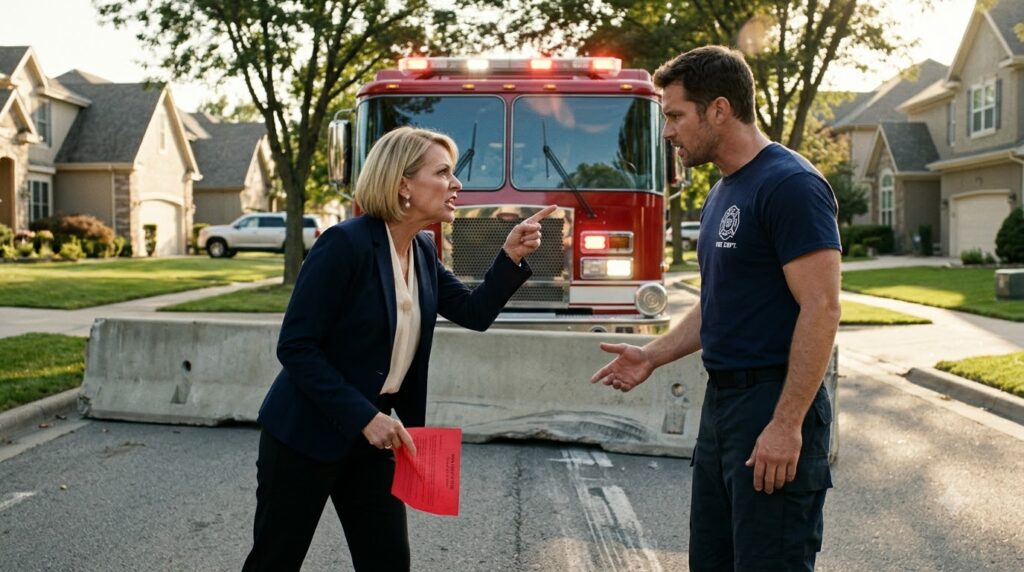
Margaret had once stood in front of a fire engine and declared that her rules came before an emergency.
She would never forget those words.
But now, whenever she saw a fire truck, ambulance, or police vehicle approaching, she thought about the frightened voice of her mother on the telephone.
She remembered the firefighters running toward danger while she stood in their way.
And she remembered the lesson that had cost her nearly everything.
The true measure of a community isn’t how strictly it controls the people who live there. It’s how quickly those people can come together when someone needs help.
At Willow Creek Estates, the road was finally clear.
And this time, everyone understood why it needed to stay that way.