Chapter 9: What Respect Really Means
The courtroom was quieter than Daniel expected.
There were no shouting spectators.
No dramatic interruptions.
No sudden revelations.
Just a judge, attorneys, court staff, and a small group of people waiting for the legal process to unfold.
Patricia Whitmore sat beside her attorney.
She wore a conservative gray suit.
Her blonde hair was neatly styled.
Without the angry gestures and expensive handbag, she looked like an ordinary middle-aged woman facing the consequences of a serious decision.
Daniel sat in the front row with Sophie.
Walter and Margaret were behind them.
Reed had helped Daniel prepare his statement, but the words were his own.
When the judge invited him to speak, Daniel moved forward.
He looked at the paper in his hands.
Then he looked up.
He explained that he had lived with a disability for twelve years.
He had adapted his home, his vehicle, and his work.
He had learned to navigate a world that was not always designed with wheelchair users in mind.
He understood inconvenience.
He understood frustration.
He understood that people sometimes made mistakes.
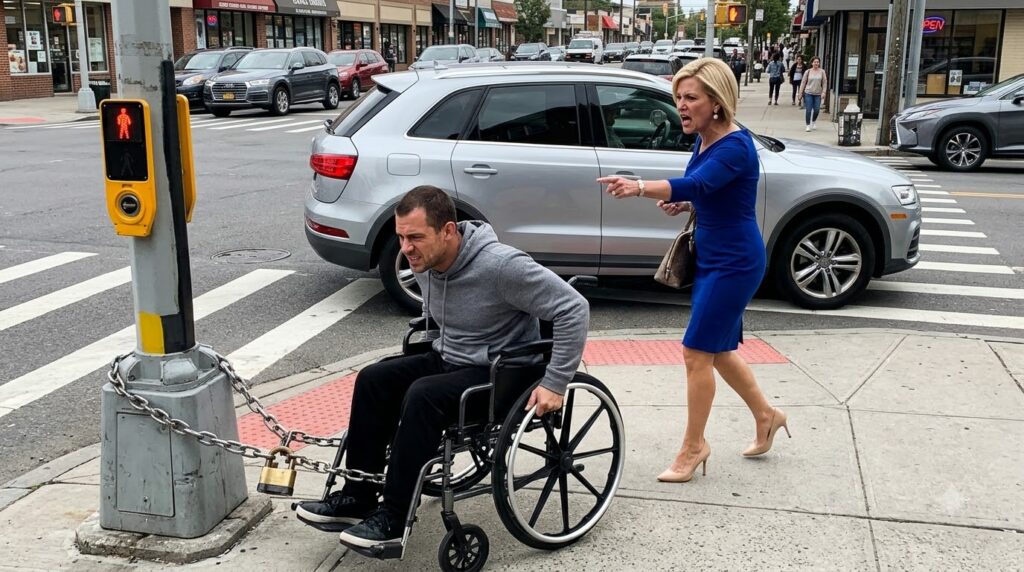
But what happened at Maple and Third was not a simple mistake.
Someone had deliberately restrained him.
Someone had taken away his freedom to move.
And someone had left him beside moving traffic because he asked for access to a public sidewalk.
Daniel paused.
He thought of Sophie watching the video.
He thought of her fear.
Then he continued.
“The hardest part wasn’t the chain. It was knowing my daughter saw someone treat me as though I didn’t deserve the same freedom as everyone else.”
The courtroom remained silent.
Daniel finished by explaining that he did not want special treatment.
He wanted the law to recognize that his dignity and safety mattered.
He returned to his place beside Sophie.
She took his hand.
Patricia’s attorney spoke next.
The defense acknowledged the seriousness of her conduct and presented information about her background and community involvement.
Patricia then addressed the court.
She admitted that chaining Daniel’s wheelchair had been wrong.
Her apology was brief.
Daniel listened.
He could not know whether she fully understood the harm she had caused.
He also knew that forgiveness, if it ever came, would be his decision.
The judge accepted the negotiated plea and imposed a sentence consistent with the agreement and the court’s findings.
Patricia received supervised probation, community service, a no-contact order protecting Daniel, and additional conditions.
The judge emphasized the seriousness of unlawfully restricting another person’s movement.
The separate financial prosecution continued.
Months later, after further investigation and court proceedings, Patricia entered a guilty plea to financial offenses involving association funds.
The court ordered restitution and imposed a sentence that included a period of incarceration followed by supervision.
Other individuals involved in the transactions faced consequences according to their own conduct and the evidence against them.
The HOA pursued recovery of misused funds through appropriate legal channels.
Not every dollar was recovered.
Some money had been spent.
Some legal expenses could not be undone.
But the association’s finances were placed under stricter oversight.
Linda’s board introduced independent annual reviews and clearer approval procedures.
Residents received regular financial reports.
The association also established a consistent process for accessibility requests and violation appeals.
Brookhaven was not transformed into a perfect neighborhood.
People still argued about landscaping.
They disagreed about budgets.
Some complained about meeting times.
Others wanted lower fees or more services.
But the arguments were different now.
They took place in meetings where residents could ask questions and expect answers.
Authority was no longer treated as personal ownership.
One year after the incident, Daniel received a letter from Margaret.
She had moved closer to her grandchildren.
Her old house had been sold to a young family.
In the letter, she thanked him for helping her find the courage to speak.
Daniel smiled as he read it.
He knew the truth was more complicated.
Margaret had kept the records.
Robert had preserved the financial documents.
Walter had stood beside him.
Emily had called the police.
Noah had recorded the evidence.
Linda had agreed to lead.
And dozens of neighbors had chosen to participate rather than remain silent.
Change had required all of them.
That spring, Brookhaven held its annual neighborhood gathering in the community park.
Families brought folding chairs, homemade food, and coolers filled with lemonade.
Children played on the grass.
Older residents sat beneath the shade trees, talking about gardens and grandchildren.
Daniel arrived with Sophie.
She had recently received her first college acceptance letter.
He was proud of her.
Not simply because she was doing well in school.
But because she had grown into someone who understood the difference between having power and using it responsibly.
As they approached the picnic tables, Walter waved them over.
He had saved two places.
Linda was helping serve food.
Emily had brought pastries from the coffee shop.
Margaret had traveled back for the afternoon.
For a few hours, the neighborhood felt like what Daniel had always hoped it could be.
A place where people looked out for one another.
A place where disagreements did not become threats.
A place where a person’s dignity was not determined by wealth, physical ability, or position.
Later, Daniel and Sophie took a walk through the neighborhood.
She walked beside his wheelchair as they approached Maple Avenue.
The intersection looked ordinary.
Fresh concrete bordered the curb ramp.
Cars moved through the green light.
A pedestrian waited with a grocery bag.
Daniel stopped at the crossing.
Sophie glanced at him.
“Do you ever think about that day?”
He considered the question.
“Sometimes.”
“Does it still make you angry?”
“Sometimes.”
She nodded.
Then she asked something he hadn’t expected.
“Do you think people can change?”
Daniel watched the traffic signal.
He thought about Patricia.
He thought about the neighbors who had once supported her without asking questions.
He thought about the people who had been afraid to speak.
And he thought about himself.
“I think people can change,” he said. “But they have to choose to.”
The signal turned white.
They crossed together.
On the other side, Sophie smiled.
“You know what Mom would have said?”
Daniel looked at her.
“What?”
“She would’ve said you were too stubborn to let anybody win.”
He laughed.
“Your mother knew me pretty well.”
Sophie slipped her hand into his.
They continued toward home.
Daniel no longer thought of the intersection only as the place where someone had chained him to a pole.
He thought of it as the place where his neighbors had decided that cruelty should not be mistaken for authority.
The place where a retired postal worker had refused to walk away.
The place where a young employee had made a phone call.
The place where one act of injustice had forced an entire community to examine what it had allowed.
And perhaps most importantly, the place where his daughter had learned something no textbook could teach.
Respect is not something a person can demand through fear, money, or power. It is something we show others through the way we treat them.
Daniel had spent years proving that a wheelchair did not define his worth.
Patricia had tried to make him powerless with a chain.
But in the end, the strongest thing about Daniel had never been his ability to move.
It was his refusal to surrender his dignity.
And that was something no padlock could ever take away.