Chapter 3: The Files Nobody Was Supposed to See
Thomas Reed’s office occupied the second floor of a brick building beside Brookhaven’s old courthouse.
The furniture was worn but carefully maintained. Framed photographs of Reed’s children and grandchildren lined one wall.
Daniel arrived the following morning.
His wrists were still tender, and a faint bruise had formed near his right thumb.
Reed greeted him without fuss.
He moved a chair away from the conference table so Daniel could position his wheelchair comfortably.
It was a small gesture.
Daniel appreciated it more than he expected.
Reed was sixty-eight, with silver hair, reading glasses, and the measured voice of someone who preferred facts to arguments.
He placed a thick folder on the table.
“I want to be clear,” he began. “Your case stands on its own. What that woman did to you was unacceptable, regardless of anything else we find.”
Daniel nodded.
“But you think there’s more.”
“I think there may be.”
Reed opened the folder.
Inside were copies of HOA notices, financial summaries, letters from homeowners, and meeting minutes.
The documents covered nearly six years.
Patricia had become president of Brookhaven Estates after the previous board resigned during a dispute over landscaping expenses.
At first, residents had welcomed her energy.
She organized neighborhood cleanups.
She negotiated new contracts.
She promised to protect property values.
Then the fines began.
Residents were charged for minor landscaping violations, exterior paint colors, decorative flags, and improperly stored trash containers.
Some rules were legitimate.
Others appeared to have been enforced selectively.
One homeowner received a fine for keeping a wheelchair ramp at the front entrance of his home, even though the ramp had been professionally installed.
Another was threatened with legal action over a handrail.
Daniel stared at the paperwork.
“Why didn’t anyone stop her?”
Reed leaned back.
“Some tried. Most people don’t have the money or time for a legal fight with an association that can use community funds to defend itself.”
He slid another document across the table.
It was a maintenance contract awarded to Whitmore Property Services.
Daniel read the name twice.
“Is that her company?”
“Her husband’s former company. According to the records we have, it was transferred to a business partner several years ago.”
The contract covered landscaping, sidewalk maintenance, and common-area repairs.
Its annual value was substantial for a neighborhood the size of Brookhaven Estates.
Reed explained that several residents had questioned the arrangement.
Their requests for detailed financial records had been delayed or denied.
A former treasurer had resigned after a heated board meeting.
Then something interesting happened.
The association began spending money on legal notices against the very homeowners asking questions.
Daniel turned another page.
There was a photograph of a cracked sidewalk near the neighborhood entrance.
Beside it sat a note describing an inaccessible curb ramp.
The repair had been approved eighteen months earlier.
According to the association’s annual report, the work had been completed.
But the photograph showed otherwise.
“Where is this?” Daniel asked.
“Two blocks from where you were chained.”
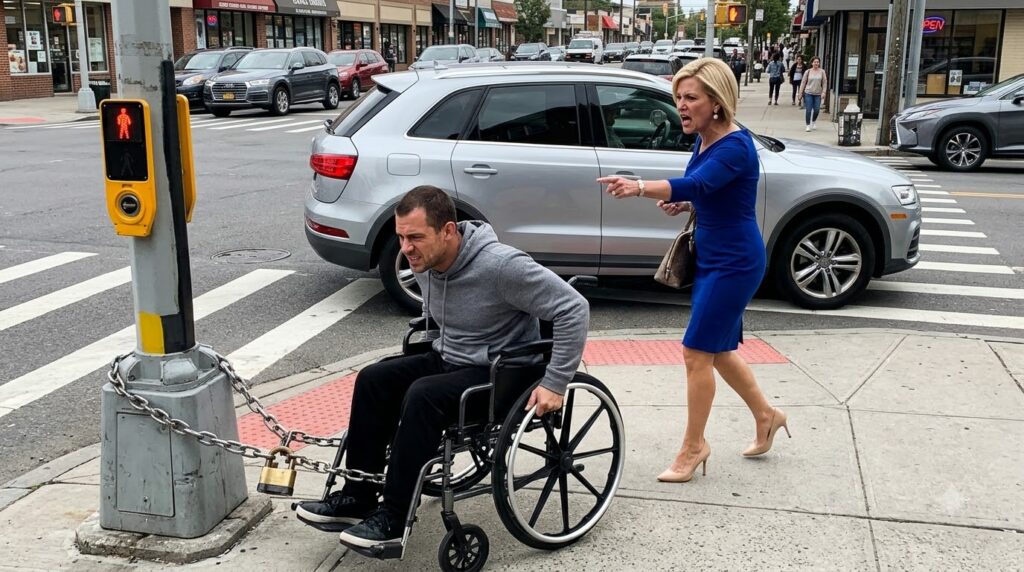
Daniel remembered the intersection.
He remembered the curb ramp blocked by Patricia’s SUV.
And he remembered something else.
The sidewalk surface had been uneven.
A small section of concrete near the crossing was broken.
He had noticed it while approaching the intersection but had been too focused on the parked vehicle to examine it.
Reed watched him.
“That intersection has generated complaints for years.”
Daniel frowned.
“Does the HOA own the sidewalk?”
“Not necessarily. That’s one of the questions. The city maintains some sections, while the association has obligations involving certain private approaches and common areas.”
Reed tapped the folder.
“The important point is that the association reported paying for accessibility-related work. We need to determine exactly what was done, where, and by whom.”
Daniel understood the distinction.
An accusation wasn’t proof.
But records could be checked.
Payments could be traced.
Work could be inspected.
He asked Reed what he needed.
“Your statement. The video. Your medical records, if you choose to provide them. And patience.”
Daniel gave a tired smile.
“That last one might be difficult.”
Reed smiled back.
Before Daniel left, the attorney showed him a letter from a former HOA board member.
Her name was Margaret Ellis.
She was seventy-four and had served as association secretary for nine years.
According to Reed, Margaret had attempted to challenge several expenditures.
She had eventually resigned after Patricia accused her of spreading false information.
The letter contained one sentence that caught Daniel’s attention.
The problem isn’t that Patricia ignores the rules. The problem is that she decides which rules exist for everyone else.
Daniel read it twice.
Then he asked for Margaret’s telephone number.
Reed hesitated.
“She’s been reluctant to get involved again.”
“Why?”
“She believes Patricia has enough influence to make life miserable for anyone who opposes her.”
Daniel looked down at the fading marks on his wrists.
He knew something about that.
Before leaving, he asked Reed a final question.
“If the records show wrongdoing, can the residents remove her?”
“Possibly. But they would need to follow the association’s governing documents, gather support, and hold a valid election or removal vote.”
Daniel nodded.
For the first time since the incident, he felt that something constructive might come from it.
Not just punishment for one woman.
A chance to change a system that had allowed her to behave that way.
That afternoon, Daniel called Margaret Ellis.
She answered after several rings.
When he introduced himself, there was a long silence.
Then she spoke.
“I saw what she did to you.”
Daniel waited.
Margaret’s voice trembled.
“I have something you need to see.”