Chapter 5: The Threat That Changed Everything
Daniel did not sleep well that night.
Every sound outside the house seemed louder than usual.
A car door closing.
A dog barking.
A vehicle slowing near the driveway.
He knew fear could distort ordinary things, but the message on his phone had crossed a line.
It had mentioned his daughter.
Sophie was sixteen.
She attended Brookhaven High School, played on the school chess team, and volunteered twice a month at the public library.
She was independent, bright, and sometimes stubborn.
Daniel recognized that last quality because she had inherited it from him.
He had raised her largely on his own after his wife, Laura, died from cancer five years earlier.
Laura had been the steady center of their family.
When Daniel lost the use of his legs, she helped him through the months when ordinary tasks seemed impossible.
When she became ill, he returned that care.
After her death, Daniel promised himself that Sophie would grow up in a home defined by love and stability rather than loss.
The anonymous message threatened that peace.
The next morning, he called Officer Collins.
She advised him to preserve the message and make a formal report.
Daniel complied.
He also informed Reed.
The attorney told him not to respond to the sender.
“Let the evidence speak,” Reed said.
Daniel agreed.
But he refused to hide.
That Saturday, Brookhaven residents held an informal gathering at the public library.
It wasn’t an official HOA meeting.
It was a chance for neighbors to discuss the video and share concerns.
Daniel attended reluctantly.
He didn’t want to become a public symbol.
He was a father and an accountant who worked from home.
Before his injury, he had spent years supervising construction projects.
He liked solving practical problems.
He disliked attention.
But when he entered the library meeting room, more than sixty people were waiting.
Some stood to greet him.
Others simply nodded.
Margaret sat near the front.
Walter Benson was there, too, holding a folder filled with handwritten notes.
Emily Carter had brought copies of the police incident information available to her.
Daniel was surprised to see several younger families alongside retirees who had lived in Brookhaven for decades.
The concerns varied.
One family had been fined for installing a temporary accessibility ramp.
A widowed homeowner described repeated notices about her porch decorations.
A veteran said he had been denied permission to widen his driveway to accommodate a mobility van.
Another resident complained about rising maintenance assessments without clear explanations.
Some attendees defended the HOA’s basic purpose.
They valued neighborhood standards and wanted common areas maintained.
Their frustration was not with having rules.
It was with inconsistent enforcement and the lack of transparency.
Daniel understood.
He wasn’t opposed to community associations.
He was opposed to people using authority without accountability.
When asked to speak, he moved to the front.
He hadn’t prepared a speech.
He looked at the room and thought of Sophie.
Then he spoke simply.
“I don’t want special treatment. I want the same right everyone here has—to use the sidewalk, get home safely, and live without being threatened.”
The room grew quiet.
He continued.
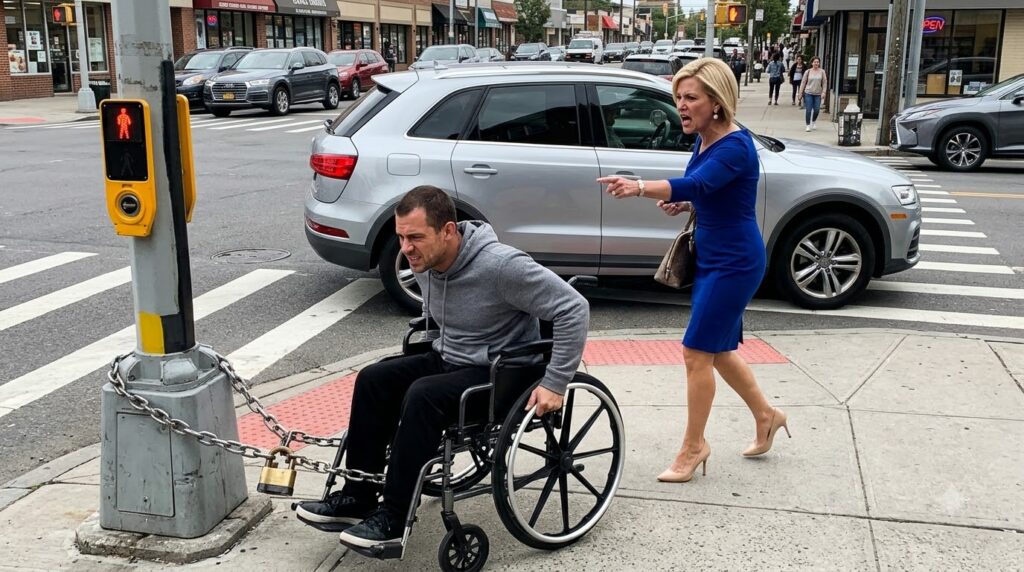
“What happened at that intersection wasn’t about a parking space. It was about someone deciding she could control another person’s freedom.”
Several people nodded.
Daniel looked toward Margaret.
“If we want things to change, we need facts. We need records. And we need to follow the rules ourselves.”
There was no dramatic applause.
Instead, something more useful happened.
People began volunteering.
A retired bookkeeper offered to review financial statements.
A former city engineer agreed to help identify which sidewalk projects belonged to the municipality and which were association responsibilities.
A younger homeowner offered to organize lawful requests for records.
Margaret agreed to contact Robert Hale.
Walter volunteered to help elderly residents understand the voting procedures.
By the end of the meeting, the group had formed a small committee.
They called it the Brookhaven Accountability Committee.
Daniel disliked the grand name, but he appreciated the purpose.
For the first time, residents who had felt isolated were working together.
That evening, Sophie asked how the meeting went.
Daniel told her.
She listened carefully.
Then she asked whether he was still afraid.
He considered lying.
Instead, he answered truthfully.
“A little.”
Sophie sat beside him.
“Me too.”
He put his arm around her shoulders.
“Being afraid doesn’t mean we have to let someone decide how we live.”
She rested her head against him.
For a while, neither spoke.
The next morning, Reed called with news.
Robert Hale had agreed to meet.
The former treasurer claimed he still possessed copies of invoices and bank records from his final year on the board.
More importantly, he remembered a particular payment that had troubled him.
It involved the same accessibility improvement project Margaret had described.
And according to Hale, the contractor listed on one invoice had never performed the work.